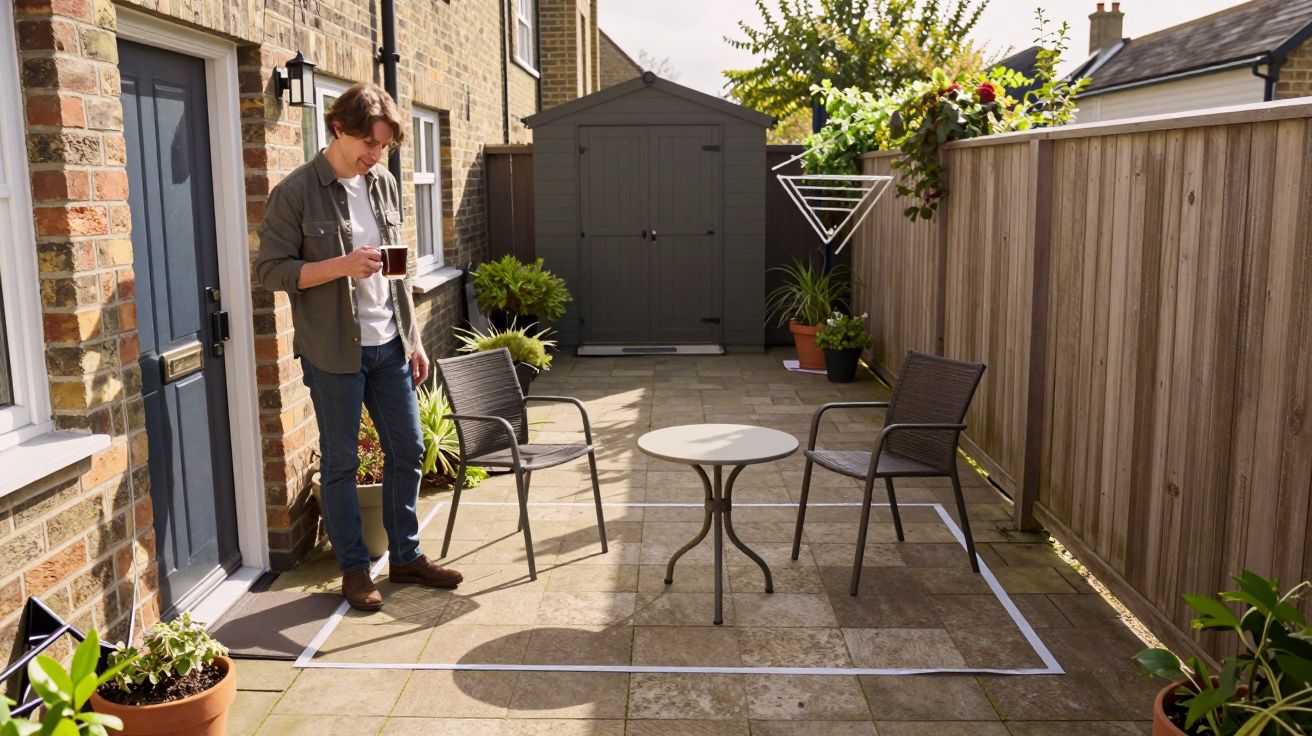
The first time you notice it is usually on a bright Saturday, when you step outside with a mug of tea and realise the whole plot feels… off. Terraced house gardens sit right in the middle of everyday life, and among all the types of urban spaces they’re the least forgiving: narrow, overlooked, often shaded, and always bordered by hard lines. They matter because they don’t let a bad layout hide behind distance, sweeping lawns, or “we’ll sort it later”.
You drag a chair out and it catches on a step that never needed to be there. The washing line cuts across the only path to the shed, so you duck like you’re in a game show. The patio looks generous in the brochure sense, but in real use it’s either too tight for four people or so big it eats the only bit of green you wanted.
Nothing is technically “wrong”. It just doesn’t work. And in a terrace, you feel it immediately.
Why terraced gardens act like layout lie detectors
Wide gardens can absorb mistakes. You can put the seating in the wrong place and still find another corner that’s nicer. You can build a path that meanders without purpose and it still feels “garden-y” because you have room to wander.
Terraced gardens don’t have that slack. When the plot is five or six metres wide, every decision becomes a collision: door swing versus table edge, bin route versus borders, shade line versus lawn. You’re not designing a landscape; you’re designing choreography.
The brutal part is that the constraints are consistent. Neighbouring windows look down the same angles. Party walls run in the same place. The sun tracks across the same strip, and if your house faces north-ish, you may only get a brief bright patch that moves like a spotlight. A layout that ignores those facts doesn’t merely look odd-it makes daily routines annoying.
The classic mistakes you only notice once you try to live in it
Most terraced gardens fail in the same few ways, because most of us plan them with our eyes rather than our feet. We picture a “patio area”, a “lawn area”, maybe a “deck area”, and then we squeeze them in like furniture on a floorplan without checking how we’ll move.
Here are the errors that tend to show themselves within a week:
- A single, oversized patio that dominates the plot, leaving a thin lawn strip that never feels usable.
- No clear route to the end (shed, bike storage, compost), so you constantly cut across planting or step over furniture.
- The best seat placed in the worst microclimate: either full shade and damp, or full sun with no shelter and nowhere to put a drink.
- A central path that steals width from both sides, turning borders into skinny afterthoughts.
- Storage that’s “somewhere later”, which becomes storage everywhere: bins by the back door, tools behind the chair, kids’ stuff in the only dry corner.
In a bigger garden, those are annoyances. In a terraced one, they become the whole experience.
The “middle shelf” principle: one calm centre beats lots of features
There’s a quiet fix that works more often than people expect: stop trying to include everything, and protect one good, comfortable zone as your default. In practice, that usually means a single primary seating space with decent light, decent privacy, and a direct, unobstructed route from the back door.
Think of it as the garden’s “middle shelf”. Not literally central, but the most balanced position in the space-where sun, wind, and access are least extreme. Once you have that, everything else can be smaller and more purposeful.
A useful rule of thumb is to decide what the garden is for on an ordinary weekday, not a fantasy weekend. If you mainly need somewhere to sit for 20 minutes, somewhere to dry washing, and somewhere to store a bike, your layout should make those three things frictionless. Fire pits, outdoor kitchens, pergolas: lovely, but only if the basics still flow.
How the boundary walls quietly boss you around
Terraced gardens feel like rooms because, effectively, they are. The party walls and fences behave like the oven walls in a cramped cavity: they shape the climate and they shape your options, whether you acknowledge them or not.
A few boundary realities drive most layout failures:
- Shade stacks up along walls, especially on the side that gets less sun. If you put your only sitting spot there, it will feel cold even in summer.
- Wind tunnels love straight runs. A clear line from back door to end fence can turn breezy days into constant discomfort unless you break it with planting or a screen.
- Overlooking isn’t symmetric. The neighbour’s first-floor window might have a perfect view of your “dining terrace” but not of a corner tucked behind a trellis.
Instead of fighting those facts with expensive structures, start by placing your key uses where the space already helps you. Seat where light lasts longest. Store things where the route is naturally direct. Put plants where they’ll actually grow, not where they look nice on a sketch.
A quick test that catches mistakes before you spend money
If you’re unsure, do a cheap, physical mock-up. It feels slightly silly and then instantly clarifying.
- Mark out your proposed patio and path with string or masking tape.
- Place real objects: a table, two chairs, a clothes airer, a bin.
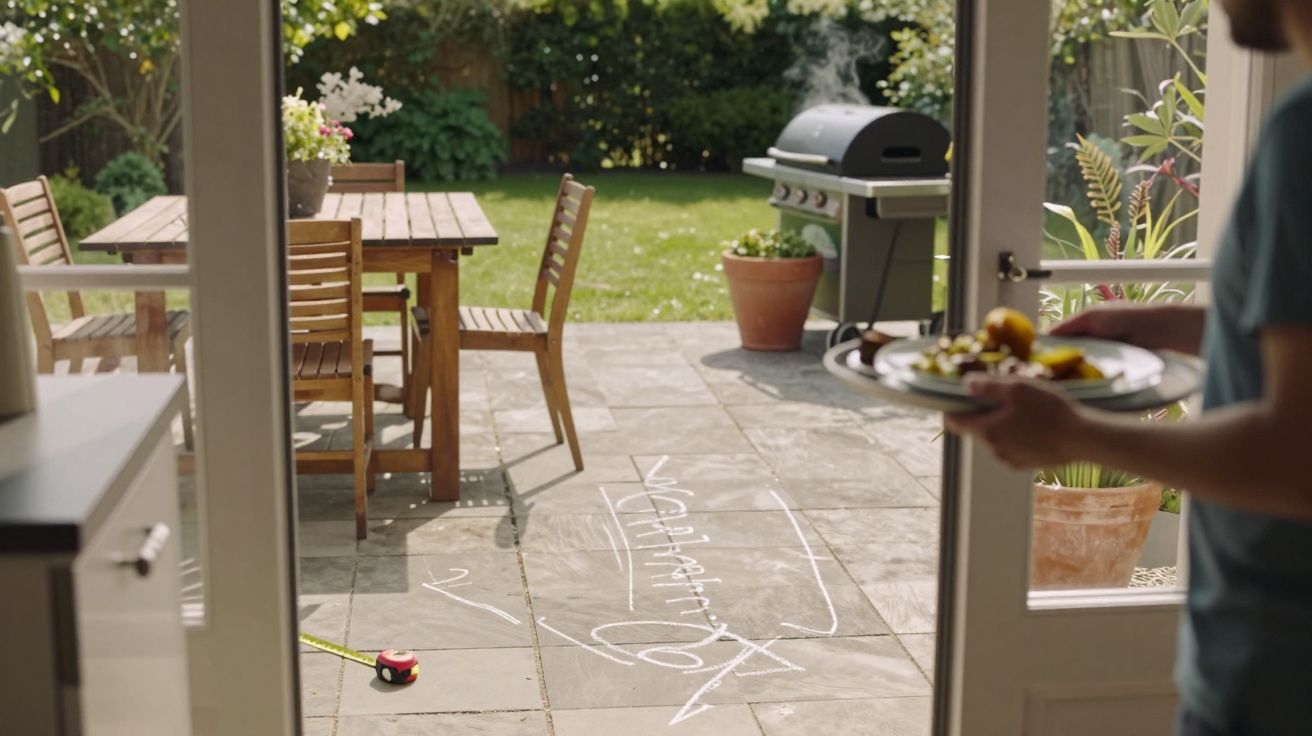
- Walk the routes you actually do: to the shed, to the washing line, back inside with a plate.
- Sit down at the time you’d use the space most (evening light is the big reveal in many terraces).
You’ll spot the problems fast: the chair leg that blocks the door, the pinch point by the steps, the “privacy screen” that only hides you when you’re standing, not sitting. Terraced gardens don’t require perfection; they require honesty.
Rethinking terraced gardens as working spaces, not mini-parks
A lot of the disappointment comes from trying to make a terrace behave like a detached-house garden. But terraced house gardens are closer to courtyards and balconies in how they perform: compact, intensely used, and sensitive to microclimate. That’s not a downgrade-it’s just a different type of urban space with different rules.
When you accept that, the design becomes simpler. You stop spreading functions thinly across the whole plot and start zoning them tightly, so each part does its job without sabotaging the rest. You prioritise a clear run, one genuinely comfortable seat, and planting that earns its keep-screening, softening, cooling, or giving you something to look at that isn’t a fence.
And once it works on a wet Tuesday as well as a sunny Sunday, it stops feeling like a tricky rectangle you need to “fix” and starts feeling like an extra room you actually use.
| Point clé | Détail | Intérêt pour le lecteur |
|---|---|---|
| Pas de “marge” | Plot étroit, lumière et circulation contraintes | Les erreurs se ressentent tout de suite |
| Une zone principale | Un seul endroit vraiment confortable avant d’ajouter des extras | Un jardin plus simple, plus utilisé |
| Tester à l’échelle 1:1 | Ficelle, meubles, parcours réels | Évite des travaux coûteux et décevants |
FAQ:
- Why do terraced gardens feel smaller than they measure? Long, narrow proportions exaggerate pinch points, and boundaries create a “corridor” effect. A single clear route plus one main seating zone usually restores the sense of space.
- Should the patio always be right outside the back door? Not always. If that spot is cold, dark, or heavily overlooked, a small threshold area plus a better-positioned seating zone a few metres down can work better.
- What’s the most common layout mistake? Oversizing hard landscaping. In a terrace, a too-large patio can remove the only softening greenery and make the whole garden feel like a yard.
- How do I improve privacy without losing light? Use layered screening (slatted panels, trellis with climbers, tall but airy planting) rather than solid fencing everywhere, and prioritise privacy at seated eye level.


Comments (0)
No comments yet. Be the first to comment!
Leave a Comment