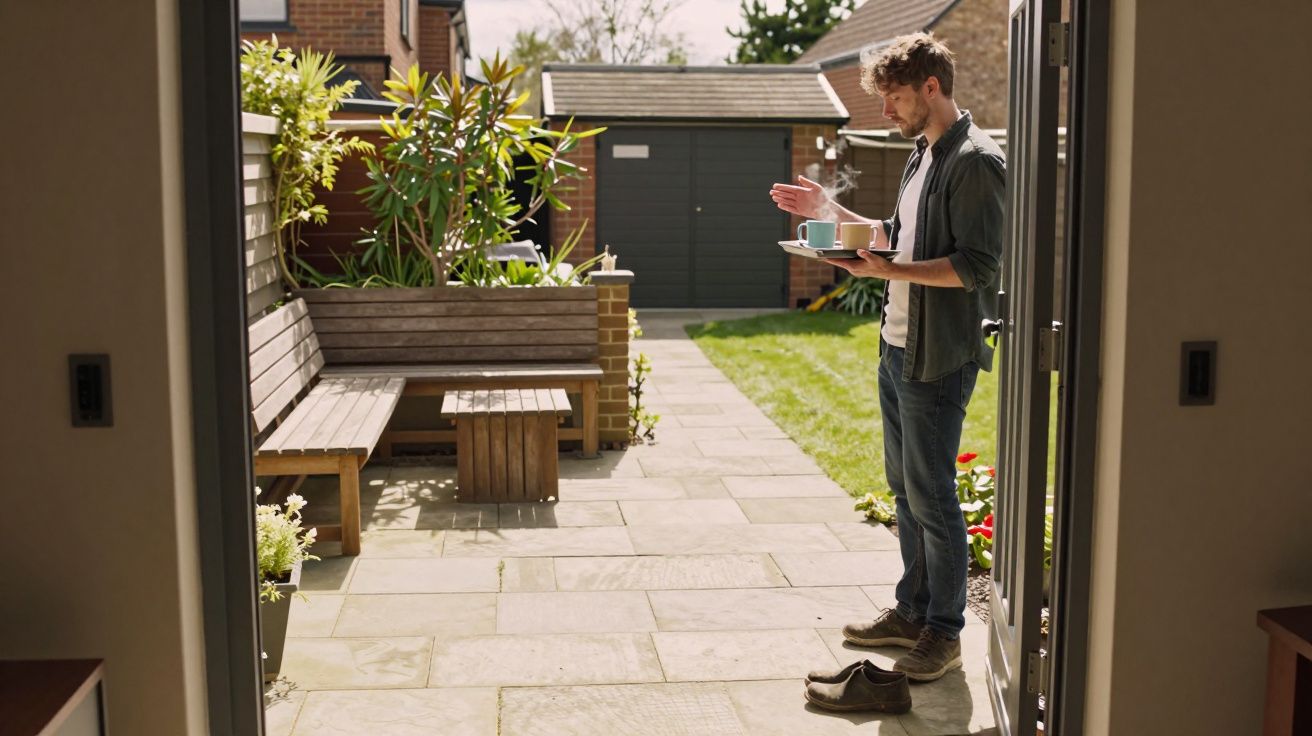
The best patios don’t start life as a “look”. They start with what you actually do outside-where you sit with coffee, where you kick off muddy shoes, how you move between the house and functional garden zones without thinking. Get that wrong and even the prettiest paving becomes a space you keep “meaning to use”.
I learned this the hard way watching a friend host a birthday in a garden that photographed beautifully, but behaved badly. Everyone clustered in a strip by the back door because the “main” patio was too far from the kitchen, too windy, and had nowhere obvious to put a drink. The style was right. The human was wrong.
The mistake we keep making: designing for the picture, not the pattern
Most patio decisions are made like a moodboard: sandstone or porcelain, grey or buff, herringbone or straight lay. That’s not the useless part. The useless part is doing it before you’ve watched the daily loops your household repeats.
Behaviour is surprisingly consistent. People take the same line to the bin every night. They sit in the first bit of sun they can find. They hover near the door when the kids are in and out. If your patio fights those patterns, the garden never feels “finished”, no matter how expensive the slabs are.
A simple test: if you removed the furniture, could you still tell what the space is for? If the answer is no, you’ve designed a surface, not a place.
The rule that changes everything
Design your patio around three behaviours: arrive, linger, and move.
Arrive is the transition point: back door, steps, threshold, the spot where you pause. Linger is where bodies settle: chairs, a bench, a dining table, somewhere to lean with a mug. Move is the circulation: routes to the lawn, the shed, the barbecue, the washing line, the side gate.
When you give each behaviour a clear home, the style choices suddenly get easier. You’re no longer picking “a pretty tile”. You’re choosing what supports the way you live.
Map the garden like you map a kitchen
Before you buy anything, stand inside and watch how you already behave. Then walk outside and mark it.
- The doorway cluster: where do people naturally stop? (This needs space, not decoration.)
- The sunny perch: where does the first usable sun hit? (That’s often your real sitting area.)
- The service run: how many steps to the bin, compost, shed, hose, barbecue? (This wants a firm, straight-ish route.)
- The messy edge: where do wet coats, dog towels, and plant pots end up? (Give it a zone before it becomes a pile.)
This is where functional garden zones stop sounding like a designer phrase and start being a relief. You’re not “adding features”. You’re giving the inevitable activities somewhere to go.
What “functional” looks like in real patio choices
1) The arrival zone: protect the threshold
This area is not the patio’s “wow” moment. It’s the bit that stops you swearing in winter.
Give yourself a generous landing outside the door, and make it forgiving: a surface that’s grippy, easy to sweep, and wide enough for two people to pass without doing that awkward sideways shuffle. If you have steps, make them comfortable, not steep and narrow, because you’ll use them one-handed with a tray.
What helps more than people expect:
- A covered edge (even a small canopy) so the door area stays usable in drizzle.
- A place to put things down-a ledge, a low table, a built-in bench end.
- Lighting that’s aimed at feet and locks, not just “ambience”.
2) The lingering zone: design for elbows, not furniture catalogues
People don’t sit where you tell them to sit. They sit where it feels sheltered, warm enough, and socially easy.
Start by choosing the behaviour: do you actually eat outside on weekdays, or is this a weekend thing? Do you want face-to-face conversation, or a sofa-style sprawl? Then give the zone the right proportions. A dining set needs clearance to pull chairs out; a lounging set needs side tables so drinks aren’t balancing on knees.
A small but powerful move is to build in a “default” seat: a bench along a wall or planter edge. It makes the space feel occupied even when nothing’s out, and it’s where people end up during parties because it’s obvious.
3) The moving zone: stop walking through your seating
If the route to the lawn cuts across the middle of your dining table, your patio will always feel busy and slightly stressful. Movement should skim the edge of lingering spaces, not slice through them.
Think of it like a polite room: you want a clear path that doesn’t force people to interrupt conversations just to get to the herb pots. Often that means a patio shape that isn’t a perfect rectangle. It means a “shoulder” for walking and a “pocket” for sitting.
A quick layout that works for most UK gardens
If you want a reliable starting point, use this three-part arrangement:
- A hard-standing apron right outside the back door (arrival).
- A main seating pad offset to the sunniest, least windy corner you can create (linger).
- A firm path line that runs from door to lawn/shed/gate without crossing the seating pad (move).
It can be one continuous surface with subtle changes, or distinct patches. The point is that the roles are clear, even if the materials match.
Style still matters-just later
Once behaviour is handled, style stops being a gamble and becomes a finishing layer.
You can choose paving that supports what the zone needs: - In the arrival and moving areas: more grip, more forgiveness, less showing every mark. - In lingering areas: warmer underfoot, nicer texture, maybe a detail edge that makes it feel like a “room”.
And if you’re torn between two looks, let maintenance be the tie-breaker. A patio you enjoy is one you don’t resent cleaning.
The small details that make a patio feel “used” (in a good way)
This is the unglamorous bit that makes the glamorous bit work.
- Shade and shelter: a pergola, sail, or planting that breaks wind. Exposure kills linger time.
- Power and water: an outdoor socket where you’ll actually plug things in; a tap that doesn’t require dragging a hose through the house.
- Storage nearby: somewhere for cushions, candles, kids’ bits. If it’s inconvenient, it won’t happen.
- Edges with purpose: raised planters as wind buffers, low walls as extra seating, steps that double as perches.
A patio doesn’t become inviting because it’s “styled”. It becomes inviting because it removes friction.
A gentle diagnostic: if you’re not using it, what’s the reason?
If your patio sits empty, it’s rarely because you chose the wrong colour slab. It’s usually one of these:
- It’s too far from the kitchen to feel effortless.
- It’s a wind tunnel, so you never quite relax.
- There’s nowhere to put a drink, a plate, a bag, a phone.
- The route to everywhere else cuts right through it.
- The chairs are technically fine, but the spot is emotionally exposed.
Fix the behaviour problem, and the style you already like will suddenly feel “right”.
FAQ:
- Do I need separate functional garden zones in a small garden? Yes, but they can overlap. In a compact space, zones are often defined by position and purpose (door apron, seating pocket, path line) rather than different materials.
- Should the patio be bigger or smaller than I think? Usually bigger at the back door and more modest at the “main” seating area. The door zone needs circulation space; the seating zone needs comfort, not acres of paving.
- Is it ever OK to put the main patio at the bottom of the garden? It can work if your behaviour supports it (you’ll actually carry food and drinks down there) and if there’s a secondary, practical hard-standing by the door. One “destination” patio rarely replaces the everyday one.
- What’s the quickest way to improve an existing patio without relaying it? Treat it like a behaviour problem: add a wind break (plants/screens), create a clear walking route (planters or furniture placement), and add surfaces to put things down (side tables, a bench, a low wall).




Comments (0)
No comments yet. Be the first to comment!
Leave a Comment