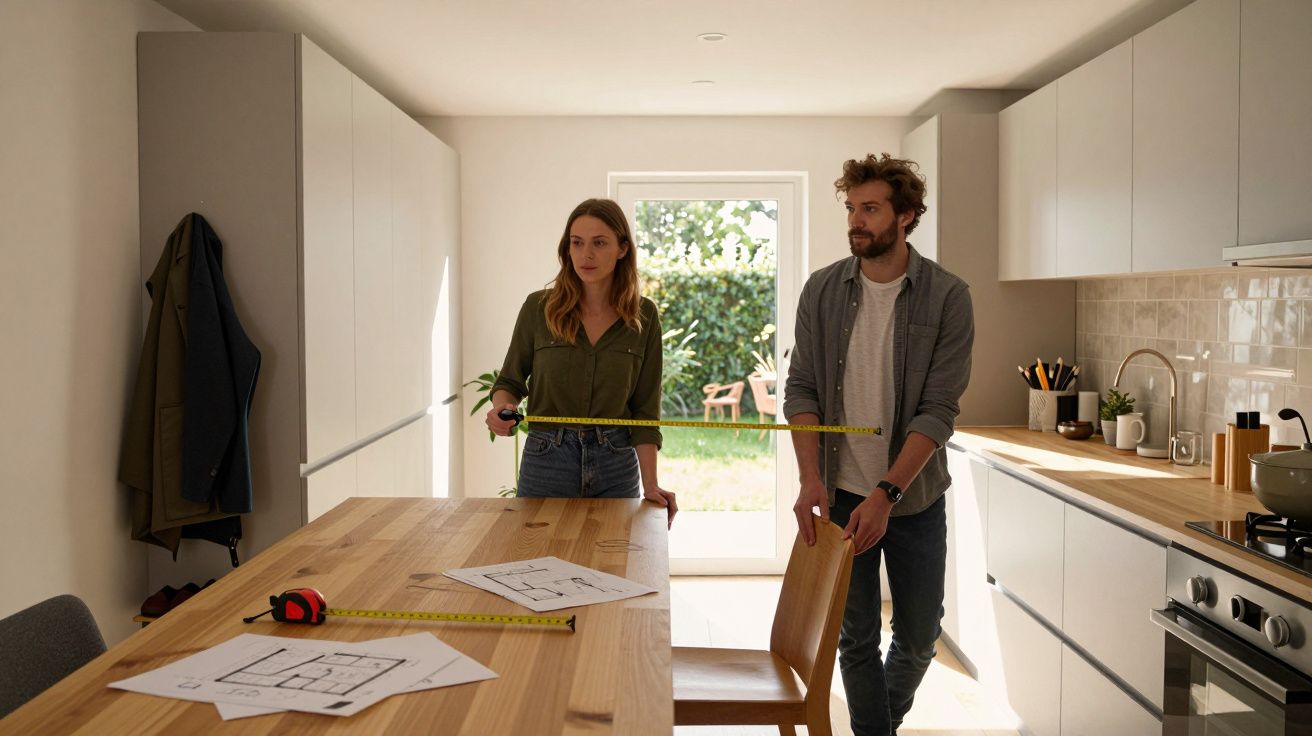
We’ve all saved a “Pinterest-perfect” floor plan and thought, that’ll work in ours. Then the first measurements land, and the dream collapses into a hallway that eats the living room. Narrow plots make space zoning non-negotiable, because a single misplaced wall can turn a home from calm to cramped faster than any colour palette ever could.
What looks generous on a mood board is often just generous in width. On a tight site, circulation, storage and daylight aren’t background details; they are the whole game.
Why narrow plots expose weak layouts
A wide room forgives bad planning. You can add a console behind the sofa, widen a passage “later”, or hide awkward joins with furniture. In narrow plots, every decision stacks, and the penalty is immediate: doors clash, sightlines shorten, and you start living in corridors.
The common trap is designing by object. A dining table here, an island there, a reading chair in the bay-each one sensible in isolation. Put them into a slender footprint and you discover you’ve designed a catalogue spread, not a working day.
If your plan relies on “it’ll feel fine”, a narrow plot will prove you wrong within a week.
The “Pinterest design” moves that fail first
These aren’t bad ideas. They’re just ideas that assume spare width, spare walls, and spare tolerance for dead space.
- The oversized island-as-centrepiece. It looks sociable, but it steals the passing space you need to move through the kitchen without shuffling sideways.
- The floating sofa with a walkway behind it. In a narrow living zone, that walkway becomes the room and the seating becomes an afterthought.
- Open shelving everywhere. It’s airy in photos; in real life it removes the closed storage that stops a slim home from feeling permanently in motion.
- Crittall-style partitions. They promise “zones without blocking light”, yet their frames and door swings still consume precious clearance.
- Feature staircases. A sculptural stair reads luxe online; on a tight plot it often forces the whole ground floor into a single-file route.
The pattern is simple: these choices prioritise the camera angle over the route your body takes fifty times a day.
Space zoning: the fix that feels boring (and works)
Good space zoning in narrow plots is less about making rooms, more about making sequences. You’re choreographing how people enter, drop bags, cook, sit, work, and head upstairs-without tripping over one another or broadcasting mess to the front door.
Start by zoning with three questions:
- What must be near the entrance? Coats, shoes, a place to put keys, somewhere to sit for laces.
- What needs daylight most? Usually living and dining; sometimes a desk if you WFH.
- What can live deeper in the plan? Utility, WC, storage, sometimes kitchen-if you can borrow light.
When those priorities are clear, aesthetics get easier. Without them, you end up decorating problems.
A narrow-plot zoning pattern that keeps showing up
One reliable approach is a “front-to-back gradient”:
- Front: quieter use (snug, study, or dining) where you can tolerate a slightly tighter feel.
- Middle: service spine (stairs, WC, storage, utility) acting as the organiser.
- Back: the most-used, most-daylit space (kitchen-living) opening to the garden.
It’s not the only answer, but it respects the physics of slim footprints: put the clutter and complexity in the middle, and let the ends breathe.
Clearances: the unglamorous numbers that decide comfort
Pinterest rarely shows the bit behind the chair. Narrow plots force you to design that bit first.
Here’s a practical pocket guide for common pinch points:
| Element | Aim for | Why it matters |
|---|---|---|
| Main walkway | ~900mm (minimum) | Two people can pass without turning sideways |
| Around dining table | 800–1000mm | Chairs pull out without blocking circulation |
| Kitchen working aisle | 1000–1200mm | Doors open, two cooks can move safely |
These aren’t laws, and older homes bend them. But if you ignore them, you don’t get “cosy”. You get constant negotiation: who moves, who waits, who carries the hot pan through a bottleneck.
Light and sightlines beat square metres
In narrow homes, you often can’t add width, so you borrow ease in other ways. The best layouts protect a long sightline and make daylight travel.
A few moves that usually outperform “statement features”:
- Keep doorways aligned where you can. A clean line of view makes the plan feel longer and calmer.
- Use glazed doors strategically. They pull light through without turning every wall into glass.
- Choose fewer, taller storage runs. Floor-to-ceiling cupboards on one side can feel lighter than lots of small bits scattered everywhere.
- Hide the messy zone. A slim utility cupboard, a tall pantry, or a pocket door can stop the whole ground floor reading as “kitchen”.
The emotional win is real: you stop feeling observed by your own stuff.
A quick self-check before you copy a layout
If you’re tempted to replicate a saved design, do this before you fall in love with the finishes. Sketch it to scale and test the daily choreography.
- Draw the walls and windows.
- Place the big pieces (sofa, table, island) to scale.
- Add door swings and chair pull-outs.
- Trace the routes: front door to kitchen, kitchen to bins, sofa to stairs, dining to garden.
If the route snakes, squeezes, or crosses itself repeatedly, the style isn’t the issue. The zoning is.
Narrow plots don’t punish taste; they punish wasted movement.
What “good” looks like in a narrow home
A good narrow-plot design feels almost invisible. You can enter and put things down without performing a dance. You can cook while someone passes behind you. You can sit without staring at a pile of coats, and you can host without blocking the only path to the garden.
That’s why Pinterest-first schemes crack so quickly: they sell a moment. Narrow plots demand a system.



Comments (0)
No comments yet. Be the first to comment!
Leave a Comment