
Narrow plots force your hand in a way wider gardens never do. When you’re trying to carve functional garden areas into a thin strip beside a terrace, down the side of a new-build, or behind a Victorian extension, every decision has a knock-on effect. Get the priorities wrong and the garden won’t just look cramped - it will feel unusable, no matter how expensive the paving is.
The trap is treating a narrow space like a normal one, just scaled down. In reality, it behaves differently: views are longer, bottlenecks are easier to create, and “one more thing” can collapse circulation completely.
The hidden physics of a thin garden
In a narrow layout, your eye reads length first and width second. That sounds helpful until you realise it magnifies clutter: anything that interrupts the line (a bin store, a bulky planter, a random curve) becomes a headline feature.
Movement has similar rules. If two people can’t pass comfortably, it doesn’t matter that you technically “fit” a dining set. You’ve built a garden that only works when nobody else is in it, which is not the point of a garden.
A simple test is to walk the route you’ll take most often - back door to seating, seating to shed, shed to side gate - and picture it when someone’s holding a tray, or a child is on a scooter. Narrow plots punish optimistic assumptions.
Ruthless prioritisation: what you’re really deciding
Prioritisation isn’t about being minimal for the sake of style. It’s choosing what the garden is for, then protecting that purpose from everything that wants to creep in.
Most narrow gardens can do two big jobs well. They struggle to do four.
Decide your top two, early:
- Eating outside (proper table, not a token bistro set)
- Lounging (comfortable seating, side tables, sun/shade)
- Play (clear run, forgiving surfaces, sightlines)
- Growing (veg beds, greenhouse, potting space, compost)
- Storage and utility (bins, bikes, logs, washing line)
- A calming view (planting, water, lighting, privacy)
When people say “I want it all”, what they often mean is “I don’t want to regret the trade-offs”. The way out is to make the trade-offs deliberate.
Build from circulation, not features
The easiest way to waste a narrow garden is to start with objects: pergola, raised beds, fire pit, built-in seating. Features are hungry; they demand clearance around them, and that clearance is the real footprint.
Start instead with the path of movement and the places you stop. If the route is awkward, you won’t use the far end. If the stopping points are compromised, you’ll sit inside and look at the garden you paid for.
A practical sequence that keeps you honest:
- Fix the primary route (usually door to main seating, plus access to storage).
- Place the main “pause” zone (where people actually sit most often).
- Allocate one secondary zone (growing, play, or utility - pick one).
- Only then add vertical structure (screens, trellis, small tree canopy).
That order feels boring, but it prevents the classic narrow-plot failure: a string of “nice ideas” with nowhere to walk.
Treat functional areas like zones, not islands
Functional garden areas work best when they share edges. In a narrow space, every dedicated buffer (a strip of gravel “just because”, a redundant border on both sides, a gap behind a bench) is width you’ll miss every day.
Instead, look for overlaps:
- A bench can be the retaining edge of a raised planter.
- A dining area can be the turning circle for moving to the shed.
- A storage wall can double as a climbing-plant backdrop.
- A single continuous surface (porcelain, brick, timber) can unify zones so the garden reads calmer and wider.
The aim is not to blur everything into one long corridor. It’s to stop the garden fragmenting into tiny pockets that feel like leftovers.
The “one hero” rule: pick where you’ll spend the width
Narrow plots can carry one generous element. Two is usually where it starts to feel tight, and three is where it becomes fussy.
Choose your hero:
- A genuinely comfortable seating setup
- A decent dining table with clearance
- A lush planted edge with depth
- A small tree with underplanting
- A striking screen or pergola that frames the view
Then protect it by simplifying what surrounds it. You can still have variety, but it must be controlled variety - repeated materials, consistent edging, and planting that doesn’t bulge into the walkway.
Common priorities that quietly break narrow gardens
Some choices look sensible on paper but steal more space than they admit.
- Raised beds on both sides: great for symmetry, terrible for usable width unless the plot is unusually wide.
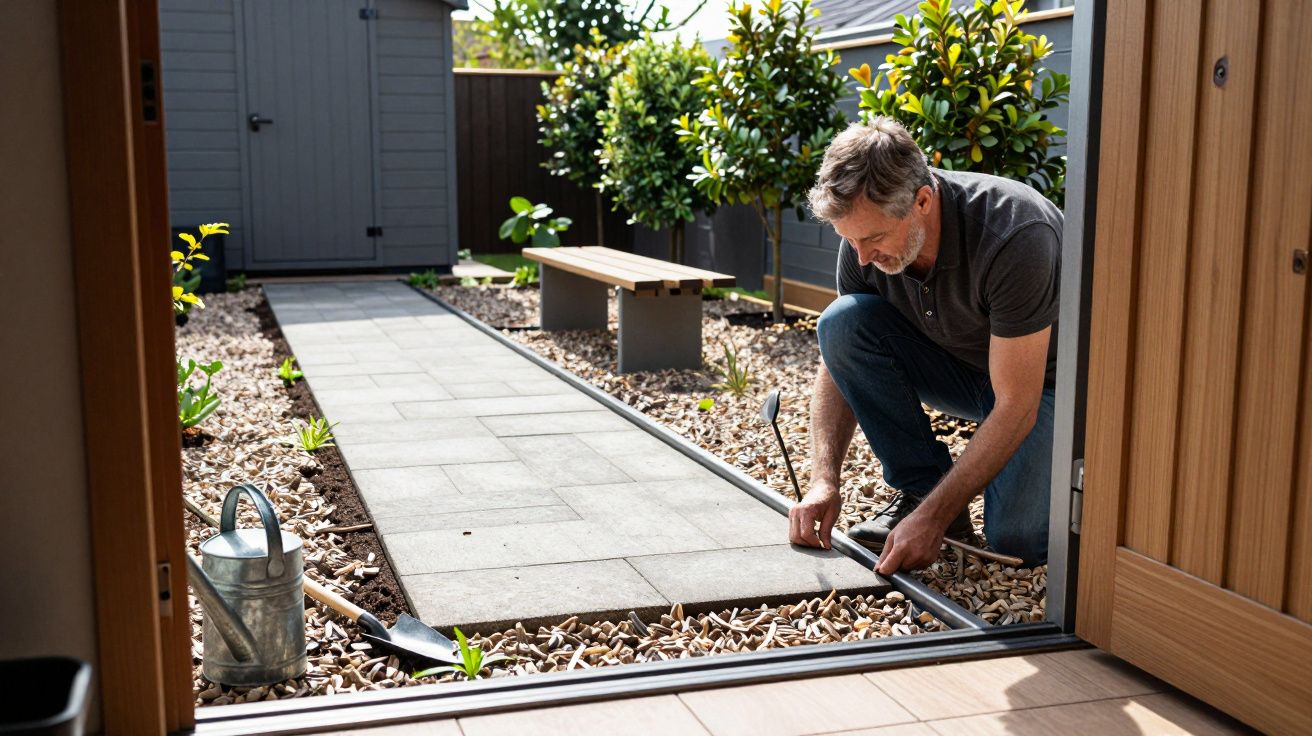
- Curvy paths: they consume width at the pinch points and exaggerate awkward angles.
- Too many “destination” spots: a coffee chair at the back sounds lovely until it means the main seating is smaller and the path narrows.
- Bulky standalone planters: they interrupt the long sightline and become obstacles instead of greenery.
A narrow garden is one of the few places where less really can be more - because “less” often means “room to move”.
A simple decision matrix (when you’re stuck)
If you’re paralysed by options, score each idea against the same three questions: does it improve daily use, does it simplify movement, and does it earn its footprint?
| Idea | Daily use | Space cost |
|---|---|---|
| Bigger main seating | High | Medium |
| Second seating spot | Low–medium | Medium |
| Deep planted border | Medium–high | Medium–high |
| Outdoor kitchen run | Medium (for keen cooks) | High |
If an element scores low on daily use and high on space cost, it’s not “nice to have”. It’s a problem you’re choosing.
The narrow-plot mindset that pays off
Think like a ship designer, not a collector. Every component should justify itself, ideally doing more than one job, and never blocking the route that makes the whole thing usable.
When you prioritise ruthlessly, a narrow garden stops trying to imitate a wide one. It becomes something better: a clear sequence of spaces that feel intentional, comfortable, and surprisingly calm for the footprint.
FAQ:
- How many functional garden areas can a narrow plot handle? Usually two main zones (for example, seating plus growing or seating plus utility) and one small supporting function. More than that tends to create pinch points.
- Should I run planting down both sides to make it feel wider? Not by default. One deeper planted side often works better than two thin strips, because it keeps a cleaner walkway and creates a stronger, calmer view.
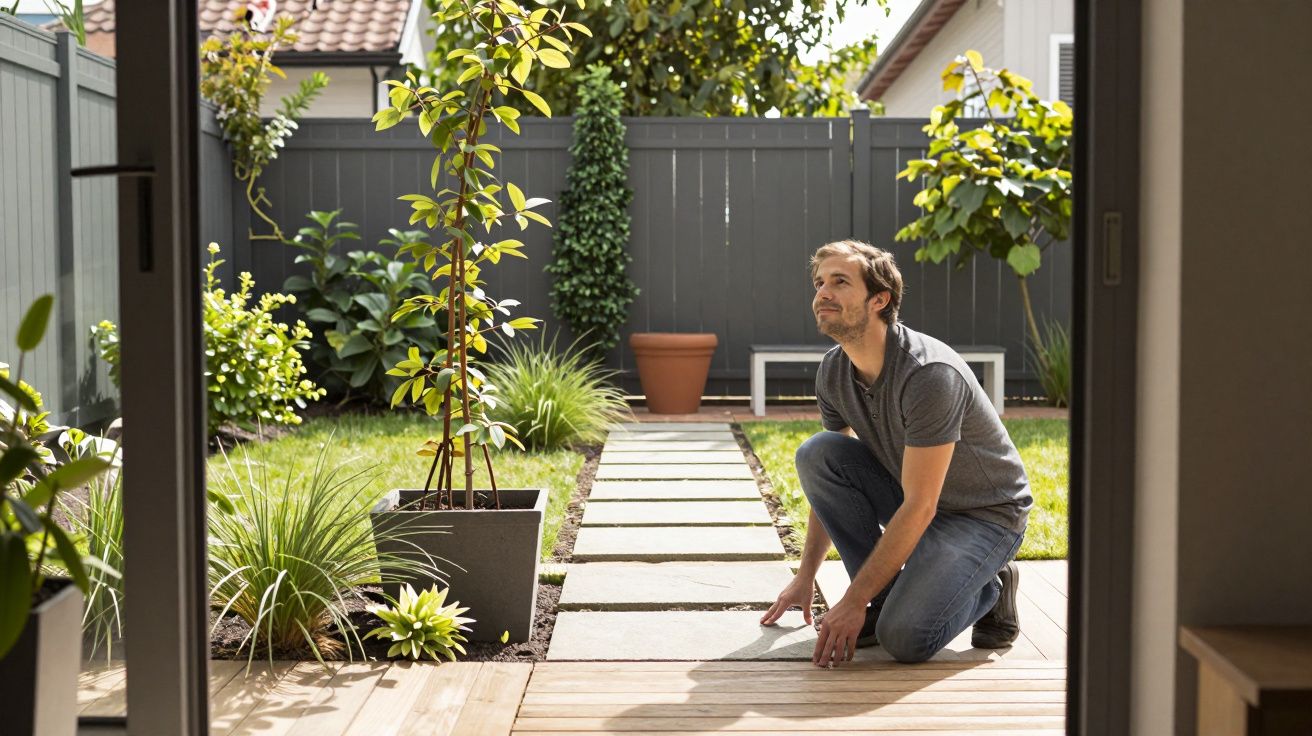
- Is a straight path always best? Often, yes. Straight lines preserve width and simplify movement. If you add curves, do it with planting shapes and vertical elements rather than bending the route.



Comments (0)
No comments yet. Be the first to comment!
Leave a Comment