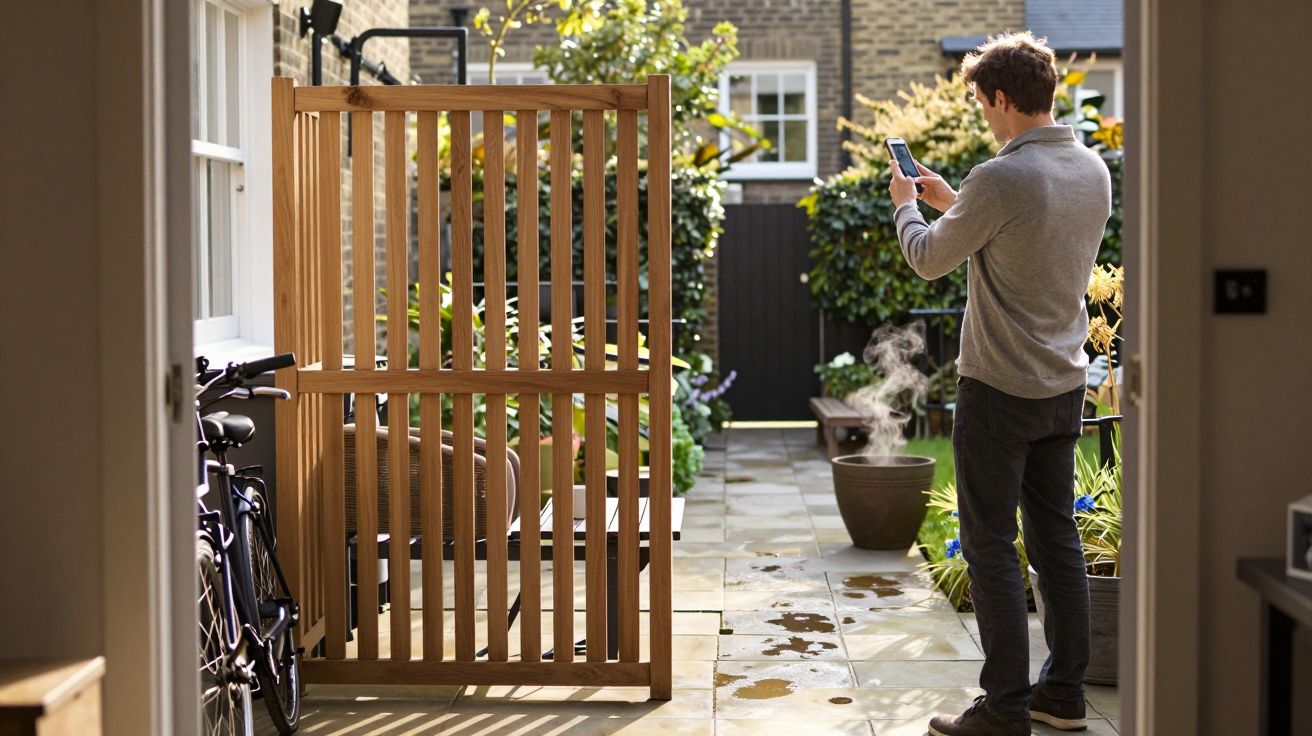
It’s 7.46am on a terraced street in Walthamstow and the kettle has only just clicked off. You look out at your patch and it’s already “busy”: bins, a bike, a damp fence, a neighbour’s upstairs window. In london gardens, sightline control matters more than plant choice because most of the stress (and most of the charm) comes from what you can see and what can see you.
That sounds grand, but it’s practical. If your garden feels overlooked, narrow, or messy even after you’ve planted, the issue is usually geometry, not greenery. Get the views right first and the planting becomes easier, cheaper, and calmer to live with.
The quiet problem with London gardens: too many eyes, too little depth
London gardens aren’t small in the same way. They’re long and thin, or square and boxed in, or split across levels with awkward steps. They sit under windows, beside kitchens, under extension shadows, and next to fences that rarely line up.
So people do what we’re told to do: add plants. A climber here, a pot there, maybe a small tree to “screen it out”. The effect is often disappointing because plants take time, and meanwhile the uncomfortable view remains perfectly intact: straight lines from your patio to a neighbour’s bedroom, from your sofa door to a row of bins.
Sightline control is the grown-up version of “tidying up”. You’re deciding what the eye lands on, what gets hidden, and where the space appears to start and end.
What “sightline engineering” actually means
It’s not about building walls or turning your garden into a fortress. It’s about redirecting attention with a few deliberate moves so the garden reads as a set of calm scenes rather than one exposed corridor.
Think in three actions:
- Block the worst view (overlook, clutter, harsh boundary).
- Frame one good view (a tree, a light, a textured panel, a bench).
- Pull the eye through the space (diagonal lines, staggered heights, a path that doesn’t point at a fence).
The goal isn’t maximum privacy. It’s minimum distraction.
Start with an audit: where do your eyes go?
Do this once, properly, and it saves months of buying the wrong plants.
- Stand at the back door where you actually spend time. Take a photo at eye level.
- Repeat from your usual chair spot and from the kitchen sink.
- Mark three things in each photo: the first thing you notice, the thing you hate, and the place your eye gets stuck.
Most london gardens have the same “stuck points”: the dead-centre fence panel, the shed front, the bins, the neighbour’s window, the bright white conservatory next door. Planting can soften these, but it rarely changes the route your gaze takes.
The three sightlines that decide whether a garden feels good
1) The back-door sightline (your daily one)
If the first view from the house is a flat fence, the garden feels shorter than it is. The fix is usually a mid-depth interrupt: something around 1.2–1.8m high that sits before the boundary so the fence stops being the “end”.
Good options that don’t require major work:
- a slim pergola frame with a light screen panel on one side
- a trellis set 30–60cm off the fence (it matters)
- a narrow upright planter with a vertical element (reeded panel, timber slats)
- a small tree positioned off-centre, not in the middle
The point is to create a nearer “end point” for the eye, so the garden gains layers.
2) The neighbour-window sightline (the uncomfortable one)
Most people try to fix overlooking with height at the fence line. That can work, but it’s slow (hedges) and sometimes contentious (light, boundaries, roots). Sightline control often works faster by moving the privacy screen closer to where you sit.
If your patio is the exposed spot, treat it like an outdoor room:
- add a screen at the patio edge, not just at the far fence
- use partial screening (one side) to break the direct line from window to chair
- angle screens slightly so they deflect views rather than creating a hard wall
A 1.6m screen two metres from your chair can feel more private than a 2m hedge twelve metres away, because it breaks the line that matters.
3) The clutter sightline (bins, bikes, storage)
Clutter is mostly a visual problem, not a moral one. London homes need bins and bikes and somewhere for muddy tools; pretending otherwise just makes the garden feel permanently unfinished.
Aim for one “service zone” with a deliberate face:
- tuck bins behind a short screen with a latch gate
- align storage with the fence and clad the front so it reads as a panel, not a pile
- keep one continuous line (screen or planting) so the eye doesn’t count objects
If you can’t hide it, make it look intentional. A single clean screen beats five “temporary” fixes every time.
A small toolkit that beats buying more plants
Plants are brilliant, but they’re the soft layer. These are the hard moves that make them work.
Use texture as a visual buffer
A flat fence is a visual dead end. Add texture and it becomes a backdrop. Fluted or slatted panels, trellis with a repeat pattern, even a simple batten rhythm gives the eye something to read, which reduces the feeling of “staring at a boundary”.
- Texture works in shade where flowers struggle.
- It looks finished even in winter.
- It lets young plants look like part of a plan, not a slow start.
Introduce a diagonal (without making it fussy)
If your garden is a rectangle, the most brutal sightline is straight down the centre. A slight diagonal path, a shifted seating area, or an off-centre focal point stops the corridor effect.
Simple rule: don’t point your paving directly at the fence panel you dislike most.
Create one focal point that earns attention
Give the eye a job. A small bench, a sculptural pot, a light, a water bowl, a feature panel-anything that becomes the “answer” to the view from indoors.
Keep it clear and singular. If everything is a feature, nothing is.
A practical order of operations (so you don’t waste money)
Do it in this sequence and you’ll buy fewer plants, and the ones you do buy will land better.
- Decide where you sit and look most (back door, patio chair, kitchen).
- Block or offset the worst line (screen placement beats fence-line panic).
- Add a mid-depth interrupt (layering creates depth in tight gardens).
- Choose the focal point (something that looks good year-round).
- Plant last to soften edges and fill gaps, not to solve the whole problem.
Planting should be your finishing layer, not your structural fix.
Common mistakes that keep London gardens feeling “meh”
- Planting along the fence and leaving the middle empty, which exaggerates the tunnel.
- Screening only at the very back, while the seating area stays exposed.
- Centring everything (path, tree, table), which strengthens the straight sightline.
- Buying tall plants to fix privacy, then realising they block light in the house.
- Hiding clutter with pots, then creating more clutter with pots.
A quick cheat sheet: what to do when the garden feels…
| Feeling | Likely cause | Sightline fix |
|---|---|---|
| Overlooked | Direct line from window to seating | Screen closer to patio, partial side screening |
| Short | Eye hits fence immediately | Mid-depth feature or frame, off-centre focal point |
| Messy | Too many objects in view | One service zone + clean screen face |
FAQ:
- Is sightline control just another word for privacy screening? Not quite. Privacy is part of it, but the bigger win is directing attention so the garden has layers, focal points, and fewer visual dead ends.
- Do I need to build anything permanent? Often no. Freestanding screens, trellis panels set off the fence, tall planters, and repositioned seating can change the main sightlines without major construction.
- Will plants eventually do the same job? Some will, but they take time and can fail in shade or poor soil. A simple structural backdrop makes even young planting look intentional while it grows in.
- What’s the fastest improvement in a typical London terrace garden? Break the straight view from the back door with a mid-depth element (screen, small tree, pergola frame) and give the eye a single focal point that isn’t the fence.





Comments (0)
No comments yet. Be the first to comment!
Leave a Comment