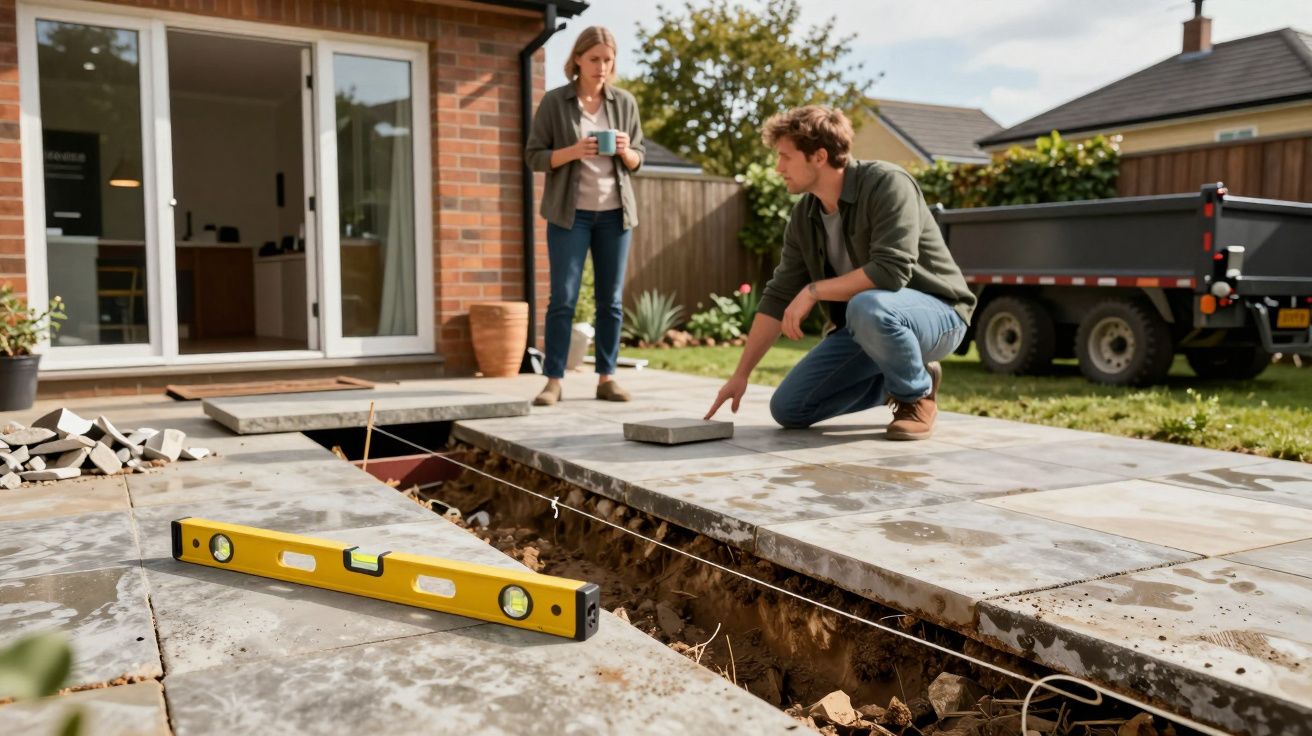
Garden modernisation projects rarely begin with planting plans and pretty finishes; they begin with structural garden works that decide what’s actually possible in your space. That can feel backwards-why destroy a patio to improve a garden?-but it’s often the only way to stop old problems (poor drainage, unsafe levels, failing walls) from being sealed in under new surfaces.
I’ve watched it play out in tidy back gardens across the UK: a neat lawn, a wobbly path, a raised bed that “sort of” holds back the slope. Then someone sketches a modern layout-clean paving lines, crisp steps, a dining terrace-and the first real action is a skip, a breaker, and a hard conversation about what’s staying. The map changes before it improves.
The hidden structure is what dates a garden
A garden can look fine while its bones are quietly giving way. Concrete slabs rock because the sub-base was too thin. Steps have odd risers because levels were guessed by eye. A retaining wall bulges a few millimetres each winter until it suddenly isn’t “a feature”, it’s a liability.
Modernisation is ruthless about lines and levels. Once you want flush thresholds, straight runs, and surfaces that don’t puddle, you stop being able to “work around” the old build. You either rebuild the structure or you inherit its quirks forever.
Here’s the uncomfortable truth: you can repaint a fence. You can’t out-style a sinking terrace.
Demolition is often the quickest route to a dry, level garden
Most of the demolition you see isn’t about aesthetics. It’s about access to the layers that actually do the work: falls, drainage, foundations, and load-bearing edges. If those are wrong, new porcelain paving or composite decking just becomes an expensive lid on a problem.
Typical “demolish-first” triggers include:
- Drainage that was never designed, especially where patios slope towards the house or lawns sit like sponges after rain.
- Mixed materials laid at different times, each with its own height, creating trip hazards and awkward transitions.
- Failing retaining walls and sleepers, often installed without proper footing or drainage behind them.
- Tree roots and heave, lifting slabs and cracking mortar where the original build didn’t allow for movement.
- Shallow sub-bases, common in older DIY patios, which can’t support modern, larger-format paving.
Demolition feels dramatic, but it’s often the cleanest way to rebuild the base correctly and set the falls so water goes where it should-away from buildings and into suitable drainage.
The “keep it” list shrinks once levels are set
The moment a designer or landscaper starts talking about finished floor levels, everything gets measured against one simple question: will this still work when the garden is made coherent?
That’s why a homeowner might plan to keep a patio, then lose it on day one. Once you set the new terrace height to meet doors safely and comply with damp-proof course considerations, the old patio might end up too high, too low, or sloping the wrong way. A single wrong level can force a chain of compromises: extra steps, awkward ramps, and water trapped against walls.
A good team will explain it plainly. They’ll mark levels with string lines and spray paint, then show you where the old build clashes with the new intent. It’s not about perfection. It’s about not building a modern garden on mismatched heights and hope.
What structural garden works actually cover (and why they come first)
People often think “structure” means a big retaining wall. Sometimes it does. More often it’s a set of unglamorous decisions that keep the garden stable for the next decade.
Structural garden works commonly include:
- Ground reduction or build-up to correct levels
- New sub-bases (Type 1, sharp sand, concrete where appropriate)
- Drainage runs, soakaways, channels, and inspection points
- Retaining walls, steps, and edgings with proper footings
- Sleeper structures rebuilt with posts/anchors and drainage behind
- Foundations for pergolas, kitchens, hot tubs, or outbuildings
Once those are in, the visible “modern” layer becomes simpler and more reliable. The paving stays flat. The lawn drains. The wall doesn’t creep forward each freeze-thaw cycle. The finish starts behaving like a finish, not a patch.
How to make demolition feel less like panic
Demolition is noisy, messy, and emotionally odd. Your garden looks worse before it looks better, and that’s hard when you live with it every day. The way through is to treat the early phase like a controlled investigation rather than chaos.
A few habits help:
- Ask for a sequence, not just a quote: what gets removed, what gets protected, and what gets rebuilt first.
- Confirm where spoil is going: grab lorries, skips, or on-site reuse-each affects cost and disruption.
- Agree the “unknowns” upfront: buried concrete, old drains, and shallow services turn up often.
- Photograph and measure access: side passages, steps, and gates decide whether you can machine-dig or you’re barrowing everything by hand.
- Plan for temporary drainage: if work spans wet weeks, you don’t want water sitting against the house.
The best reassurance is a clear plan and a tidy site. The second-best is accepting that a modern garden is built from the ground up, not the surface down.
A quick snapshot you can use before you start
- If the garden holds water: expect digging and drainage before finishes.
- If there are retaining edges: expect rebuilds with proper footings and back-drainage.
- If you want large-format paving: expect thicker sub-bases and stricter levels.
- If you’re adding weight (kitchen, hot tub, outbuilding): expect foundations and load planning.
Demolition isn’t failure. It’s the moment your garden stops being a collection of past decisions and starts becoming one coherent build.
FAQ:
- Do I always need to demolish an existing patio to modernise a garden? No, but if the levels, slope, or sub-base are wrong, keeping it usually creates bigger costs later. A good contractor can test stability and falls before deciding.
- What’s the most common reason modern gardens fail after a makeover? Water management. Poor falls and missing drainage show up as puddling, algae, movement in paving, and damp problems near the house.
- Can structural garden works be done in phases? Often yes, especially for budgets. Just be careful: drainage and levels usually need to be planned as one system, even if finishes come later.
- How disruptive is demolition in a typical UK back garden? It depends on access. With side access and machinery it’s faster; with terraced-house access it can mean more hand work, noise, and days of barrowing.
- How do I know if a retaining wall is structural? If it holds back soil at different levels, supports steps/terraces, or shows bulging and cracking, treat it as structural and get it assessed before building on top of it.




Comments (0)
No comments yet. Be the first to comment!
Leave a Comment