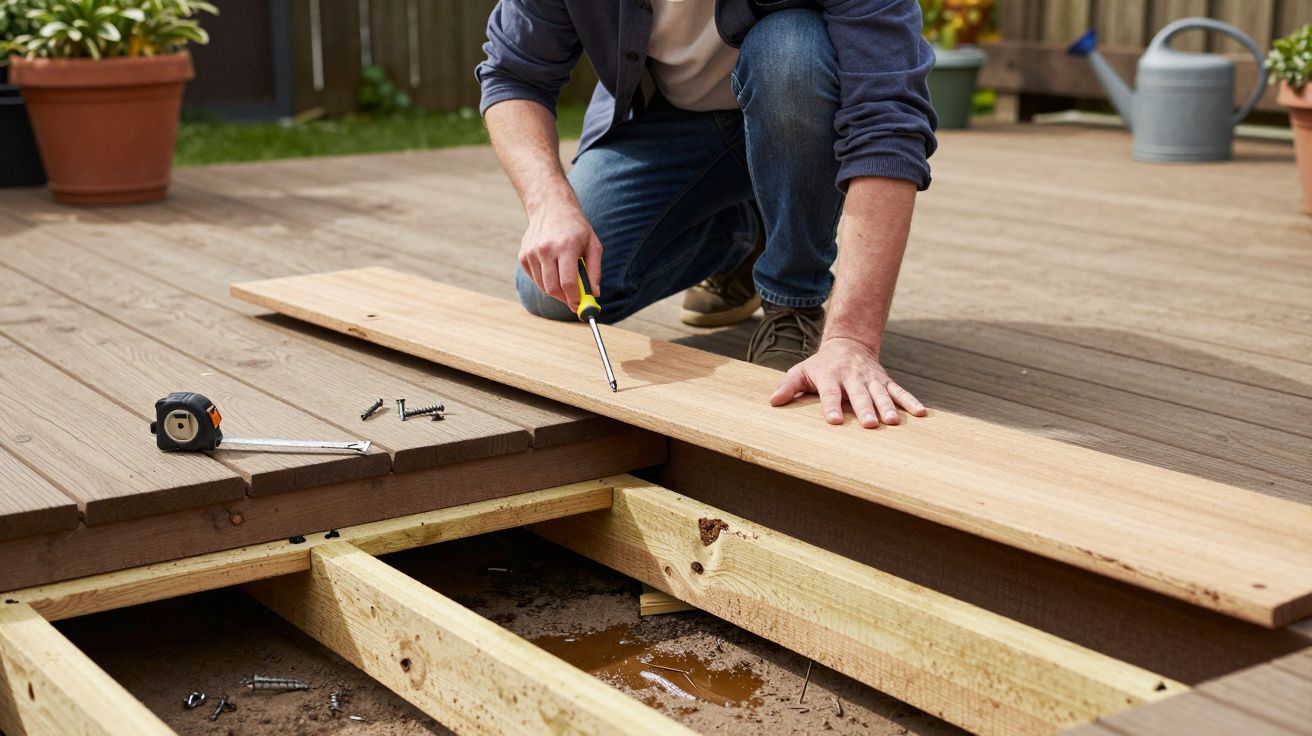
The first time decking fails, it rarely announces itself with a dramatic snap. It shows up as a faint bounce underfoot, a handrail that feels “a bit loose”, a board that never quite sits flat - the kind of annoyances people live with for months. That’s why structural garden works matter so much: the unseen support system decides whether your deck stays straight and safe, or quietly starts to unravel.
Most decks don’t go wrong because the timber was “bad” or the screws were “cheap”. They go wrong because the structure was treated like a formality, as if the visible boards were the job and everything beneath was just… wood holding up wood. It isn’t. It’s engineering, outdoors, in a wet climate, on ground that moves.
Why the surface can look perfect while the deck is already failing
A fresh deck can look flawless on day one even if the frame is wrong. Boards hide a lot: uneven joists, under-sized beams, too few posts, poor fixings, and ground that was never properly prepared. In the first weeks, everything still feels tight because the materials haven’t yet had time to swell, shrink, and settle.
Then the British weather begins doing what it always does. Rain finds the lowest points, moisture sits where airflow is poor, timber cycles between wet and dry, and the frame starts to telegraph its weaknesses upwards. You don’t see “structural failure” at first. You feel it as movement.
A common story: someone installs composite decking because it’s meant to be low-maintenance. Six months later, the boards look fine - but the deck has a soft trampoline feel near the steps. Composite didn’t cause that. The joist spacing did. The surface is only as stable as what it’s screwed to.
The quiet mechanics that actually break a deck
Decking failures usually come from a small handful of structural mistakes. None of them look like mistakes while you’re building.
1) The ground wasn’t treated as part of the structure
If posts sit on soil that wasn’t dug out, compacted, and given proper footings, the deck doesn’t have a stable “base layer”. Clay-heavy gardens can heave and shrink seasonally; made-up ground can settle for years. A deck frame built on wishful thinking will move, and movement loosens everything else.
There’s also drainage. If water is encouraged to sit under the deck - because the area wasn’t graded, membrane wasn’t used appropriately, or ventilation is blocked - timber stays damp far longer than it should. That doesn’t always rot it instantly. It just accelerates every weakness you already built in.
2) Joist spacing is guessed, not designed
This is where many projects quietly fail early. Joist spacing depends on the decking material, board thickness, orientation, and expected loads (hot tubs, planters, lots of people at once). Too wide a spacing creates flex; flex creates squeaks; squeaks create repeated micro-movement; and micro-movement slowly enlarges fixings and cracks boards.
People often notice it first near high-traffic spots: the door threshold, the top step, the corner where everyone turns. The deck becomes “annoying” before it becomes “unsafe”, which is exactly why it gets ignored.
3) Ledger boards and fixings are treated like carpentry, not structure
Where a deck attaches to a house (if it does), the ledger connection is not decorative. It’s a critical structural junction that must be correctly fixed, correctly flashed, and correctly spaced to prevent trapped moisture.
A deck can look smart while water is being directed behind the ledger, wetting masonry, dampening joist ends, and corroding fixings. The first visible clue might be a dark stain line on the wall, or a slightly springy edge where the deck meets the house. By the time you see that, the problem has often been active for a while.
4) “It’s only a small deck” becomes an excuse
Small decks still carry real loads. A 3m x 3m deck can hold a table, eight adults, and heavy planters without anyone thinking twice. Under-building because the footprint is small is one of the easiest ways to end up with bounce, twist, and long-term instability.
And there’s a psychological trap: because it’s outdoors, people tolerate movement they’d never accept indoors. A bit of flex becomes normal. Until someone trips.
The early warning signs people miss (because they’re easy to explain away)
Most homeowners don’t ignore problems out of laziness. They ignore them because the signs are subtle, and the deck still “works”.
Look for patterns like these:
- A rhythmic squeak in the same two or three spots (often a fixing or joist edge issue).
- Slight cupping or a raised board end that keeps returning after you screw it down again (movement underneath).
- Handrails that feel solid in winter but wobble more in summer (timber cycling, posts not braced correctly).
- Standing water that appears in the same area after rain (fall/levelling and drainage below).
- A step that feels different from the rest - either higher, lower, or springier (settlement at a support point).
One especially telling clue is “repairs that don’t stay repaired”. If you keep tightening screws, re-fixing boards, or packing a step, and the issue returns, that’s the deck telling you the frame is moving.
What good structural garden works actually look like under a deck
You don’t need to become a structural engineer to judge whether the fundamentals were respected. You just need a clearer picture of what should be there.
A well-built deck typically has:
- Footings appropriate to the ground conditions, not just what was easiest to dig.
- Posts that are properly anchored and protected where needed, not sitting in permanent damp.
- Correct joist sizing and spacing for the chosen decking and the loads.
- Bracing where racking (sideways sway) could happen, especially on raised decks.
- Ventilation and drainage underneath so the structure can dry, not stew.
- Fixings chosen for outdoors (corrosion resistance) and used in a way that doesn’t invite splitting.
It’s not about making it “overbuilt”. It’s about making it predictable. The best decks feel boring underfoot - solid, quiet, and consistent everywhere.
A simple pre-visibility checklist before you commit to a surface
If you’re planning a new deck (or thinking of resurfacing an old one), this is the moment to pause. Replacing boards on a weak frame is like painting over damp: it buys you time, not quality.
Before you invest in new decking, do a quick structural sense-check:
- Check for bounce: walk slowly and deliberately; movement should be minimal and consistent.
- Look underneath: are there obvious wet zones, green growth, or trapped debris?
- Inspect fixings: are there rusty screws, black staining around fixings, or snapped heads?
- Test the rail: push sideways, not down; sideways movement is a bracing conversation.
- Look at support points: posts, base plates, and steps should look deliberate, not improvised.
If any of these feel uncertain, that’s not a failure - it’s information. Decking is easy to change later. Structure is what you’ll live with.
| What you notice | Likely structural cause | What to do next |
|---|---|---|
| Bounce in one area | Spacing/support issue | Inspect joists and support points |
| Recurring loose boards | Frame movement | Check fixings and levelling |
| Damp smell/green growth | Poor airflow/drainage | Improve ventilation, clear ground, assess rot |
FAQ:
- Is it worth resurfacing old decking boards to save money? Sometimes, but only if the frame is sound. If you have bounce, recurring loose fixings, or damp trapped underneath, resurfacing usually masks the problem and can waste the cost of new boards.
- Does composite decking fix structural issues because it doesn’t rot? No. Composite can reduce surface maintenance, but it still needs correct joist spacing and a stable subframe. A weak structure will still flex and loosen over time.
- What’s the biggest hidden cause of early deck failure in the UK? Water management: poor drainage and poor ventilation. Timber that can’t dry stays stressed, and stressed timber exposes every shortcut in the structure.
- When should I involve a professional rather than DIY? If the deck is raised, attached to the house, supporting heavy loads (hot tub/planters), or showing movement you can’t explain. Those are structural questions, not cosmetic ones.




Comments (0)
No comments yet. Be the first to comment!
Leave a Comment