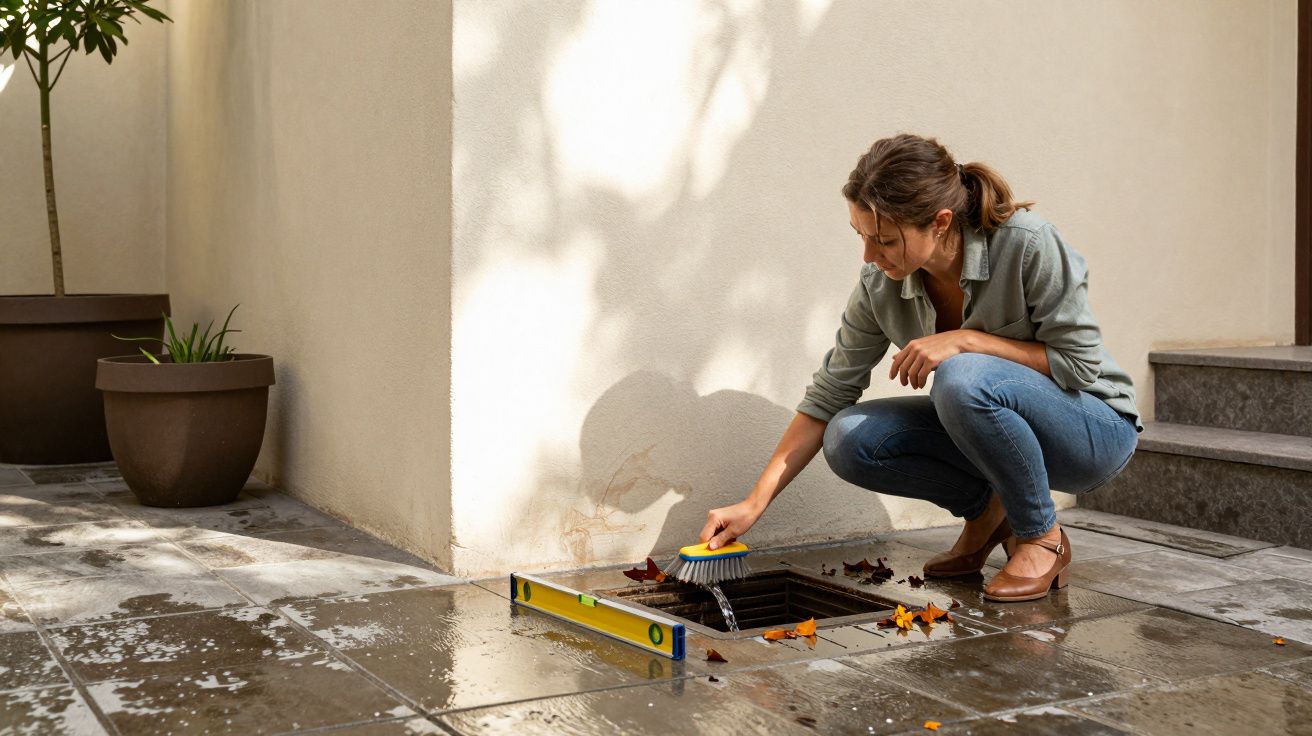
You don’t have to go far in the city to see how types of urban spaces are being re-invented, but basement gardens are one of the strangest and most useful of the lot. They’re outdoor rooms set below street level-often carved from a front lightwell, a sunken courtyard, or a stepped terrace behind a lower-ground flat-and they matter because they turn dead space into daylight, privacy, and habitat. The catch is that they rarely behave like “normal” gardens, so the usual design rules start to wobble the moment you draw the first line.
A basement garden is never just about plants. It’s about water behaving badly, light arriving sideways, neighbours looking down, and a microclimate that can feel sheltered one minute and wind-tunnel the next. Design, here, is less about decoration and more about risk management with a green finish.
The rulebook assumes level ground and open sky
Most garden advice is built on a quiet assumption: you have horizon, drainage, and a roughly predictable amount of sun. Basement gardens have none of those guarantees. Your “sky” is a rectangle, your edges are walls, and the ground is usually sitting right beside the most sensitive part of the building.
That changes the priorities. In an ordinary back garden you can correct a mistake next season. In a sunken space, a mistake can become damp, mould, and a phone call to a builder.
Treat the garden as part landscape, part external room, part building detail. If you over-design the waterproofing and under-design the planting, you still win.
Light is not a quantity; it’s a direction
In a basement garden, sunlight doesn’t arrive like a blanket. It arrives like a spotlight, bouncing off render, glass, and paving. Two hours of direct sun can be plenty for the right plants-if that sun reaches the soil, not just the wall.
You end up designing for angles. Pale surfaces can lift the brightness without feeling clinical. Vertical planting can help, but only if it’s not so dense that it steals the little light you have.
What to check before you pick a plant palette
- Where the sun actually lands in spring and autumn, not just midsummer.
- Whether the walls cast long shadows over the beds at the exact time you want to use the space.
- How reflective nearby surfaces are (brick absorbs; light render bounces).
- Whether you’re dealing with dry shade (under overhangs) or damp shade (near drainage runs).
A simple habit helps: stand in the space at three different times of day and take photos from the same spot. You’re not making art; you’re collecting evidence.
Drainage stops being a detail and becomes the plot
Standard garden design treats drainage like something you improve with compost, grit, and a bit of fall away from the house. Basement gardens live next to retaining walls and lower-ground rooms, so water has more ways to cause trouble and fewer places to escape.
This is why the “pretty” decisions-paving types, raised beds, lawn patches-are secondary to the unseen system underneath. If you can’t describe where rainwater goes during a downpour, you’re designing a puddle, not a garden.
The non-negotiables that break the usual rules
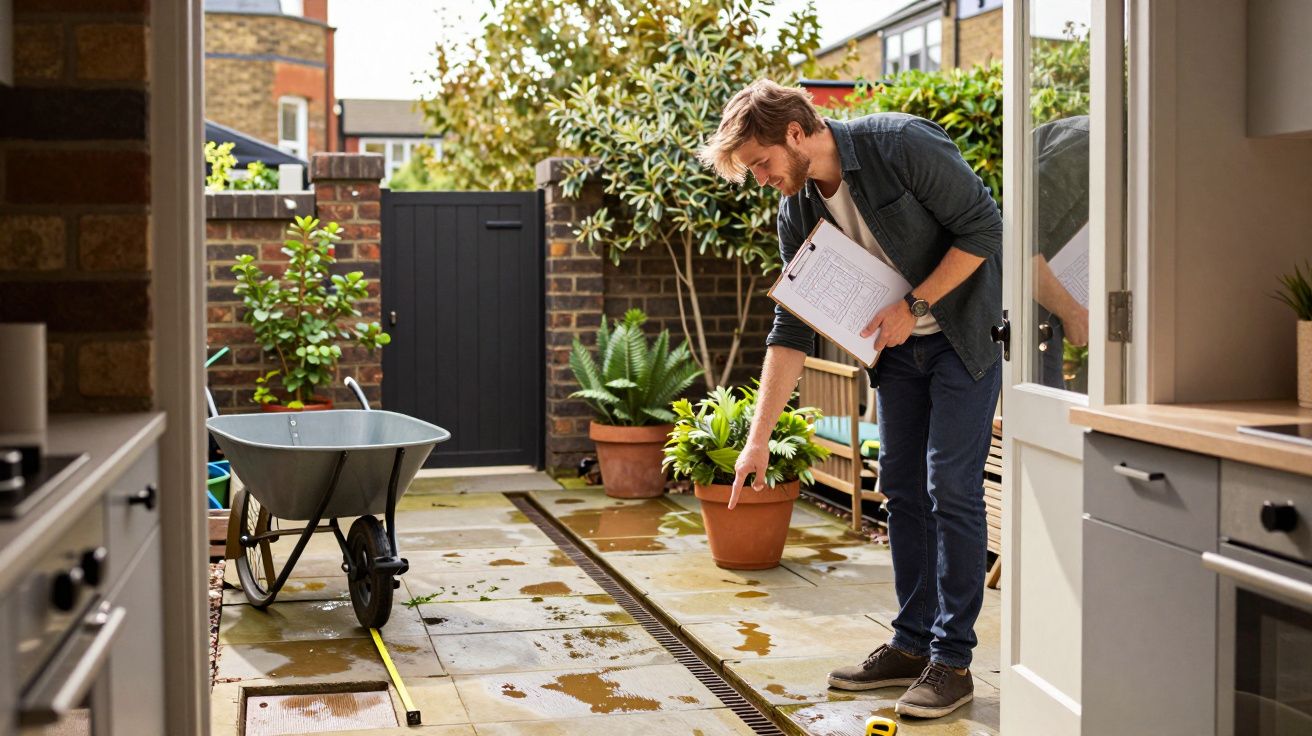
- Falls and levels: surfaces must slope towards a drain, not “feel level” underfoot.
- Free-draining build-ups: sub-bases, geotextiles, and drainage layers matter more than edging.
- Overflow thinking: assume one drain will clog at the worst time, then plan a safe route for water anyway.
- Access for maintenance: you need to be able to clear leaves, silt, and roots without dismantling the garden.
If that sounds unromantic, good. Romance belongs in the planting; engineering belongs under it.
Privacy flips: you’re not looking out, you’re being looked down on
Most small gardens try to block neighbours at eye level. Basement gardens have a different geometry: the overlooking often comes from above. A fence that would feel generous at ground level can look like a token gesture from a first-floor window.
You can’t always win with height, especially where planning or light access is tight. The better move is layered screening: partial cover, soft edges, and sightline control rather than total blockage.
A practical privacy toolkit
- Slatted screens set back from the edge (so they don’t feel like a barricade).
- Multi-stem small trees in large containers to lift foliage into the line of sight.
- Pergolas or simple overhead frames with climbers for “ceiling privacy”.
- Seating positioned where the view out is best and the view in is worst.
The goal is not to disappear. It’s to feel unobserved enough that you actually use the space.
Wind and warmth behave like a corridor, not a field
Sunken spaces can be oddly calm, which makes them feel warmer and more habitable than the street above. But the same walls that shelter you can also funnel gusts, especially between buildings, near gates, or where stairwells create a channel.
Microclimate design becomes more like interior design: you place elements to control comfort. A bench isn’t just a bench; it’s a windbreak and a thermal mass if it’s brick or stone.
| Symptom | Likely cause | Design response |
|---|---|---|
| Damp corners that never dry | Cold walls + shade | More airflow, shade-tolerant planting, avoid dense groundcovers there |
| Sudden gusts near the door | Funnel effect from access route | Screens, planting buffers, change seating position |
| Plants scorched in a “shady” garden | Light bouncing off pale walls | Choose tougher foliage, add textured surfaces to soften glare |
Access is awkward, so the design has to carry its own logistics
Standard advice says “bring in compost, move the paving, plant a tree”. Basement gardens ask: how? Many are reached by narrow stairs, tight corridors, or through the flat itself. That changes material choices immediately.
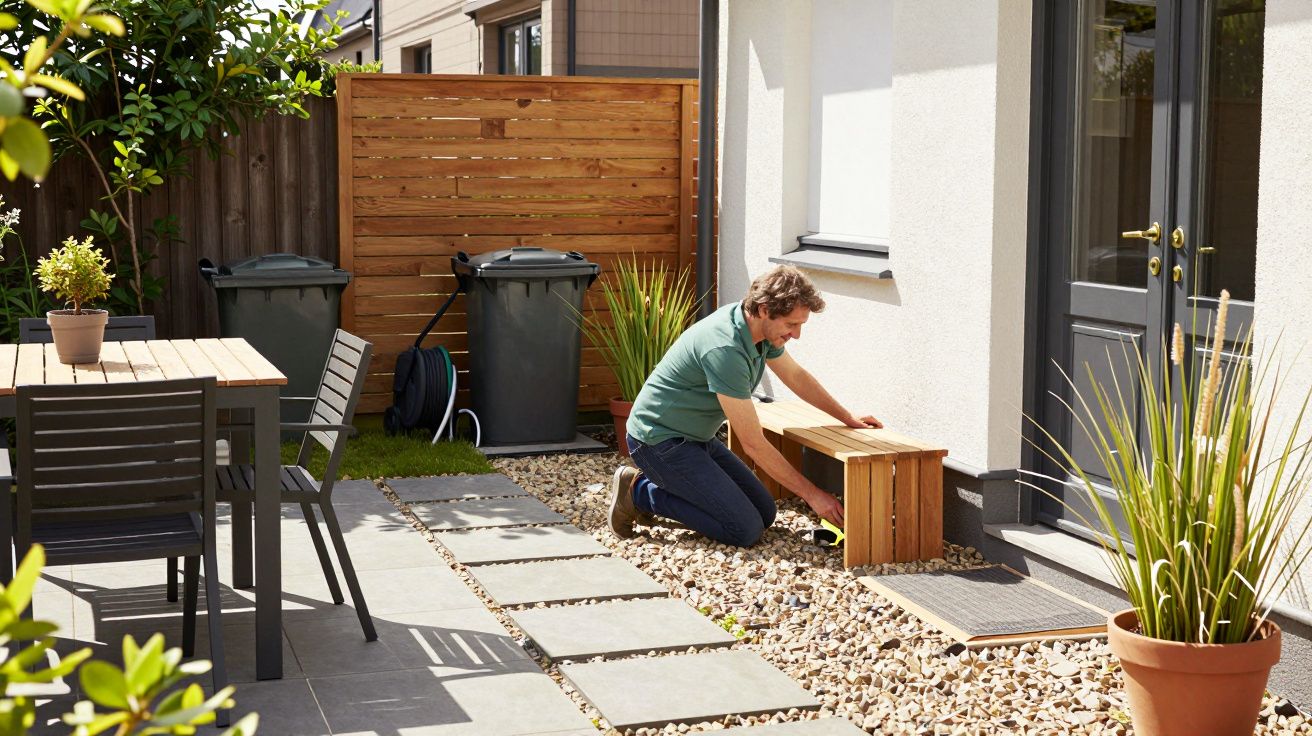
You’ll favour modular elements and manageable weights. You’ll also design storage properly, because hauling tools up and down steps turns every small job into a project.
A good basement-garden build plan is boring on purpose
- Confirm waterproofing details and existing drainage points before you design the layout.
- Design levels, falls, and thresholds as if you’re detailing a bathroom floor.
- Choose hardscape materials that can be carried in sections.
- Build in maintenance access to drains, lightwells, and vents.
- Plant last, and plant for the reality of light and moisture, not the fantasy.
It reads like a checklist because it is one. In a sunken garden, the “sequence” is half the design.
The best basement gardens behave like calm, green courtyards
Once the engineering is right, you can lean into what basement gardens do better than most types of urban spaces: they create refuge. The walls give you a sense of enclosure that’s hard to buy in a city. The sound can soften. The air can feel still. Even a small footprint can become a daily place rather than an occasional one.
A useful mental model is to design two layers: the reliable layer (drainage, surfaces, lighting, access) and the expressive layer (planting, furniture, texture). If you make the reliable layer quietly over-capable, you earn the right to be playful on top.
FAQ:
- Do basement gardens always need planning permission? Not always, but changes to railings, walls, terraces, and lightwells can trigger permissions or conditions, especially in conservation areas or listed buildings. Check before altering levels or boundaries.
- Are basement gardens always shady? No. Many get strong mid-day or afternoon sun because light drops in from above. The challenge is that it’s often brief and directional, so plant selection must match that pattern.
- What’s the biggest design mistake? Treating it like a normal patio with a few pots. If drainage, falls, and maintenance access aren’t designed first, the garden can become a damp trap rather than a usable room.




Comments (0)
No comments yet. Be the first to comment!
Leave a Comment