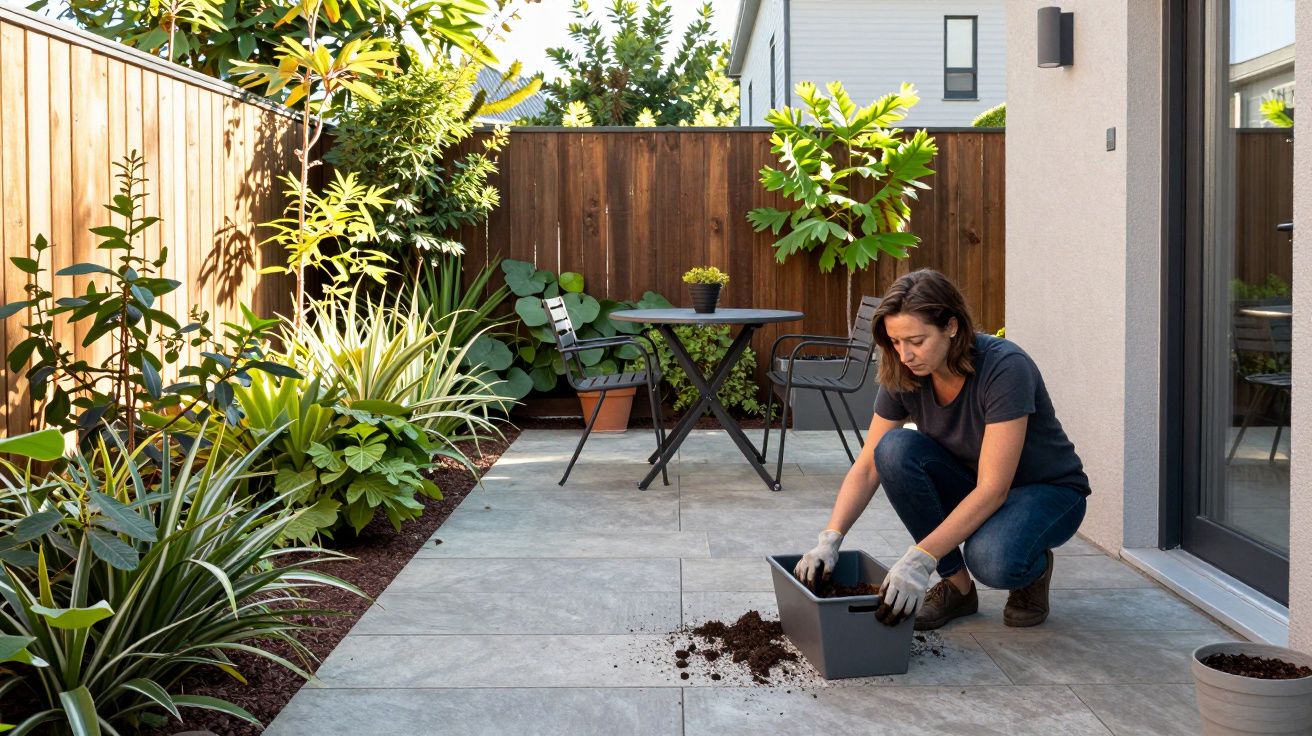
Small urban gardens are often redesigned like tiny living rooms: a bit of dining here, a fire pit there, a water feature somewhere “to make it special”. Space zoning can help you make sense of that urge, but it also reveals the trap: every new “feature” quietly eats the one thing these gardens need most-continuous, usable space.
The result is rarely ugly. It’s just strangely stressful to be in, and harder to look after than it should be. You end up with lots of things, but no garden.
The hidden cost of “just one more thing”
In a small plot, every object isn’t only an object. It becomes a boundary, a route change, a shadow line, a maintenance job and a visual demand.
A bench isn’t only for sitting. It forces a clearance around it, it blocks a view, it creates a dead corner where leaves collect, and it often dictates where everything else must go. Multiply that by three or four features and the garden stops behaving like one place.
In big gardens, features are punctuation. In small ones, they can become the whole sentence.
What people mean by “adding features” (and why it feels sensible)
Most additions come from a good instinct: make the garden more “useful”. But usefulness in a compact space doesn’t stack neatly; it competes.
Common feature-creep looks like this:
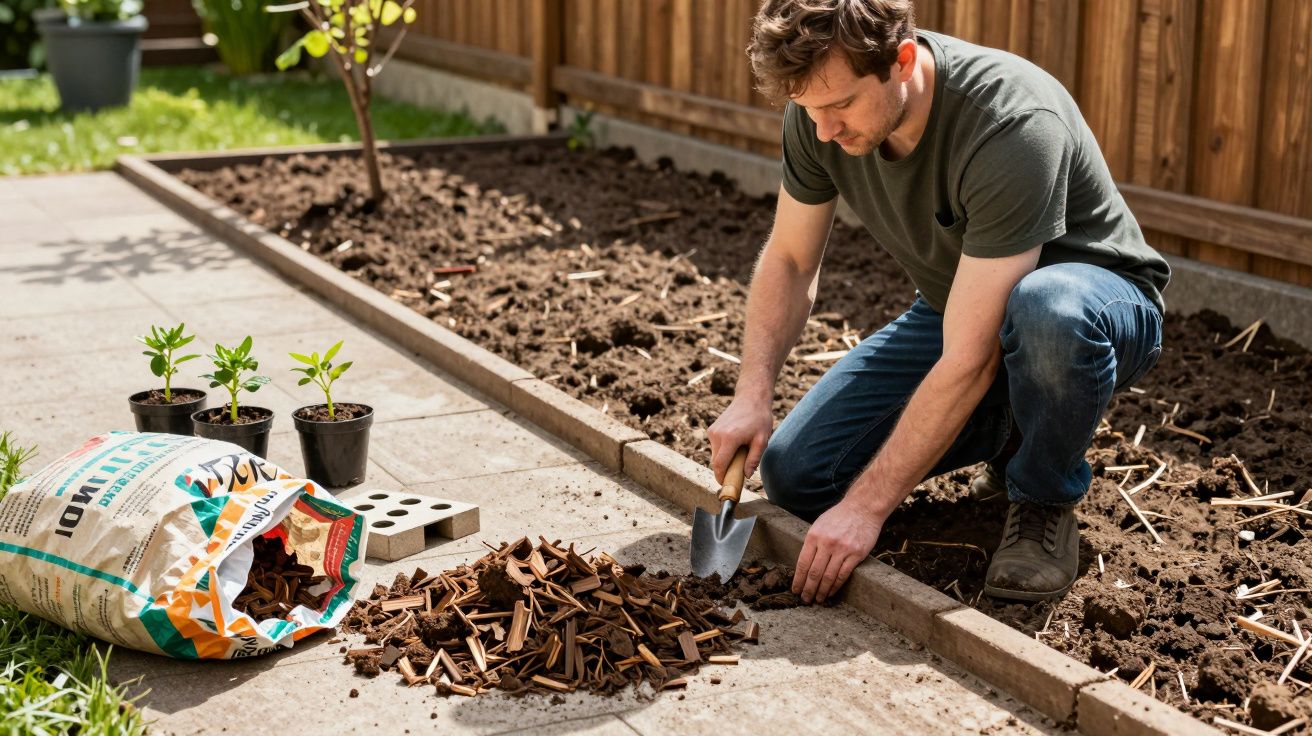
- A raised bed “for veg”, then two more because the first feels lonely
- A pergola to “define the seating area”, then lighting, then a heater
- A water bowl that becomes a pump, then a reservoir, then a cable run
- Built-in planters that turn into permanent obstacles
- Decorative gravel strips that become weed nurseries
None of these are inherently wrong. The problem is the accumulation without a clear hierarchy.
Space zoning is meant to reduce decisions, not increase them
Good space zoning in small urban gardens does one thing brilliantly: it tells you what happens where, with as few transitions as possible. Bad zoning does the opposite. It creates lots of micro-areas that feel like separate projects, each needing its own edges, finishes and “moment”.
A practical way to think about zoning is not “How many zones can I fit?” but “How few can I get away with?”
A simple zoning test you can do in five minutes
Stand at the back door and ask:
- Can I see one obvious place to sit?
- Is there a single clear path to it without sidestepping pots or furniture?
- Do I have one generous planting area, not five thin ones?
- Does anything exist only because it was on sale or looked good on Instagram?
If you hesitate, the garden is probably over-featured rather than under-designed.
The “edge tax”: why small spaces punish complexity
Every new element needs an edge: timber sleepers need a line against paving, gravel needs a border, planters need a finish, decking needs a frame. In small urban gardens, those edges multiply fast and steal area twice-once physically, and again visually.
Edges also create cleaning. You don’t maintain “a garden”; you maintain seams.
Typical edge-tax symptoms:
- Slivers of gravel you can’t rake properly
- Narrow beds you can’t weed without stepping on plants
- Awkward triangles of paving that never feel intentional
- Materials meeting in too many places, so the whole space looks busy
When people say a small garden feels “fiddly”, they’re often describing edge tax.
How features break the one thing that makes a garden feel bigger
Small urban gardens feel larger when the eye travels. That’s not a trick; it’s a physical experience of continuity.
Features interrupt that continuity. A pergola can be beautiful, but if it sits in the middle and stops the sightline, it makes the space feel chopped. A cluster of tall planters can add greenery, but if it narrows the walking line, the garden starts to feel like an obstacle course.
A good rule is to protect one long, calm visual sweep:
- from the back door to the far boundary, or
- along the longest side, if the plot is narrow
If a new feature breaks that sweep, it needs to earn its place.
The maintenance spiral nobody budgets for
Extra features create extra failure points. Timber warps, pumps clog, solar lights die, gravel migrates, planters dry out faster than ground soil. In a small space, you notice every bit of neglect because you’re always close to it.
The spiral usually goes like this: you add features to make the garden more enjoyable, then you spend more time maintaining them, then you use the garden less because it feels like work.
If a feature adds maintenance without adding daily use, it’s a net loss.
What to do instead: design around one “anchor”, then allow breathing room
Most successful small urban gardens have one strong anchor and a few supporting choices that stay quiet.
Anchors that tend to work:
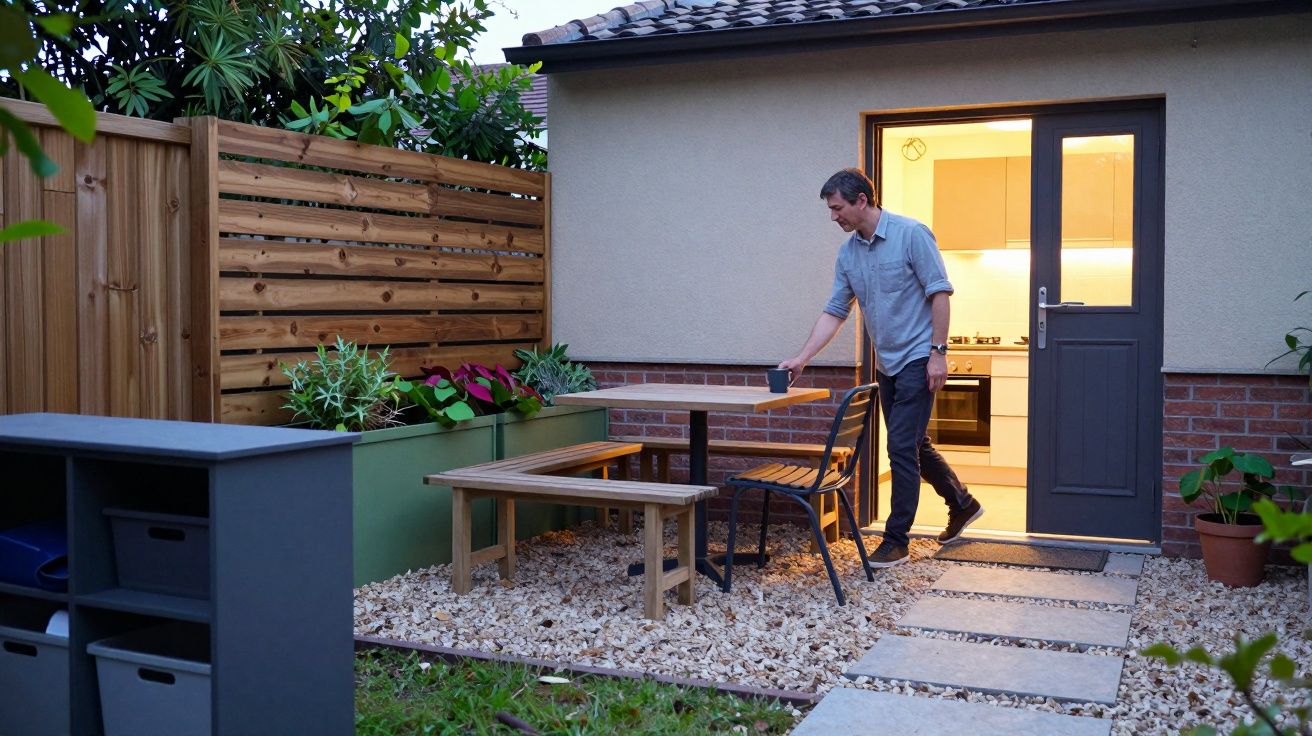
- One comfortable seating area that fits how you actually sit (not how a catalogue stages it)
- One generous planting bed (often along a boundary)
- One simple surface underfoot, kept consistent
- One vertical element (a small tree, a climber on wires, or a single pergola at the far end)
Then you leave space. Not “empty” space-breathing space that lets the garden function.
A quick priority list to stop feature creep
Before you buy or build anything new, rank these:
- Movement: can two people pass without turning sideways?
- Comfort: is there shade or shelter where you’ll actually sit?
- Green mass: do you have enough planting to soften hard edges?
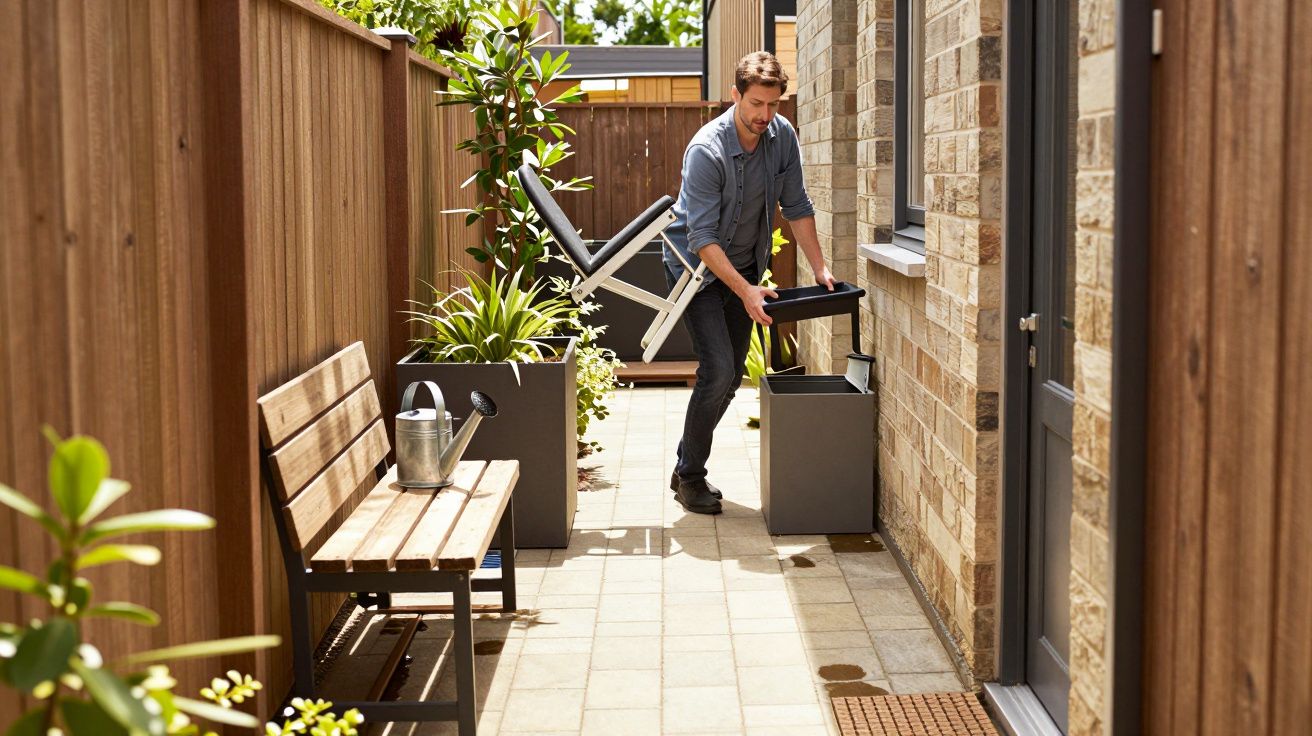
- Storage: is the mess hidden so the space stays calm?
- Details: lighting, water, ornament, extra zones
Most people start at number 5 and wonder why it doesn’t feel right.
When adding a feature does work
Sometimes a feature improves a small garden-when it replaces clutter rather than adding to it, and when it supports the zoning instead of fragmenting it.
Good additions tend to have three traits:
- They do more than one job (seat + storage, planter + screen)
- They reduce edges (one larger bed instead of three small ones)
- They simplify routines (drip line, clear access, fewer materials)
If you can’t name the routine it improves, it’s probably decoration dressed up as function.
What to keep in mind
Small urban gardens don’t fail because they lack ambition. They fail because ambition shows up as too many objects, too many edges, and too many tiny zones competing for attention. Use space zoning to protect what matters: one clear layout, one strong anchor, and enough uninterrupted space for the garden to feel like a single, liveable place again.



Comments (0)
No comments yet. Be the first to comment!
Leave a Comment