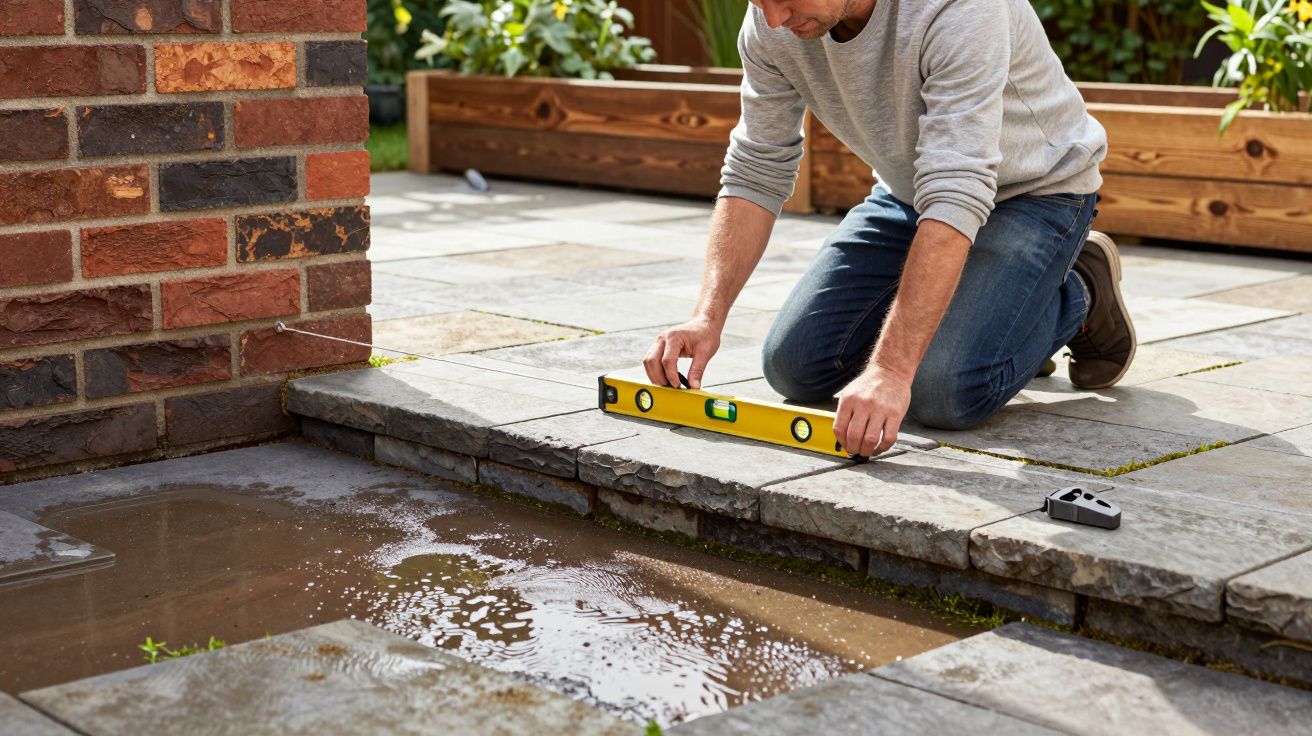
You can build a patio, path or raised bed and it’ll look spotless on day one, then start failing quietly. In garden construction, the structural mistakes that cost the most long-term often aren’t dramatic collapses-they’re the tiny details that trap water where it shouldn’t sit. One of the worst is a missing or wrong fall: that barely-noticeable slope that decides whether your build drains, or rots.
It’s the kind of detail you only notice when you’re already annoyed. The slabs wobble after winter. The timber stays damp. The joints green up. And suddenly “low maintenance” becomes a weekend job you can’t quit.
The small detail: no fall (or the wrong fall)
A fall is simply a gentle slope that moves water away. When it’s absent, too shallow, or pointing the wrong way, rain becomes a long soak rather than a quick pass. Water lingers at the edge of paving, under a sleeper, against a wall, or in the base of a planter-exactly where you don’t want it.
Most DIY builds don’t fail because the materials were bad. They fail because the water had nowhere sensible to go, so it went everywhere else.
Golden rule: don’t build “level”; build “draining”. If water can’t leave, maintenance moves in.
The tell-tale signs you’ve got it wrong
- Puddles that sit for more than an hour after rain.
- Algae and black spots concentrated in one strip.
- Jointing compound cracking at one edge again and again.
- Efflorescence (white salts) on brickwork or paving.
- Timber edging that stays dark and wet at the base.
None of these are purely cosmetic. They’re early warnings that your structure is staying saturated.
Why it ruins long-term maintenance (and not just the look)
Standing water is a multiplier. It washes out jointing sand, drives freeze–thaw movement, and keeps sub-bases soft so slabs rock underfoot. Against buildings, it pushes damp into the lowest courses and can turn a small drainage oversight into a persistent problem.
For timber, it’s even less forgiving. Wood that’s “usually wet” will swell, twist, and invite rot and fixings corrosion, even if it’s treated. You end up repainting, re-fixing, re-levelling-work that feels like it comes back faster every year.
The frustrating part is how little slope would have prevented it. We’re talking millimetres per metre, not a ski ramp.
How much fall you actually need
Think in gentle gradients you can set with a string line and a spirit level, not guesswork by eye.
- Patios and paths: aim for about 1:60 to 1:40 (roughly 16–25 mm drop per metre) away from buildings.
- Drainage-critical areas (tight courtyards, shaded spots): lean towards the steeper end.
- Ramps and accessibility: you may need shallower slopes, but then you must plan drainage routes more carefully.
If you’re using a bubble level, add a packer under one end as a guide. It’s not fancy, but it’s repeatable-and repeatable beats “looks about right” every time.
Different garden builds, different failure points
| Build type | Where water gets trapped | What happens next |
|---|---|---|
| Paving/patio | Against the house or in low corners | Damp risk, rocking slabs, joint loss |
| Raised beds/planters | Base with no outlet or waterlogged backfill | Rot, staining, bowing sides |
| Steps and landings | On treads or at the bottom riser | Slippery algae, frost damage, loose nosings |
The pattern is the same: water sits, then everything else follows.
The simple routine that prevents years of rework
Start with the “exit plan” for water before you think about finishes. Where does rain go when it hits this surface, and where does it go next?
- Set finished levels first. Mark the height at the house (or fixed edge), then mark the lower edge with the correct drop.
- Build the base to the fall, not just the top. A sloping slab on a flat, poorly compacted base will still move.
- Keep water away from walls. Leave a gap, add drainage, or direct fall away-don’t rely on pointing to “seal” it.
- Avoid creating a low corner. If two edges are fixed, the third often becomes a sump unless you plan for it.
- Give planters an outlet. Drainage holes, a free-draining layer, and a place for water to escape matter more than how pretty the cladding is.
Warm tip from hard-earned experience: if you find yourself thinking “the jointing will sort that out,” stop. Jointing is not a drainage system.
The common traps that look neat on day one
- Edging set too high: it forms a dam that holds water on the surface.
- Falls pointing towards fences: you end up with boggy borders and rotting posts.
- No allowance for settlement: the lowest spot becomes the one spot you walk through every day.
- Decorative gravel over clay: it looks dry, but stays wet underneath and migrates into the sub-base.
- Planters built tight to paving: splashback and trapped moisture keep timber wet around the base.
If you recognise your project in any of these, the fix is often simpler early on than later. Once the surface is down, changing falls usually means lifting and rebuilding sections.
A quick check you can do this weekend
Pick the wettest day you’ve had recently and walk the area after the rain stops. Don’t look for a flood; look for hesitation.
- Where does the water slow down?
- Where does it darken and stay dark?
- Which edges stay green the longest?
Then run a string line along the key direction and measure the drop over a metre. If it’s close to zero, you’ve found the maintenance leak-before it becomes a structural one.
FAQ:
- Will sealing paving fix standing water? No. Sealers may reduce staining, but they don’t create fall or stop water getting into joints and the base. You still need a drainage route.
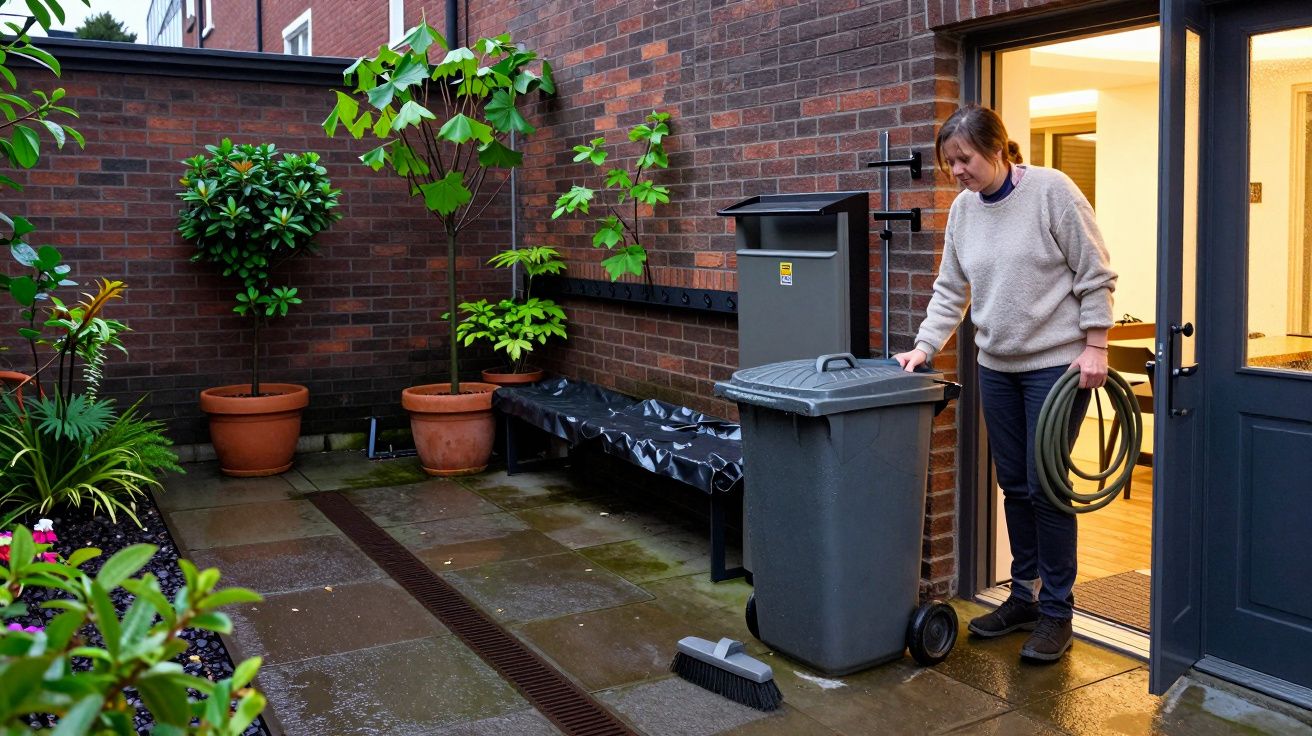
- What if I can’t fall away from the house because of levels? Use a channel drain or gully at the threshold and fall towards it. The goal is controlled collection and discharge, not “perfectly level”.
- Do raised beds need fall too? The bed itself doesn’t, but it needs drainage out of the base and away from adjacent hardstanding. Trapped water is what rots the bottom course first.
- Is more fall always better? Not always. Too steep can feel awkward underfoot and can encourage surface wash-out. Aim for steady, consistent fall and good base compaction.




Comments (0)
No comments yet. Be the first to comment!
Leave a Comment