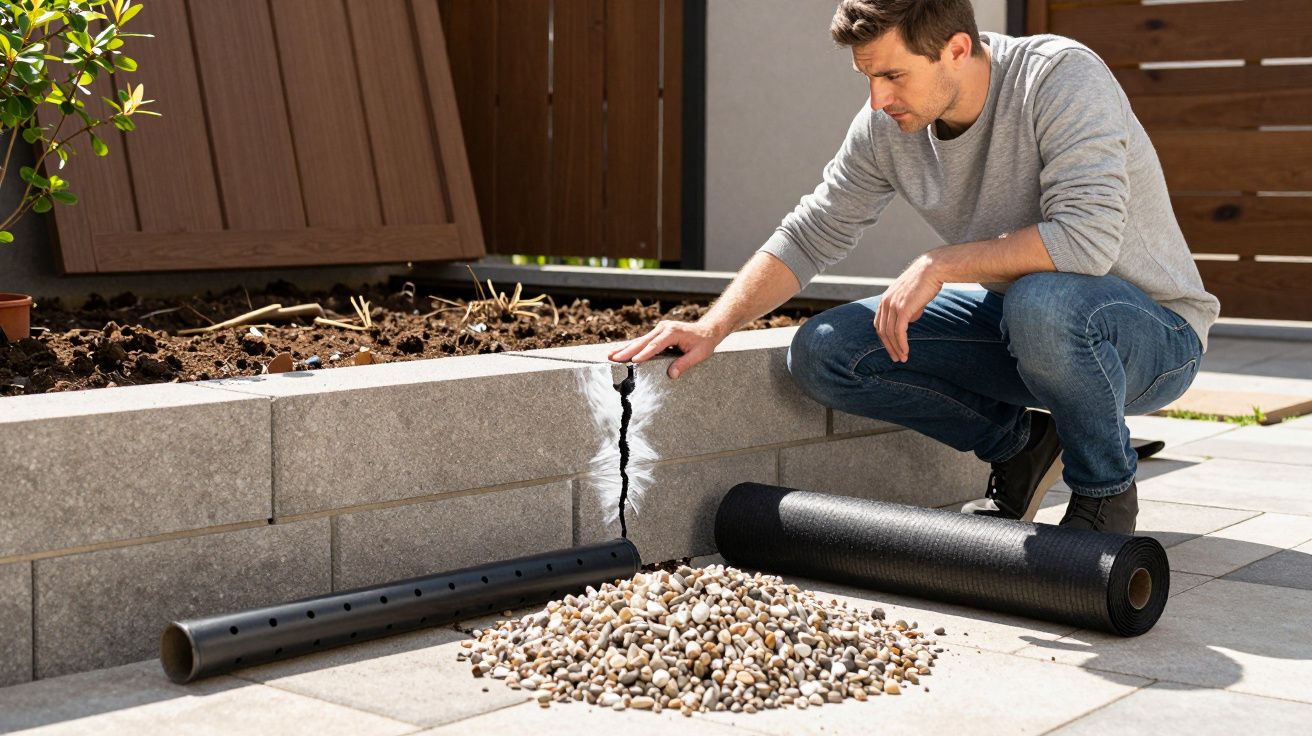
The first time most people notice a retaining wall problem, it’s not dramatic. It’s a hairline crack that wasn’t there last spring, a line of dampness on the patio, a fence panel that suddenly won’t sit straight. In structural garden works, that’s the dangerous stage - when the wall still looks “fine” but the ground behind it has started rewriting the rules.
Because retaining walls don’t just hold soil. They manage water, pressure, and the slow, seasonal movement of everything in your garden.
The mistake that looks tidy - and fails quietly
The long-term problem usually starts with one decision that feels sensible at the time: building a wall that looks solid, then backfilling it with soil and calling it done. No drainage layer. No weep holes. No proper outlet for water to escape. Just earth pressed tight against masonry, sleepers, or blocks.
From the outside, it can look beautifully finished. Straight lines, crisp edging, fresh planting on top. Inside, it’s a sealed container waiting to be filled by the next heavy rain.
Water doesn’t politely soak away. It sits behind the wall, saturates the soil, and turns “a bit of garden” into a heavy, shifting mass. Hydrostatic pressure builds. Freeze–thaw cycles expand tiny gaps into cracks. The wall starts to bow so subtly you only notice when you stare at it too long.
What’s actually happening behind the wall
Think of wet soil as a weight that changes character. Dry backfill behaves like something you can compact and trust. Saturated backfill behaves like a material that wants to move, slump, and push.
A wall without drainage is fighting two forces at once:
- Lateral earth pressure from the soil itself
- Hydrostatic pressure from water trapped in that soil
The second one is the bully. It turns a “strong enough” wall into a wall that is constantly being asked to do more than it was designed for, every time the weather turns.
If you’ve ever seen a wall that has developed a gentle belly - not collapsed, just… no longer straight - you’ve seen water winning slowly.
The signs people dismiss (until the bill arrives)
Most failures don’t begin with a collapse. They begin with small changes that are easy to explain away as age, settlement, or “one of those things”.
Look for these common tells:
- A bulge or slight lean, especially mid-span
- Cracks stepping through mortar joints or blocks
- Efflorescence (white, salty staining) on the face of the wall
- Soft ground or persistent damp patches at the base
- Soil washing out through gaps, or planting beds sinking behind the wall
- Paving lifting or dipping near the top edge
Let’s be honest: most people only take it seriously once a gate starts scraping or the patio begins to slope towards the house. By then, the wall has been under extra load for seasons.
Why this becomes a long-term problem, not a quick fix
Drainage mistakes age badly because they compound. Each winter adds expansion stress. Each storm adds water load. Each spring the soil dries and shrinks, then swells again when wet. That movement loosens what was once tightly packed, creating more pathways for water to sit - and more pressure cycles against the wall.
And once a retaining wall moves, it rarely “moves back”. You might patch a crack, repoint joints, or add a bit of concrete at the toe. Those are cosmetics if the water has nowhere to go.
In practice, long-term means:
- repeated repairs that never quite hold
- a garden that slowly regrades itself in the direction of failure
- damage migrating into adjacent structural garden works (steps, patios, fence posts, even underground services)
The simple design choices that prevent it
Good drainage isn’t fancy, but it is specific. The goal is to remove water from behind the wall before it can build pressure.
A typical drainage approach includes:
- Free-draining backfill directly behind the wall (often clean gravel)
- A perforated land drain at the base, laid to fall and connected to a lawful outfall
- Filter fabric (geotextile) separating soil from gravel to stop clogging
- Weep holes (where appropriate) to relieve pressure and give visible discharge points
- A cap and surface detailing that reduces water entering from above (copings, falls, edging)
One common trap is installing a land drain but skipping the filter fabric. It works for a while, then silts up and becomes an expensive ornament buried in mud.
When you should stop DIY-ing and get it checked
Not every garden wall needs an engineer, but some situations do. Height, loads, and proximity raise the stakes quickly.
Consider professional advice if:
- the wall is over 1 metre and supporting a slope, driveway, or structure
- there are signs of movement and the wall is near your home, boundary, or public footpath
- you’re seeing ongoing water issues (springs, poor drainage, heavy clay)
- the wall supports steps, terraces, or paved areas you rely on daily
A good contractor will talk more about water and foundations than about block choices. That’s usually a reassuring sign.
A quick reality check before you build (or rebuild)
If you’re planning new structural garden works, ask yourself one question that cuts through the aesthetics:
Where does the water go, in February, after three days of rain?
If the answer is “into the soil behind the wall”, you’re not finished designing it. You’re just finishing the front face.
| Risk | What it looks like | What it leads to |
|---|---|---|
| No drainage | Bulging, cracking, damp staining | Progressive movement and rebuild |
| Poor outfall | Standing water, soggy beds | Blocked drains, pressure returns |
| Silted backfill | Weep holes stop running | “Fixed” wall fails again |
FAQ:
- Do all retaining walls need drainage? Nearly all do. Even small walls benefit from a free-draining zone; taller walls should be designed with proper drainage and an outfall.
- Are weep holes enough on their own? Usually not. They help relieve pressure, but without a gravel backfill zone and filtration they can clog and stop working.
- Can I add drainage after the wall is built? Sometimes, but it’s rarely simple. Proper fixes often involve excavating behind the wall, adding drainage layers, and correcting the base conditions.
- Is a crack always a sign of failure? Not always, but cracks plus damp staining, bulging, or recurring movement are strong indicators that pressure is building behind the wall.
- What’s the biggest “hidden” cost of getting this wrong? The knock-on damage: patios, steps, fences, and planting areas can shift as the wall moves, turning one problem into multiple repairs.




Comments (0)
No comments yet. Be the first to comment!
Leave a Comment