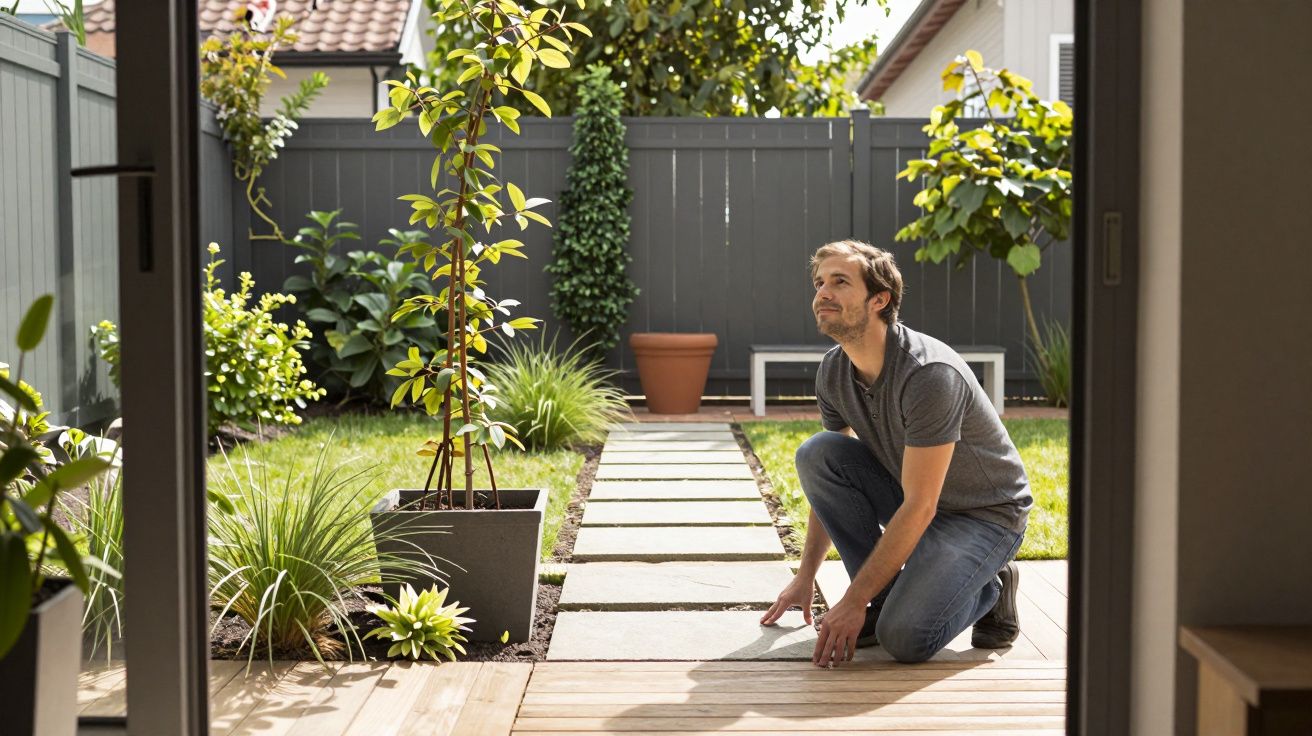
You can spend a weekend doing a full garden redesign and still feel like the space shrank the moment you put the furniture back. Visual depth is the decision that flips that feeling: it’s the deliberate use of lines, layers and focal points to make a short plot read as longer, wider and more interesting. Once you see it, you realise most “small garden problems” are really perspective problems.
The surprise is that it’s rarely about buying more plants or ripping everything out. It’s about choosing one layout move that gives the eye somewhere to travel, rather than stopping it dead at the fence.
Why small gardens feel smaller than they are
Walk into a compact garden and notice what your eyes do. They hit the nearest “full stop”: a straight path ending at a flat fence panel, a patio edge running perfectly parallel to the house, a row of pots lining the boundary like a ruler. The brain reads that as: that’s the limit.
Most small plots are designed for convenience first, depth second. Straight lines are easy to set out, easy to pave, and easy to maintain. They’re also brutally honest about distance.
Visual depth doesn’t lie. It stages.
The redesign decision that makes the biggest difference: stop making everything parallel
The single most effective shift is to introduce a diagonal or offset axis-something that refuses to let the garden be read in one glance. In practice, that means one of these “not quite straight” moves:
- A path that runs slightly diagonal, or steps sideways halfway down.
- A lawn edge that curves gently, so you can’t see its full length from the back door.
- A seating area that’s rotated a few degrees, not squared to the house.
- A bed line that pinches in one place and opens out in another, like a river rather than a corridor.
This works because the eye measures space by comparing edges. When every edge is parallel, the brain calculates the plot like a rectangle on graph paper. When edges shift, the brain starts exploring, and exploration feels like more space.
A lot of people resist this because it sounds like “making it awkward”. Done well, it isn’t awkward at all. It’s subtle. It’s just enough to break the ruler.
How to build visual depth without rebuilding everything
You don’t need to hire a digger to create depth. You need a foreground, a midground and a background, and you need to stop showing all three at once.
1) Give the eye a route, not a view
A small garden benefits from a “journey”. That can be as simple as a stepping-stone line that disappears behind a plant, or a narrow path that widens into a small destination.
Good routes usually have:
- A clear start (from the door or patio)
- A gentle bend or offset
- A reason to continue (light, texture, a seat, a feature)
If you can see the back fence clearly from where you stand most of the time, you’re giving away the ending.
2) Use a focal point that isn’t the fence
Most gardens accidentally make the boundary the star of the show. Visual depth improves when the focal point sits in front of the boundary, with the fence becoming backdrop.
Easy focal points that don’t eat space:
- A slim bench tucked into planting
- A tall pot with a single structural plant
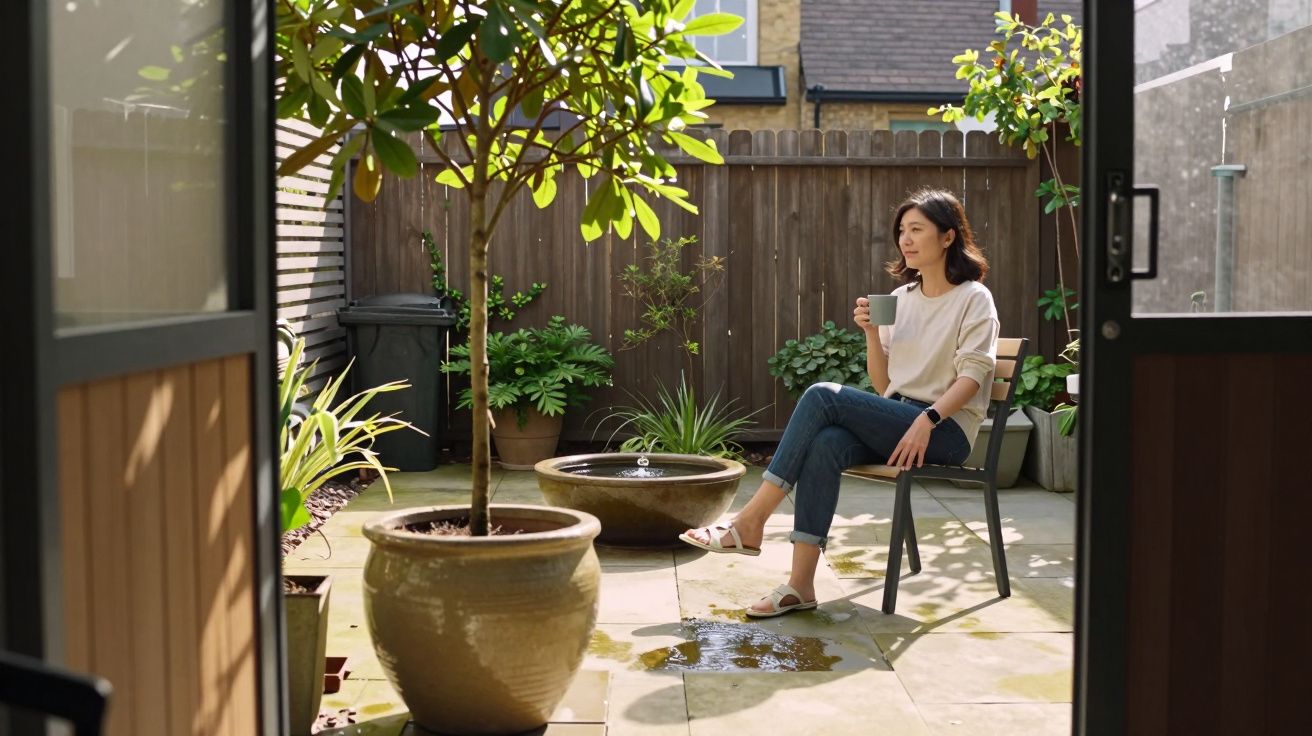
- A small water bowl or bird bath
- A simple vertical feature (obelisks, trellis, narrow mirror used carefully)
Place it slightly off-centre. Symmetry can look neat, but it also shouts “this is the width”.
3) Layer planting like theatre scenery
Flat planting (one row, one height) makes the boundary feel close. Layered planting makes the garden feel deep because it creates overlapping planes.
A simple layering recipe:
- Front: low, soft edge (grasses, groundcover, small perennials)
- Middle: medium mass (shrubs, repeated clumps)
- Back: vertical punctuation (small tree, multi-stem, climber on a frame)
The trick is repetition, not chaos. One of the fastest ways to lose the “twice as large” effect is to place one of everything, everywhere.
The common mistake: widening the patio to “make it usable”
It’s tempting to solve a small garden by paving more of it. The problem is that a large patio reads as one big foreground, and it compresses everything beyond it. You end up with a garden that feels like a room with a narrow strip of planting at the end.
If you want usability and depth, think in zones instead:
- A modest patio near the house
- A second, smaller “destination” further down (a chair, a tiny table, a bench)
- Planting or a screen that partially separates them
Separation is what creates scale. One open slab rarely does.
A quick “before you start” check that changes decisions
Stand at the back door and take a photo. Then ask three blunt questions:
- What is the first hard line my eye hits?
- Can I see the whole boundary in one glance?
- Is there anything that makes me want to walk forward?
If your answers are “the patio edge”, “yes”, and “no”, you don’t need more ornaments. You need a shifted axis and a layered view.
A simple plan you can copy this weekend
If you want an actionable template that doesn’t require a full garden redesign, do this:
- Pick one diagonal: rotate a seating area or skew the path line.
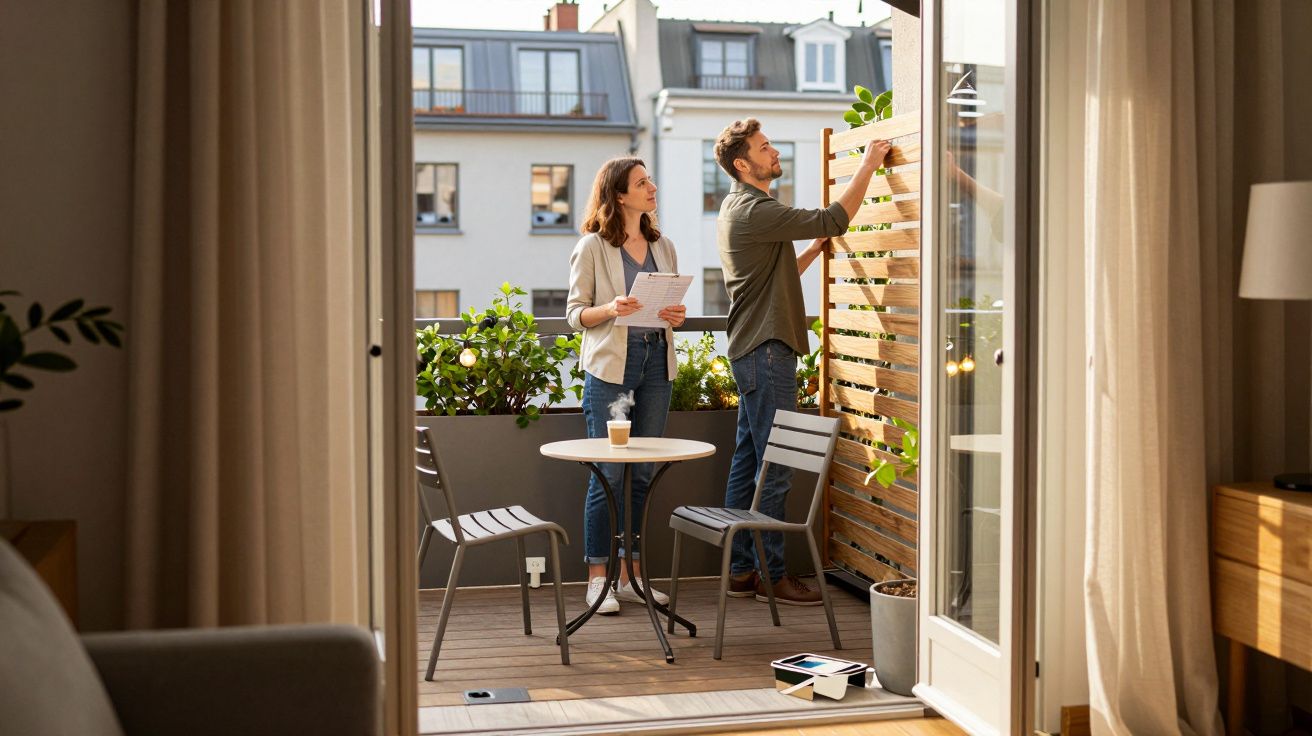
- Create one screen: a tall planter, trellis panel, or a shrub that blocks a direct sightline.
- Add one focal point: place it beyond the screen, slightly off-centre.
- Repeat one plant shape: three to five clumps of the same thing to create rhythm.
The garden won’t physically grow. But it will stop being “a rectangle with a fence” and start feeling like a place with distance.
| Move | What it does | Best for |
|---|---|---|
| Diagonal/offset line | Breaks the “graph paper” feel | Very small, boxy plots |
| Screen/partial block | Creates mystery and a midground | Overlooked fences, short gardens |
| Off-centre focal point | Pulls the eye through the space | Gardens that feel flat |
FAQ:
- Will diagonals make my garden feel messy? Not if they’re subtle. A slight rotation or gentle curve reads as designed, not chaotic-especially if planting is repeated.
- What if I rent and can’t change the paving? Use movable elements: tall planters, trellis in pots, and a bench placed off-centre to create a shifted axis and a screen.
- Do mirrors really help with visual depth? Sometimes. A narrow, weatherproof mirror placed to reflect planting (not the house or a neighbour) can extend depth, but it must be positioned carefully for realism and safety.
- Is this better than just adding more plants? More plants can help, but without layered structure and a broken sightline, extra pots often just clutter the same short view.



Comments (0)
No comments yet. Be the first to comment!
Leave a Comment