
You can spend good money on paving and still end up with a patio that feels oddly “off” when you walk across it. The culprit is often movement flow - the way people naturally enter, cross, pause, and turn in a space - and it gets derailed by one layout mistake that doesn’t look like a mistake until you live with it.
It shows up as little hesitations: a sideways shuffle with a tray, a chair that never quite sits square, a path that everyone cuts across the lawn to avoid. The surface is flat, the slabs are neat, and yet the space fights you.
The subtle mistake: setting the pattern without a “line of travel”
The common error is choosing a paving layout purely for how it looks from above - centred on the house or the boundary - and ignoring the routes people actually take. On paper, a symmetrical grid feels orderly. In real life, your feet don’t move in perfect rectangles.
When the main direction of travel hits lots of joints at awkward angles, the surface reads as busy. Your eyes track every break line, and your body subconsciously slows down, especially near thresholds, steps, and door openings where you want a clean, confident stride.
A patio can be level and well-laid, and still feel like it has “speed bumps” if the lines don’t support how you move.
Why it ruins flow (even when nothing is technically wrong)
1) Your eye keeps “counting” joints
Long, uninterrupted lines feel calm; frequent visual breaks feel fussy. If your layout chops the main walking route into short segments, the brain treats it like a series of micro-decisions. You don’t notice that thought happening, you just feel less relaxed using the space.
This gets worse with high-contrast jointing, multi-tone slabs, or strong linear textures. The paving becomes a pattern you have to read, not a surface you can forget.
2) It creates awkward cuts where you notice them most
If you don’t plan around movement, you often end up with thin slivers of cut slab right at:
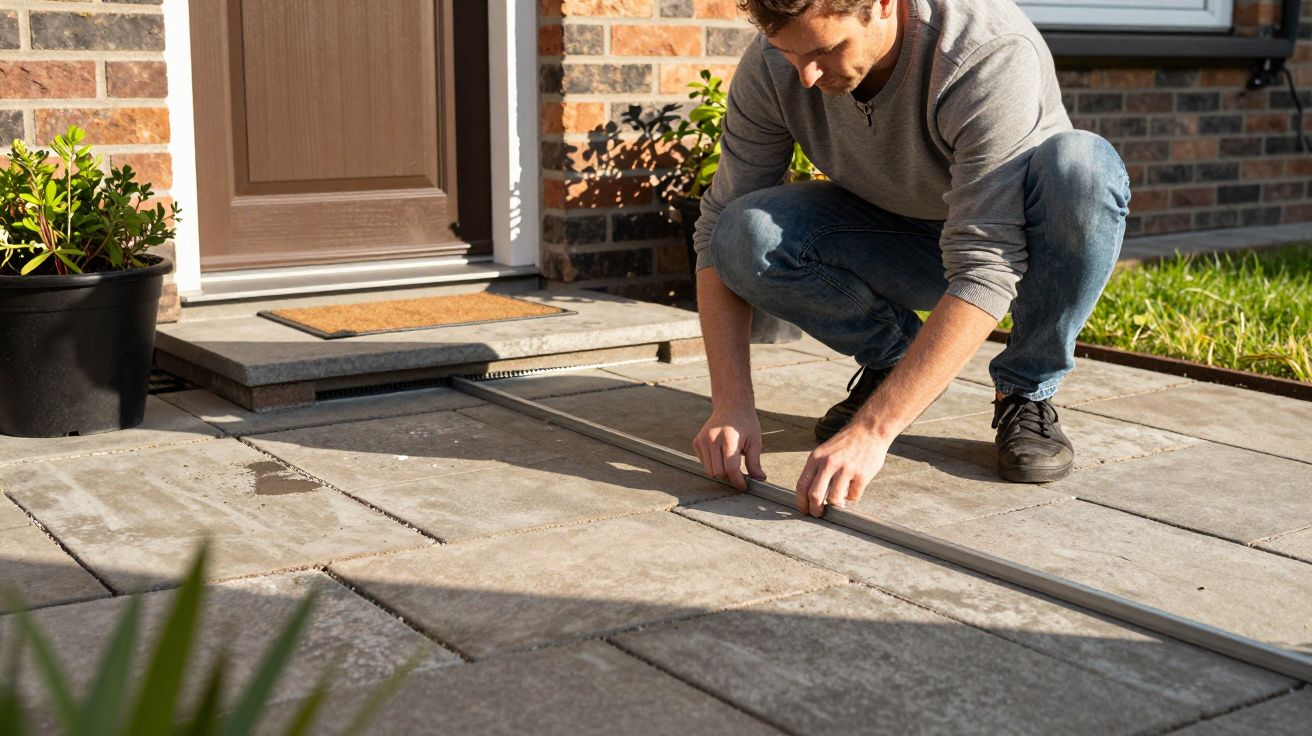
- the door threshold
- the step edge
- the main “crossing point” between house and garden
- the spot where a table naturally wants to sit
Those skinny pieces might be structurally fine if bedded properly, but they look fidgety and draw attention. People step around them without meaning to, which subtly changes the route - and that’s where the weirdness begins.
3) Furniture refuses to “settle” into the space
A table placed on paving should feel anchored, not like it’s perpetually being adjusted. When joints run diagonally through a dining zone or seating area, chair legs land on different planes and visual lines slice through the arrangement.
You end up with the classic patio behaviour: chairs migrate, the rug never sits straight, and you keep nudging things to make them feel aligned.
How to spot it before you commit
Stand where you’ll actually enter the space - back door, side gate, steps - and imagine the first five paces. Then look at your proposed layout and ask two questions:
- Do the main lines guide me where I’m going, or do they fight it?
- Where will the “ugly cuts” land: at edges and borders, or right in my eyeline?
If you’re already looking at an installed patio and thinking “I can’t explain what bugs me,” look for a path where your feet cross the most joints per step. That’s usually the friction point.
The fix is simpler than a full rip-up (most of the time)
You don’t always need to relay everything. Often, the goal is to create one clear line of travel and one clear “zone” where joints stay quiet.
Start with a movement map
Walk it, don’t measure it yet. Note:
- the dominant route from door to lawn/shed/bins
- the natural turning point (often near a corner of the house)
- the pause points (BBQ, table, steps)
That route deserves the calmest paving read: fewer interruptions, bigger uninterrupted spans, and cuts pushed out to the perimeter.
Layout moves that restore flow
- Run the bond with the travel: If it’s a stretcher bond or linear plank look, align the long direction with the main walk line.
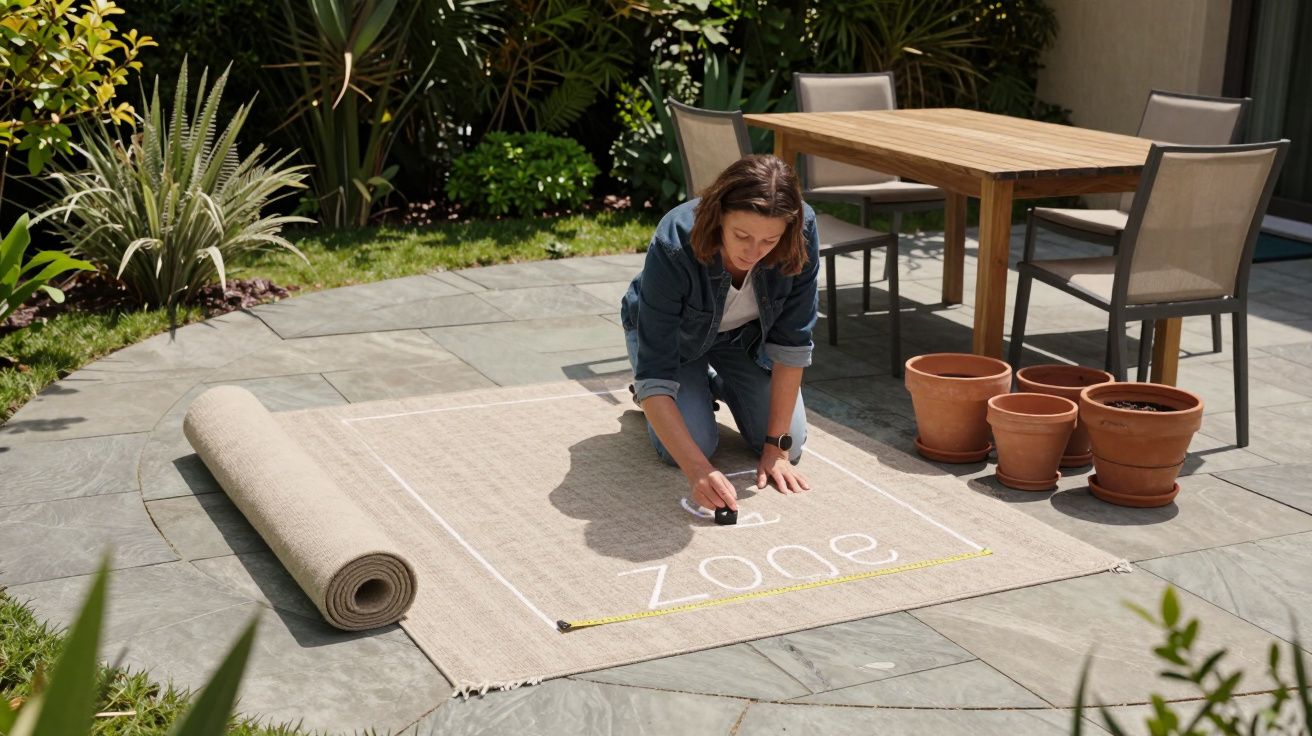
- Use a “quiet zone” under furniture: Aim for larger full slabs beneath a table and chairs, with cuts outside the footprint.
- Hide the awkward cuts: Put slivers at edges against walls, planting, or a soldier course, not in the middle of the patio.
- Break the space on purpose: If your patio serves two functions (dining + path), consider a subtle border or a change of orientation between zones so the jointing looks intentional, not accidental.
When a small redesign beats patching
If your patio forces traffic diagonally across a rigid grid, you can sometimes fix the feeling by adding a defined path strip (matching slab, contrasting border, or even a different module size) that gives the feet and eyes a “yes, this way” cue. It’s not just decoration - it’s direction.
A quick guide: what to align with what
| Situation | What usually works | What often causes the “stutter” |
|---|---|---|
| Door to main garden route | Lines running with the route; clean threshold | Grid that creates lots of joints right at the doorway |
| Dining area | Full slabs under table footprint | Diagonal joints cutting through chair positions |
| Narrow side return | Linear bond lengthways | Crosswise lines that visually shorten and clutter |
The quiet rule that keeps patios feeling expensive
Plan paving like you plan lighting: for use first, looks second - because the best-looking result is often the one you barely notice. When the layout supports movement flow, you stop thinking about where to put your feet. You just walk, place a chair, carry plates out, and the space feels bigger than it is.
That’s the test. Not “does it photograph well from upstairs,” but “does it disappear under normal life.”
FAQ:
- Will changing the laying pattern really make that much difference? Yes. Joint direction and cut placement can change how calm or busy the space feels, even if the slabs and workmanship are identical.
- Is this only an issue with rectangular slabs? It’s most obvious with rectangular formats and plank-style paving, but mixed sizes and setts can also disrupt flow if the busiest pattern lands on the main route.
- What’s the easiest fix on an existing patio? If you can’t relay, create a clear “travel line” with a border strip, a change in orientation, or a dedicated path section that gives the eye a simpler route.
- Where should cuts go ideally? At edges and borders, tucked against walls or planting, and away from thresholds, step noses, and the centre of seating/dining zones.
- Does joint colour matter for flow? More than people think. High-contrast joints emphasise every line, so any misalignment with movement flow becomes more noticeable.



Comments (0)
No comments yet. Be the first to comment!
Leave a Comment