
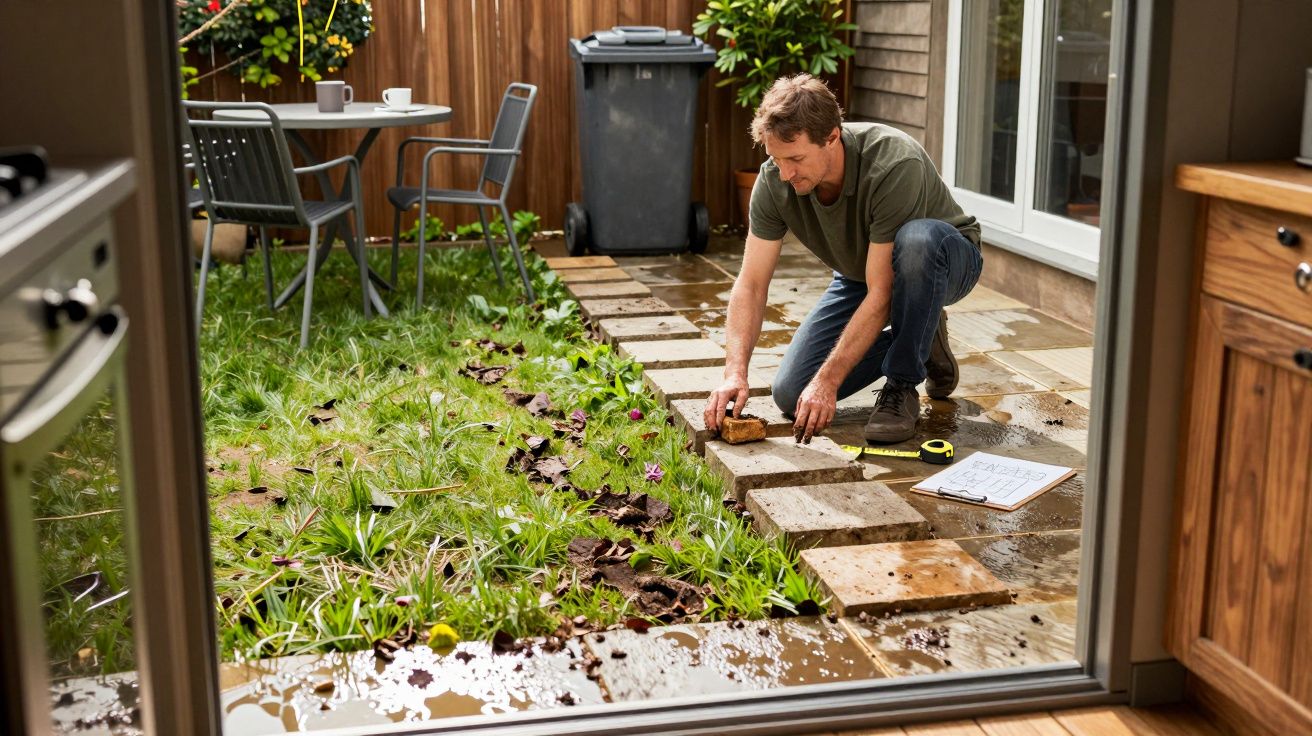
You lay the paving, step back, and it looks like a show garden. Clean lines, crisp joints, that satisfying “done” feeling. Then you add a table and chairs to create functional garden zones - dining here, lounging there - and suddenly the whole space feels like it’s got a stutter in it.
It’s not that the paving is wrong, exactly. It’s that the layout was designed to impress the eye when it’s empty, not to behave when real life turns up with chair legs, planters, and the inevitable BBQ shuffle.
I see it most on patios built from long, slim formats: plank porcelain, linear sandstone, anything that reads like “premium” because the pattern looks deliberate. Until the furniture arrives. Then the pattern starts arguing with everything.
The “premium” pattern that only works when nothing sits on it
Straight-line paving looks sharp because it gives you direction. It pulls your gaze through the garden like a corridor: length, order, a sense of design rather than “we had slabs left over”.
But furniture is its own geometry. Chair legs land where they land. Table bases insist on being centred. Loungers need to sit square to a view, not square to a bond pattern.
So you end up with tiny, irritating moments:
- One chair leg always teeters on a joint.
- The table base straddles two slabs and never feels properly anchored.
- A rug (if you use one) constantly fights the lines beneath it, like two grids competing.
In an empty patio, a running-bond layout reads like calm. Under a dining set, it can read like static.
Why it feels “broken” (even if nothing is actually moving)
This is less about stability and more about visual logic. Our brains love when the floor supports the activity above it. When it doesn’t, it’s subtle, but you feel it every time you step out with a mug of tea.
Three common clashes cause that broken feeling:
- Scale mismatch: long, narrow pavers under small, spindly furniture creates lots of joints in the “wrong” places.
- Direction conflict: paving lines pull one way while the seating faces another, so the zone never settles.
- No hierarchy: the paving pattern is the loudest element, so the furniture looks like it’s floating on top rather than belonging.
If your paving is the star, your dining area becomes an afterthought. That’s backwards. The zone should lead; the surface should support.
A quick test: mark your zones first, then judge the pattern
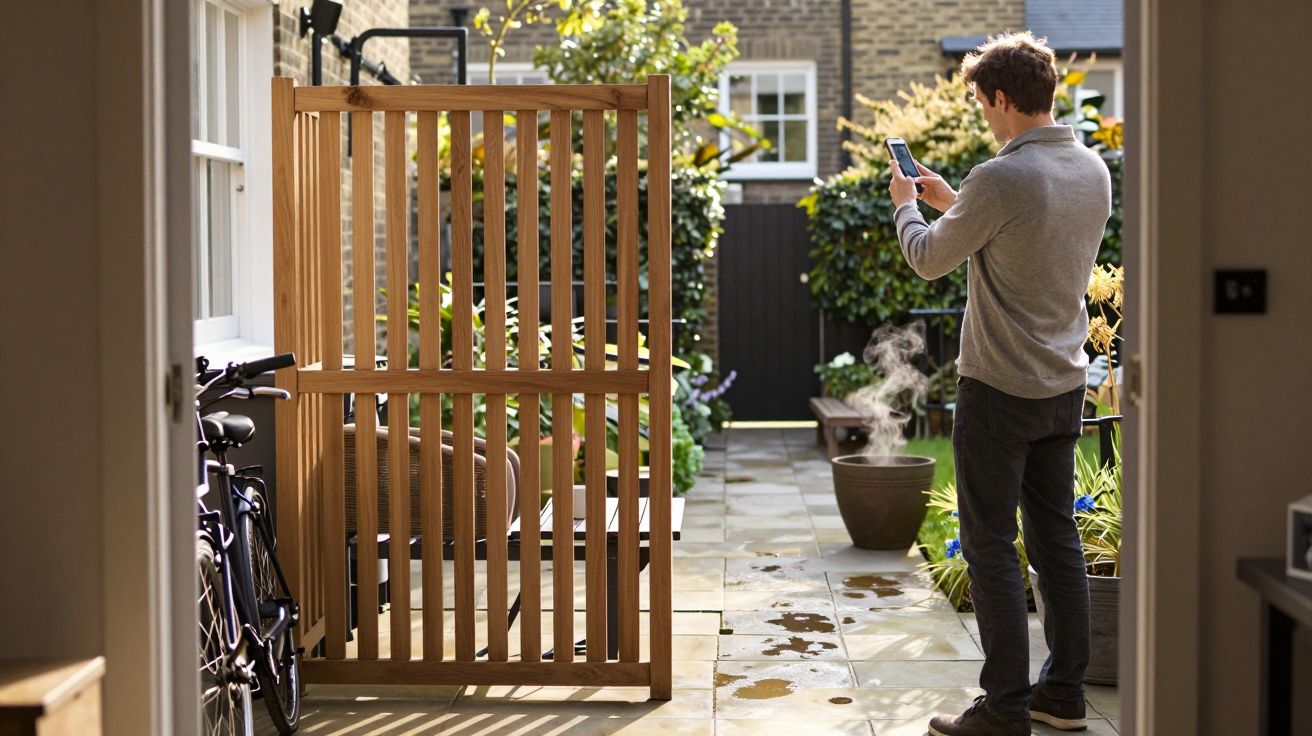
Before you rip anything up, do a low-effort experiment. It’s the outdoor version of moving furniture around a living room before buying a sofa.
- Put the dining table where you actually use it (not where it “should” go).
- Add chairs, and pull them out as if people were sitting down.
- Mark the outline with masking tape, chalk, or spare timber battens.
- Stand at the back door and ask: does the paving help this rectangle feel intentional, or does it slice through it?
Most people discover the issue isn’t the whole patio. It’s that the functional garden zones were never “drawn” into the paving design. The pattern runs straight through, indifferent.
Fixes that don’t require relaying the whole patio
Let’s be honest: nobody wants to lift a finished patio because the chairs look awkward. The goal is to introduce one clear moment of order that tells the eye, “this is the dining area”, even if the paving bond keeps running underneath.
1) Add a border that creates a room
A simple soldier course or contrasting frame around the dining or lounge zone does two jobs: it stops the eye from following endless lines, and it makes furniture look placed rather than parked.
- Keep the border wide enough to read (often 200–300mm, depending on slab size).
- Match it to something else in the garden (edging, step treads, coping) so it looks intentional.
2) Rotate the “zone” with a rug or deck tile insert
If you can’t rotate the paving, rotate the layer above it. An outdoor rug, or a set of click-together deck tiles beneath a bistro set, can create a new grid that your furniture obeys.
The trick is commitment: choose something big enough that all chair legs stay on it even when pulled out. Tiny rugs make the problem worse by introducing yet another awkward edge.
3) Use heavier, fewer contact points
Spindly chair legs are the worst for highlighting joints and lippage. Furniture with sled bases, broad feet, or a pedestal table base visually “weights” the zone and stops the floor pattern from stealing attention.
If you love your current set, even swapping chair glides for wider ones can reduce the constant micro-wobble on joints.
4) Break the lines with planting, not ornaments
A line-heavy paving layout often needs a soft interruption. Not a random statue - something that belongs.
Two large planters placed to define the dining zone edges can stop the eye tracking along the bond. A bench with a planter behind it can do the same for a lounge area. Think of it as punctuation.
If you are still designing: make the paving serve the zones
This is where it gets simple, and slightly annoying: the best paving layouts are drawn from the furniture outwards.
Start with your two or three functional garden zones and decide what “shape” each one wants to be. Dining wants a clean rectangle with breathing space for chairs. Lounging wants a softer rectangle or square that centres a table. Circulation wants a clear path that doesn’t cut through chair pull-out space.
Then choose a paving approach that supports that.
- Dining area: consider a more regular grid (stack bond) or a border frame so the table can sit centred on a predictable geometry.
- Lounge area: larger format slabs reduce joint noise under furniture and make the zone feel calmer.
- Paths and edges: use linear pavers where direction matters, not where people sit.
A good rule: put the “premium” pattern where you walk and look. Put the calmer, simpler format where you sit and live.
What you’re aiming for: one clear story per area
When a patio feels expensive, it’s rarely because the paving is complicated. It’s because the space reads easily. You can tell where you’re meant to eat, where you’re meant to relax, and how you’re meant to move between them.
That’s what breaks when furniture arrives: the story gets muddy.
Fix the story - with a border, a layer, a heavier furniture silhouette, or a planting interruption - and the paving stops performing and starts working.
| Problem you notice | What’s really happening | Quick fix |
|---|---|---|
| Chairs wobble or feel “fussy” | Too many joints under small legs | Wider glides, sled-base chairs, larger rug |
| Dining set looks “lost” | No zone boundary | Contrasting border, big planters to frame |
| Pattern fights the seating direction | Competing lines and sightlines | Rotate zone with rug/tiles; add a frame |
FAQ:
- Is this mainly a porcelain paving issue? No. Porcelain makes it more obvious because joints are crisp and formats are often linear, but the same clash happens with sandstone, concrete flags, and even brick pavers.
- Do I need to avoid long plank-style paving completely? Not at all. Use it where direction is helpful (paths, runs alongside the house) and give seating areas a calmer “room” within it via a border or inset.
- Will an outdoor rug trap water on paving? On dense porcelain it’s usually fine if you choose a breathable rug and lift it occasionally to dry. On more porous stone, avoid leaving it down all winter to prevent staining and algae.
- What’s the simplest design rule if I’m starting from scratch? Place your furniture first (even with tape outlines), then choose slab size and pattern so the dining rectangle sits cleanly within the grid, rather than being sliced by joints.

Comments (0)
No comments yet. Be the first to comment!
Leave a Comment