Patios are having a moment: curved edges, soft corners, pebble-like outlines that look calm and contemporary on a plan. They’re often sold as the missing link between the house and functional garden zones, a way to make outdoor living feel more “designed” and less like a slab. The catch is that the trendiest shapes are also the easiest to furnish badly, because furniture doesn’t bend with them.
You see it in real gardens all the time. The paving looks expensive; the planting is thoughtful; then the table arrives and suddenly the whole space feels awkward, like someone parked a dining set in the middle of a roundabout. It isn’t that curves are wrong. It’s that most outdoor pieces are rectangles pretending they belong anywhere.
The shape that photographs well (and lives badly)
The popular offender is the soft-edged circle or kidney-bean patio: visually light, friendly, and great at breaking up a straight fence line. From the window it reads like a resort detail. On Instagram it’s flawless.
In use, though, that same shape can create dead wedges and uncomfortable circulation. A round-ish edge wants a continuous halo of “spare” space, yet dining wants straight runs: chairs pulling out, serving paths, a clear line from door to seat. When those needs collide, the furniture usually wins-and the patio starts to look like it shrank.
Why furniture ruins it: one mismatch changes everything
Most garden furniture is built on right angles: rectangular dining tables, modular sofas, benches, storage boxes. Drop one of those onto a curved patio and two things happen. First, you instinctively square it to the house, because everything indoors is square; now the patio edge looks randomly positioned, not intentional. Second, the corners of the furniture create leftover slivers that are too small to use but too big to ignore.
The giveaway is how you walk through it. If you’re constantly stepping around chair backs, skirting table corners, or cutting across planting to avoid the “tight bit”, the shape isn’t serving you. It’s forcing you to live around it.
If your table needs to sit off-centre to “fit”, the patio shape is already in charge - and not in a good way.
A quick test before you buy anything (or lay a single slab)
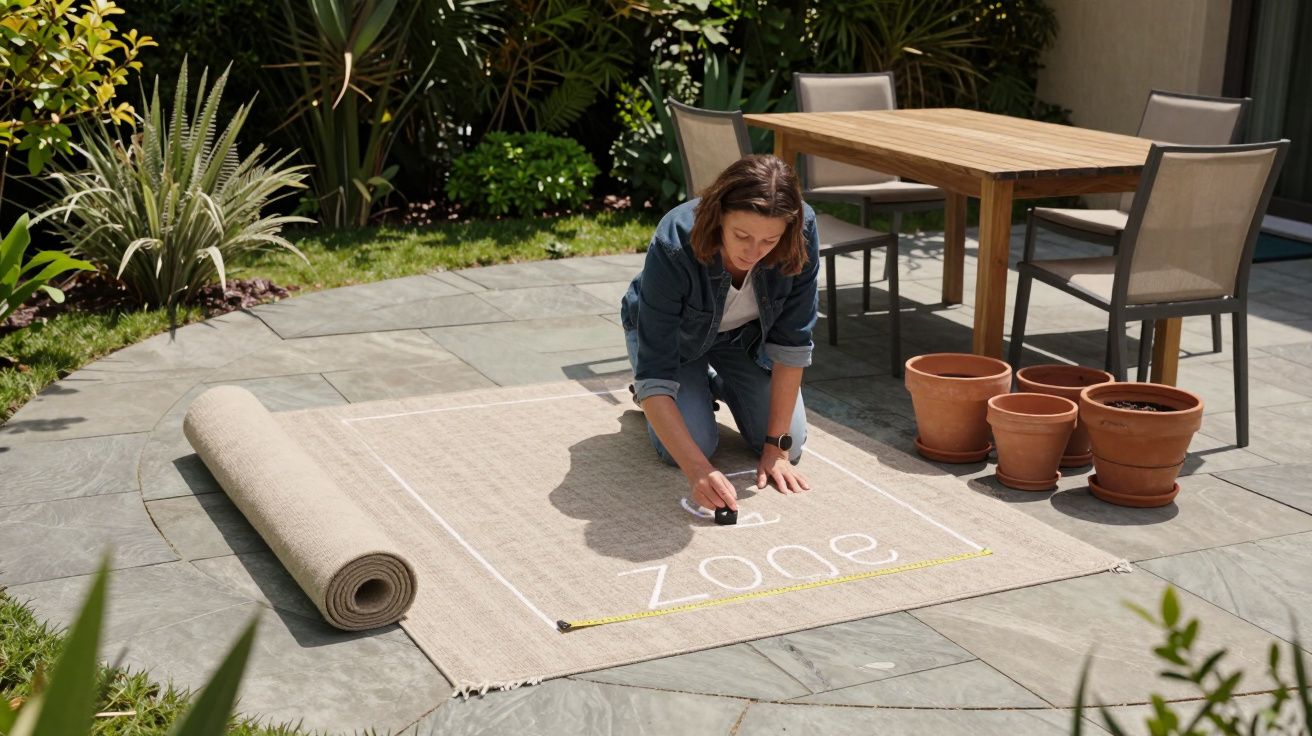
Give yourself ten minutes with a tape measure and chalk (or string). Mark the patio outline on the ground, then sketch your furniture footprint inside it. Don’t be optimistic: add the “chair pull-out” zone and the walkway you’ll actually use.
Use these practical clearances as a sanity check:
- Dining chair pull-out: ~60 cm behind each chair (more if the space is tight and people need to pass).
- Main walkway: ~90 cm for comfortable passing; 60–75 cm is a squeeze.
- Door swing / threshold landing: don’t trap it with a chair back or table edge.
If the only way to make it work is to angle the table, compress the walkway, or push chairs onto the paving edge, the shape is wrong for the job-even if it’s “prettier”.
Make the curve work: design the patio around the activity
Curves work brilliantly when the activity is also “loose”: lounging, firepit seating, sunbathing, small café sets. They struggle when the activity demands a grid: dining for six, outdoor kitchens, long benches, anything modular.
Think in functional garden zones first, then choose the outline that supports them:
- Eating zone: prioritise a rectangle (or a rectangle with softened corners) that matches the table footprint.
- Lounging zone: curves are your friend; they mirror the casual layout of chairs and side tables.
- Transition zone: a narrower path-like terrace can be curved, but keep the walking line direct from door to lawn/steps.
A good compromise is a patio that is mostly rectangular where the furniture sits, with a curve reserved for the edge that meets planting. That way you get the modern softness without sacrificing the logic of how you use the space.
The fix if it’s already built: “square inside, soft outside”
If your patio is already a circle/kidney and you don’t want to rip it up, you can still rescue the look. The move is to create an inner rectangle where the furniture lives, and treat the curved perimeter as a buffer.
Three reliable fixes:
- Create a rug zone: an outdoor rug (or two) defines a straight-edged “room” so the furniture stops fighting the curve.
- Use the wedges on purpose: fill the leftover crescents with a planter, a low herb trough, a lantern cluster, or a single occasional chair-anything that reads intentional.
- Swap one big rectangle for smaller pieces: a round café table, bistro chairs, or a smaller dining table plus a serving trolley often fits better than forcing a full-size set.
What you’re doing is giving the eye a clear hierarchy: furniture first, shape second. Without that, the curve becomes visual noise.
Common mistakes that make a trendy patio feel cheap
You can spot the problem patterns quickly. They’re rarely about taste; they’re about geometry.
- Oversized dining on a curved edge: chairs end up half-on/half-off, and the whole setup looks temporary.
- Furniture pushed to the perimeter “to make space”: this leaves an empty centre that feels like a waiting room.
- A curve with no anchor: if there’s no focal point (fire bowl, tree, parasol, feature pot), the curve reads like a random decision.
If you want the curve, give it a job. If you want a dining terrace, give it straight lines to do the work.
A simple decision guide: choose the shape like you choose the table
Before committing to a fashionable outline, answer one question: What is the default setting of this space on an average day? Not the party version. The Tuesday version.
| Your default use | Patio outline that behaves | Furniture that suits it |
|---|---|---|
| Dining most days | Rectangle / softened rectangle | Rectangular or extendable table |
| Lounging + firepit | Circle / kidney / arc | Separate chairs, round side tables |
| Mixed, flexible | Rectangle with one curved edge | Smaller table + movable seating |
If you build for the Tuesday version, the patio will feel bigger, calmer, and easier to keep tidy-because you won’t be constantly rearranging it to stop it looking “off”.
FAQ:
- Is a circular patio always a bad idea? No. It’s excellent for informal seating, firepit layouts, and small café sets. It becomes difficult when you expect it to function as a straight-lined dining room.
- Can I make a kidney-shaped patio work with a dining set? Sometimes, if you size the patio around the table footprint and keep generous clearance behind chairs. The safer route is a rectangle where the table sits, with curves reserved for planting edges.
- What’s the quickest fix if my furniture looks awkward on my curved patio? Define a straight-edged “room” with an outdoor rug, then use the leftover curved wedges for planters or lighting so they look intentional rather than accidental.




Comments (0)
No comments yet. Be the first to comment!
Leave a Comment