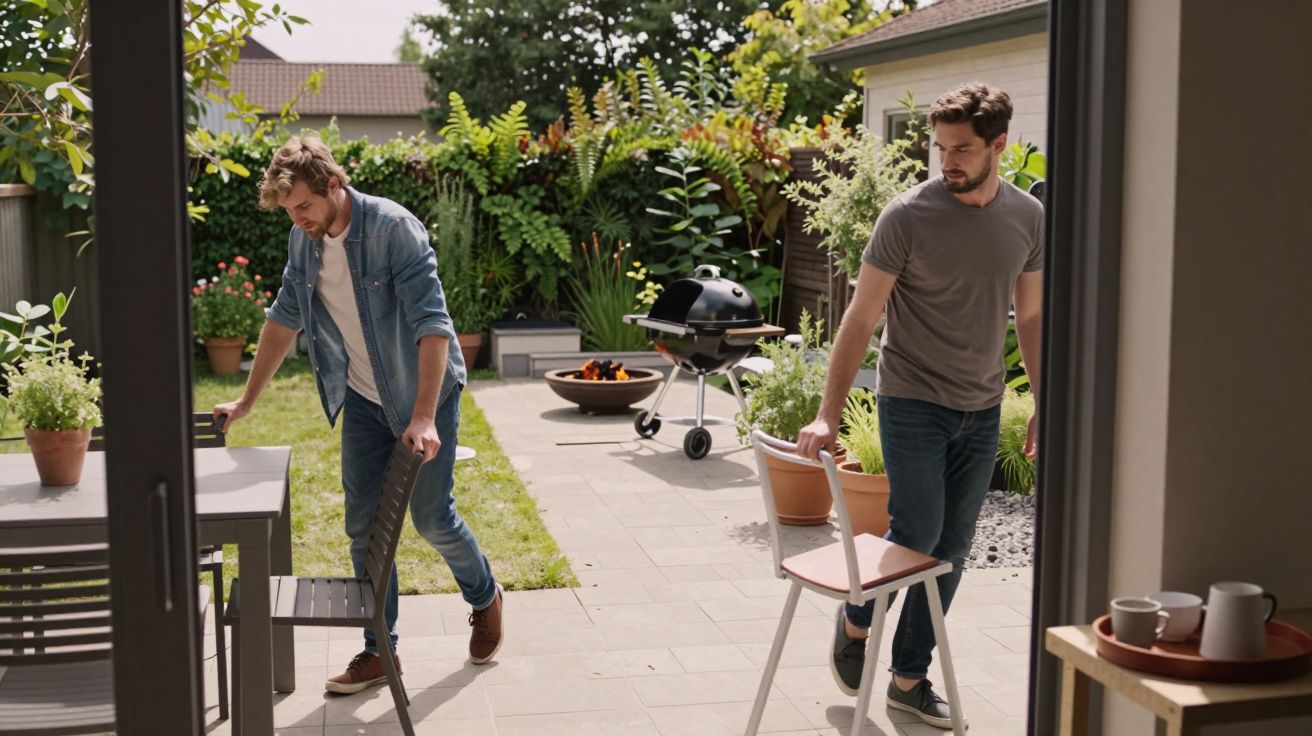
You can design patios to look like the perfect little stage for entertainment areas: a tight circle of chairs, a dining set tucked beside the house, a fire pit “conversation zone” in the corner. It photographs brilliantly, and it feels sociable on day one. Then the first real gathering arrives, and suddenly nobody can pull a chair out, the barbecue lid won’t open, and the only route to the kitchen is through someone’s knees.
This is the quiet failure of the “everything has a zone” layout. It doesn’t break because it’s ugly; it breaks because it forgets movement, heat, and the fact that people don’t sit still.
The moment it stops being a patio and becomes an obstacle course
The tell is always the same. You find yourself doing that little sideways shuffle with a plate, apologising as you squeeze past a chair back, trying not to tip a drink into someone’s lap. The space may be big enough in square metres, but functionally it’s too small because the circulation is missing.
Most “social” plans accidentally spend the whole patio on furniture footprints. What they don’t budget for is the space furniture needs to be used-chairs pulled out, doors opened, people standing up to chat, and the inevitable drift towards the food.
The chair test (and why it’s harsher than it sounds)
A chair isn’t one rectangle. It’s a rectangle plus a halo of movement. If you can’t pull it out without scraping pavers or bumping another chair, you’ve built a display, not a dining spot.
Do a quick, unsentimental check:
- Can someone push a chair back and stand up without hitting anything behind them?
- Can two people pass each other without one turning sideways?
- Can you carry a tray from the door to the table without stopping?
If any of those answers are “only if everyone cooperates,” the layout will collapse the moment you have more than four people.
The classic “looks social” trap: too many focal points
Designers love a focal point because it gives a plan confidence. Homeowners love them because they feel intentional: fire pit, outdoor sofa, dining set, barbecue station. The problem is that patios don’t behave like open-plan living rooms. Outside, focal points compete with wind direction, sun position, and smoke.
So the plan ends up trying to serve three masters at once, and none of them works well. The dining table is too close to the grill, the sofa area is in the main walkway, and the fire pit becomes a heat bottleneck that people skirt around like it’s a puddle.
“It felt like we’d made loads of seating,” a neighbour told me after their first summer party, “but everyone stood in the doorway and the corner by the drinks.”
That’s not a personality problem. That’s a layout problem.
Why traffic flow is the real social feature
People don’t gather where you tell them to. They gather where it’s easy to stand, where they can see faces, and where they don’t feel trapped. The most sociable patios have one boring, brilliant thing: a clear route that doesn’t cut through the middle of the action.
Think of it like a runway from the house to the garden, and build everything else around it. If guests have to cross the dining zone to reach the lawn, the dining zone becomes a corridor. If the barbecue is in the narrowest pinch point, that pinch point becomes a queue.
A simple circulation map you can do in five minutes
Before you move a single slab or buy a new set:
- Mark the main exits from the house (usually kitchen and lounge doors).
- Mark where people actually go (barbecue, drinks, bins, lawn, loo route back inside).
- Draw the most direct walking lines between them.
Where those lines cut through your “conversation area,” you’ve found the future problem. Don’t fight it-re-route it.
Heat, smoke, and the furniture that makes you hate your own fire pit
A fire pit is the ultimate “this will be so cosy” purchase. It also turns usable space into dead space when it’s placed like a coffee table, surrounded too tightly by seating.
You need distance for comfort, but you also need a place for people to stand without roasting. When that buffer doesn’t exist, guests perch on the very edge of chairs and then migrate-usually back towards the house, where the layout becomes even more congested.
A better rule of thumb is to treat heat features like you would a cooker hob indoors: give them clearance, and don’t put the main walkway through the hot zone. If smoke direction is unpredictable, keep the seating flexible rather than built-in and fixed.
The “unusable” tipping points to watch for
These are the small design choices that quietly push a patio over the edge:
- Built-in seating everywhere. It looks tidy, but it locks the plan. Real entertaining needs rearranging.
- A dining table placed as a centrepiece. Centrepieces are for vases; tables need edges and escape routes.
- No landing space by the back door. People step outside and immediately hit chairs, planters, or a narrow corridor.
- One narrow pinch point. That’s where every bottle-necked conversation, spilled drink, and awkward squeeze will happen.
- Outdoor kitchen/BBQ facing the seating. The cook becomes theatre, yes-but also a barrier everyone crowds around.
None of this means you need a bigger patio. It usually means you need fewer “zones” and more slack.
A layout that stays social when people actually arrive
The most reliable fix is to decide what your patio is primarily for, then let everything else be secondary. If you want dinners, prioritise the dining area and make the lounge lighter and movable. If you want lounging, shrink the table and plan for people eating with plates on laps sometimes. The mistake is trying to run both at full size.
Here’s a practical approach that tends to work:
- Put the dining area closest to the door you use for food, but not directly in the doorway path.
- Keep a clear main route at the patio edge, not through the middle.
- Treat the barbecue as a work zone, with standing space beside it so the cook isn’t pinned.
- Use light, movable seating (two extra chairs you can pull in, not a massive fixed bench).
- Leave one patch of patio intentionally “empty” so the space can breathe when everyone stands up at once.
It sounds almost too plain to be good design. Then you host, and you realise the empty patch is where the best conversations happen-because nobody has to fight the furniture to be there.
The quick reset: what to move before you buy anything
If your patio already feels a bit tight, start with a no-spend experiment. Pull everything away from the main walking lines and see what remains.
Try this in order:
- Create one clear path from door to garden/bins that stays clear even with chairs pulled out.
- Rotate the dining table so chair backs don’t face the route.
- Move the fire pit so seating isn’t blocking access to anywhere important.
- Remove one item (often a side table, a bench, or an extra chair) and notice how much the patio relaxes.
You’re not making it less social. You’re making it possible for people to circulate without breaking the spell.
FAQ:
- Can a small patio still handle entertainment areas? Yes, but it needs one priority use (dining or lounging) and flexible pieces. Trying to do both at full size is what makes it fail.
- What’s the fastest sign my layout won’t work? If you can’t pull out a chair and stand up without hitting something, it’ll feel unusable once guests arrive.
- Where should the barbecue go? Near the kitchen route, but out of the main traffic line, with standing space beside it so people aren’t forced to queue in a walkway.
- Is built-in seating a bad idea? Not always, but too much of it removes flexibility. One fixed bench can work; an all-around built-in “U” often turns the patio into a trap.
- Do I need a bigger patio to fix this? Usually not. Removing one “zone” and restoring circulation space solves more than adding square metres ever will.




Comments (0)
No comments yet. Be the first to comment!
Leave a Comment