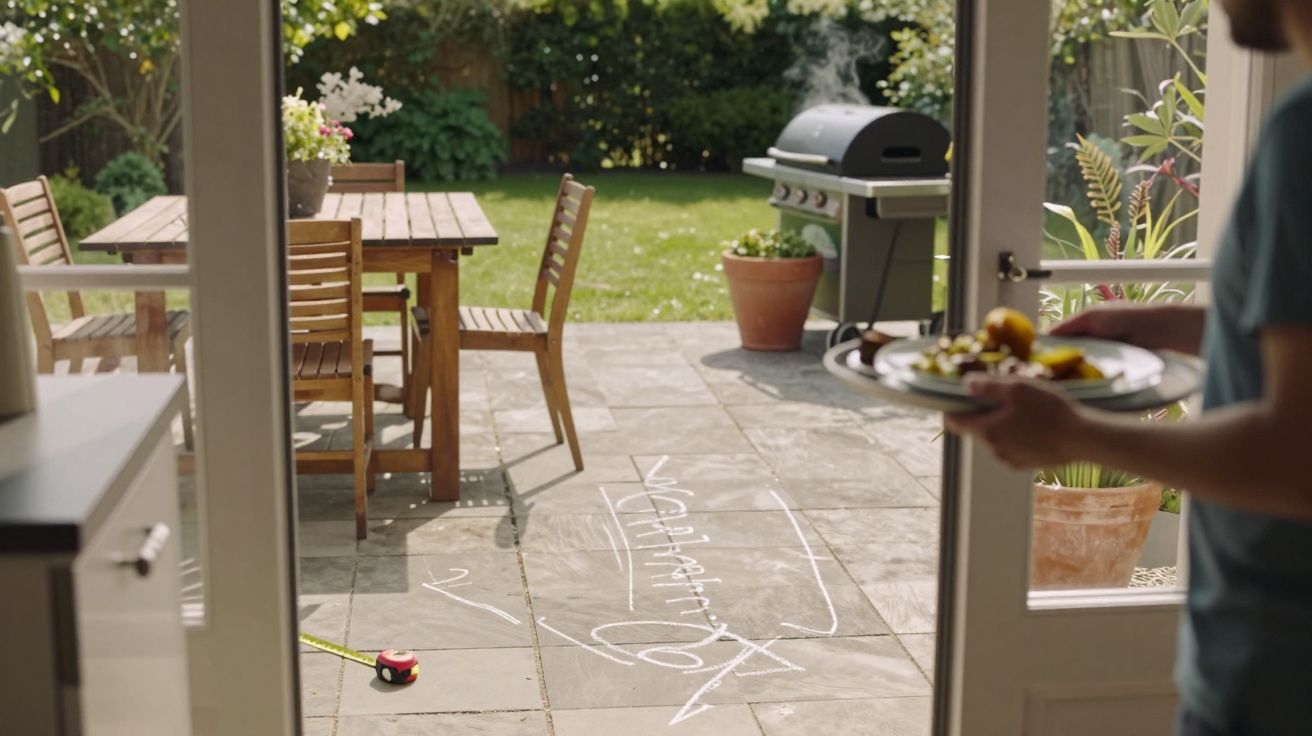
You notice it on the third barbecue, when everyone keeps doing that little sidestep like they’re dodging an invisible dog. Patios are meant to make outside life easier, yet one tiny choice can quietly wreck movement flow between the kitchen door, the seating, and the garden. It matters because “awkward” outdoors doesn’t just feel cramped - it changes how often you use the space at all.
I’ve watched people spend thousands on stone and furniture, then end up carrying plates in a tense, shuffling line because the route pinches in exactly the wrong place. No one says it out loud. They just stop hosting, or they start apologising for their own garden.
The small decision that breaks everything: where the path actually goes
Most patio plans are drawn like a pretty picture: dining set here, planter there, maybe a fire pit like a promise. Real life draws it differently. Real life is someone with a tray, a child with a football, and a friend arriving two minutes late trying to squeeze past the chair legs without knocking over a drink.
The killer is a “desire line” you didn’t design for: the shortest, most natural route people will take. If your patio forces that route through the narrowest point - between the table and the steps, or through the only door swing zone - the whole layout becomes a constant micro‑obstacle course. The space can be generous on paper and still feel stingy underfoot.
Movement flow is a home comfort, not a design trend
You can have the best paving in the world and still hate being outside if you have to keep saying, “Sorry-just past you,” every 30 seconds. Movement flow is the invisible comfort of a space: how bodies pass, pause, turn, and carry things without performing a little dance.
Think about the jobs your patio has to do, not just the vibe.
- Kitchen → table with hot food and sharp corners avoided
- Back door → garden without cutting through a “private” seating moment
- Bins, washing line, shed access that doesn’t become a daily irritation
- Kids and dogs having a loop, not a dead end that funnels into shins
If any one of these routes crosses your main seating zone, you’ll feel it as friction. And friction is the reason patios become decorative rather than lived-in.
The pinch points that ambush you later
A patio rarely fails in the middle; it fails at the edges. That’s where doors, steps, thresholds, and furniture create the bottlenecks that dictate everything else.
The most common culprits
1) A table placed on the main thoroughfare
If you can’t walk around it comfortably when chairs are pulled out, you’ve built a blockage. You might manage it as the homeowner because you know the moves. Guests don’t.
2) Steps that land in the wrong place
A step down from the house that drops you directly into a chair back or a tight corner forces people to slow, turn, and apologise. Multiply that by every cup of tea, and suddenly outside feels like effort.
3) The “pretty corner” that steals the turning radius
That oversized planter, storage box, or L‑sofa can be the thing that turns a smooth route into a narrow channel. The space isn’t just smaller; it’s more stressful.
4) A path that starts too late
If the route to the lawn begins after you’ve already crossed the dining area, you’ve made your guests walk through the action to get anywhere else. It’s the garden equivalent of placing the hallway through the living room.
A quick test before you lay anything
Do this with a tape measure, chalk, and brutal honesty. It’s ten minutes that saves you years of muttering.
- Mark the door swing fully open, and pretend you’re holding a tray.
- Chalk the natural route from door to table, table to lawn, lawn to shed/bins.
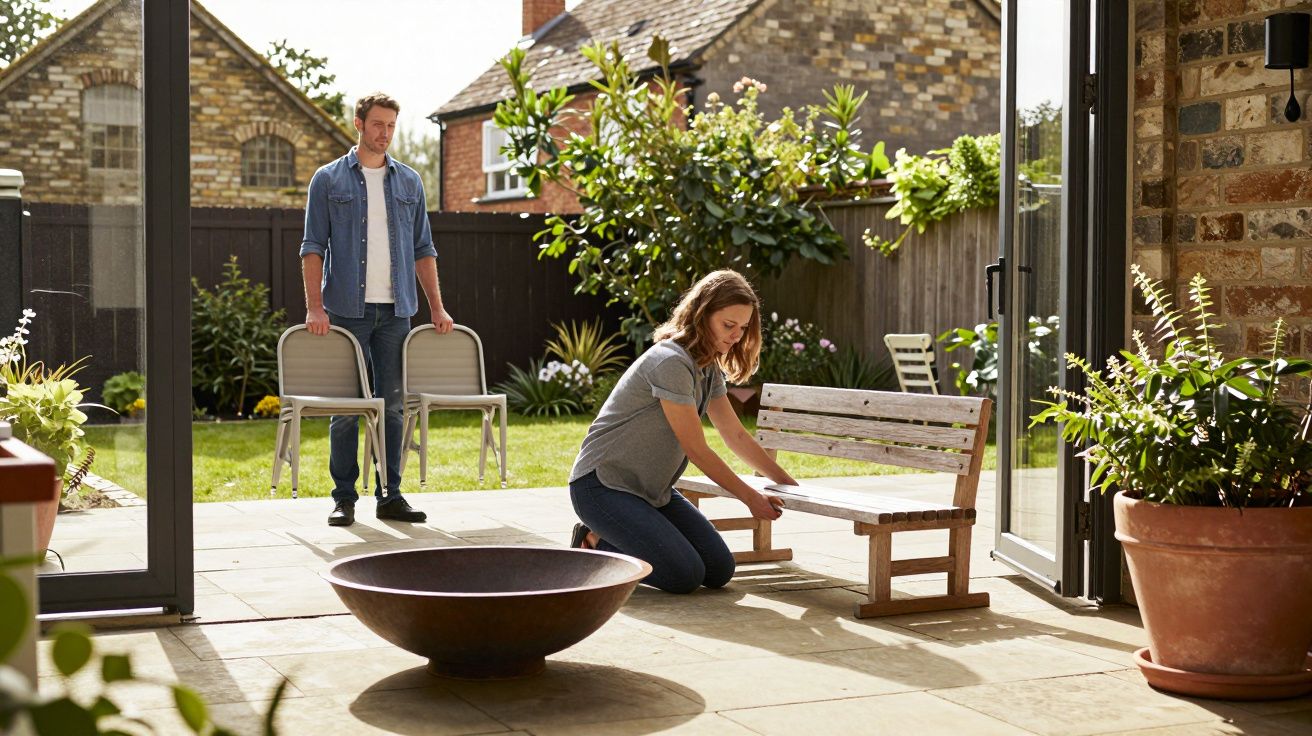
- Place “ghost furniture” using boxes or garden chairs to mimic the real footprint.
- Walk it twice: once empty‑handed, once carrying something bulky.
If you find yourself turning sideways, doing a little shuffle, or pausing to let an imaginary person pass, your patio is telling you the truth. Listen before the grout does.
The numbers that keep it human
You don’t need a textbook; you need enough space for two adults to pass without performing manners. As a rough guide:
- Main routes: aim for about 1.0–1.2m clear where possible.
- Secondary routes: 800–900mm can work, but expect “single file” moments.
- Behind dining chairs: you want enough room for chairs pulled out and someone walking past - otherwise the route vanishes the second you sit down.
What catches people out is measuring only the patio and forgetting the working size of furniture. Chairs don’t live tucked in. People don’t glide. Coats, bags, and elbows exist.
How to fix it without ripping it all up
If your patio is already down and the flow feels wrong, you’re not doomed. Often it’s a layout problem, not a paving problem.
Small changes that restore movement flow fast
- Rotate the dining set so the long side runs parallel to the main route, not across it.
- Move the “big item” (planter, storage, barbecue) out of the turning zone near steps and doors.
- Create a clear lane with a narrow path or different paving strip that quietly tells feet where to go.
- Stop furniture touching boundaries: leaving a deliberate gap by a wall or edge can become the walkway you didn’t know you needed.
If you’re redesigning from scratch, treat the route like the first piece of furniture. Lay out the “corridor” first, then place everything else around it like it’s a real room - because it is.
The patio that feels calm has a secret: it doesn’t argue with your body
When a patio works, nobody comments on it. People just move. Plates arrive without drama, kids loop without collisions, and conversations don’t pause for someone to squeeze through.
That’s the quiet standard worth building to: a space that doesn’t require choreography. The decision looks small when you’re choosing where to put the table or how wide to make the landing, but it’s the kind of small that decides whether you live out there - or merely look at it through the glass.
FAQ:
- What’s the biggest cause of bad movement flow on patios? Putting the main seating or dining area on the shortest route between the house and the garden. It turns everyday journeys into constant squeeze points.
- Do I need a huge patio for good flow? No. You need clear routes and sensible furniture placement. A smaller patio with a defined walkway often feels better than a larger one filled edge-to-edge.
- How can I test a layout before buying furniture? Mark out furniture sizes with boxes or tape, then walk the key routes while carrying something bulky (like a laundry basket). If it feels fiddly, it will be worse with guests.
- Should the path to the lawn cut through the dining area? Ideally not. Give people a way to reach the garden without interrupting whoever is seated, even if it’s a narrow side route.
- What if my door opens straight onto a table zone? Create a landing area: keep the first metre outside the door as clear as possible, then place dining or lounge zones beyond that buffer.


Comments (0)
No comments yet. Be the first to comment!
Leave a Comment