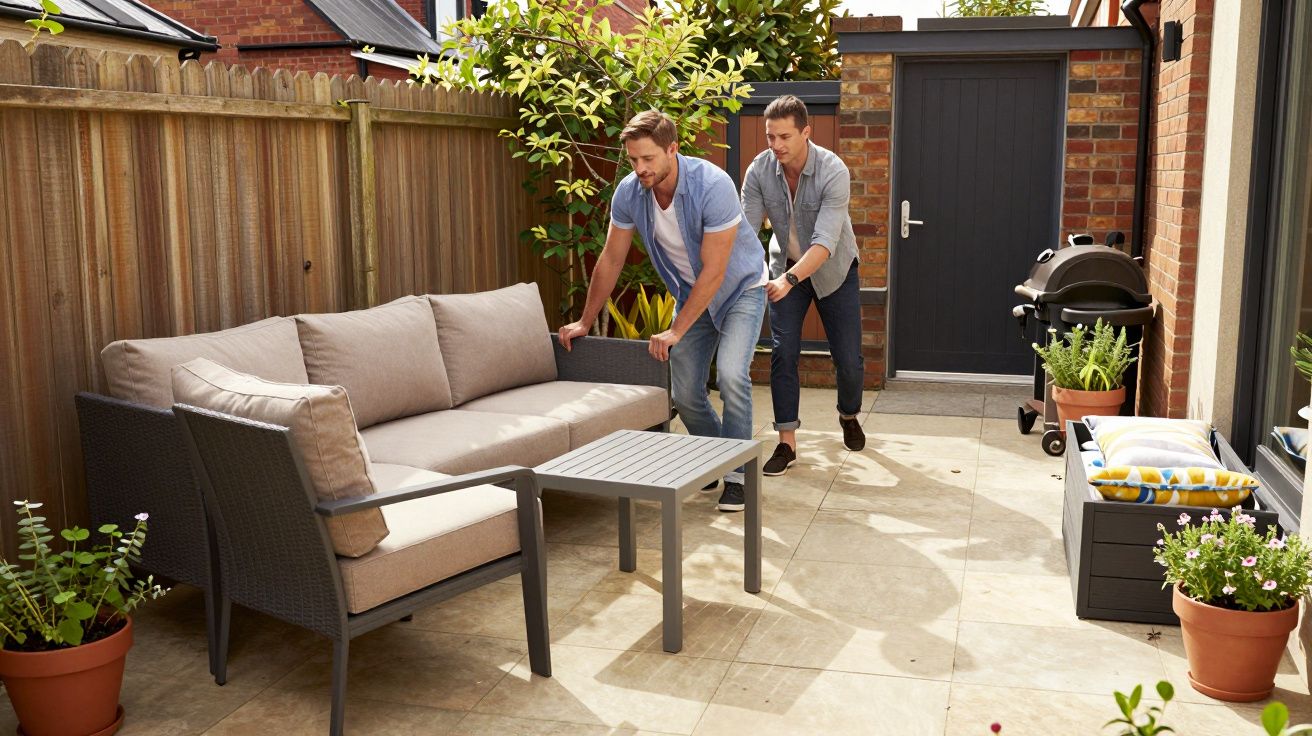
Outdoor seating areas are meant to make the garden feel easy: somewhere to eat, talk, read, work, or let the kids crash after the paddling pool. But one common arrangement quietly breaks that promise, especially if you’re aiming for multi-purpose outdoor layouts that can cope with British weather, surprise guests, and a week that never runs to plan.
It looks polished on day one, then you realise you’ve built a set: one scene, one use, and everything else becomes awkward. The problem isn’t the furniture. It’s the layout.
The layout that kills flexibility
It’s the “fixed lounge vignette”: an L‑shaped corner sofa pushed hard against a wall or fence, a coffee table locked in the middle, and a fire pit or dining set sitting elsewhere like a separate room. You’ve created a dead centre and a single path around it, so the whole space becomes a one‑way system.
The giveaway is how often you say, “We’ll just make do.” Make do with a laptop on your knees. Make do with plates balanced on armrests. Make do with extra guests perched on the edge because there’s nowhere to pull a chair in.
A rigid outdoor setup doesn’t fail because it’s uncomfortable. It fails because it can’t change shape fast enough.
Why it feels fine until you actually live with it
The one-direction conversation
Corner seating points everyone inwards at the coffee table. Great for drinks, less great for mixed groups where half want to eat and half want to chat. When you add one or two extra chairs, they end up floating at odd angles, like they’re not invited.
It also makes you commit to “lounge mode” even when the moment is “dinner mode”. Your garden becomes a pub snug without a bar.
The blocked-through route
In real gardens, people cut across. They go to the tap, the barbecue, the back door, the shed, the washing line. When a big fixed unit sits in the middle or hugs the only long edge, circulation narrows and you start walking around furniture like it’s a parked car.
That’s when outdoor seating areas stop feeling generous, no matter how big the patio is.
The table mismatch
Coffee tables are brilliant until you want to eat properly. Dining tables are brilliant until you want feet up. If your layout forces you to choose one table type forever, you’ve made a single-purpose room outdoors.
Multi-purpose outdoor layouts work when surfaces can change role: serving, dining, working, games, crafts, potting, prep.
The simple test: if these three things are hard, it’s too fixed
Walk outside and try:
- Add two extra people without blocking the path to the door.
- Switch from drinks to dinner without carrying everything back inside.
- Make shade without moving the entire set.
If any of those turns into a shuffle of cushions and apologies, the layout is doing what it was built to do: stay still.
The flexible alternative: build zones, not a “set”
You don’t need more furniture. You need fewer commitments.
Step 1: Put the “anchor” where it doesn’t trap you
Choose one heavy piece to be the anchor (often a small sofa or bench), then place it so there’s a clear route behind or beside it. Aim for at least a comfortable walking lane, not a squeeze. If the only good view is along the fence, fine-just don’t pin the whole arrangement into that edge.
A flexible anchor supports everything else. A trapped anchor dictates everything else.
Step 2: Use light seating you can pull in, not “spares” you hate
Instead of a massive L-shape plus two sad folding chairs, go for a smaller main seat plus four to six moveable options. Stools, stackable chairs, or a bench that can face either way change the entire feel of the space.
Good moveable seating does three jobs: - tops up guest numbers, - turns a coffee setup into a dining setup, - shifts with sun, shade, and wind.
Step 3: Choose one table that changes height (or one that nests)
This is the quiet upgrade that makes outdoor seating areas feel like a real room. A lift-top coffee table, a bistro table that can tuck in close, or nesting tables that expand when food arrives keeps the layout from being locked to one activity.
If you’re set on a dining table, keep it compact and leave breathing space around it. The table should invite movement, not block it.
A better “default” arrangement that suits UK gardens
Here’s a layout that behaves well in small and medium patios:
- Sofa or bench against a boundary but not jammed into the corner.
- Two chairs opposite, angled slightly so conversation works whether you’re eating or lounging.
- A moveable table (nesting or lift-top) that can sit central, then slide closer to the sofa for dinner.
- One clear path from back door to lawn/barbecue/tap that doesn’t cut through the middle.
It looks less like a showroom. It lives better.
The overlooked detail: storage is what makes it multi-purpose
Multi-purpose outdoor layouts only stay flexible if you can clear and change them quickly. If moving things is a faff, you won’t do it.
A small deck box or bench with storage earns its keep by hiding: - chair cushions (so you’ll actually move chairs), - throws (so evenings don’t end early), - a clip-on parasol base or side table.
When the weather flips-which it will-speed matters more than perfection.
Quick comparison: rigid set vs flexible plan
| Feature | Fixed lounge “set” | Flexible zone layout |
|---|---|---|
| Extra guests | Awkward add-ons | Chairs pull in naturally |
| Eating outside | Balancing act | Table adapts to meals |
| Daily use | One mode | Many modes |
Small changes that rescue an existing setup
If you already own the big corner unit, you can still get your garden back.
- Pull it off the fence by 10–20 cm to create air and a sneaky route for cables, cleaning, and movement.
- Swap the coffee table for nesting tables or a lift-top.
- Add two matching light chairs you actually like using, then stop pretending the dining set is “for later”.
- Create one “parking spot” for moved pieces (against a wall, near a planter) so the garden doesn’t look messy when you reconfigure it.
The goal isn’t constant rearranging. It’s knowing you can rearrange it in thirty seconds when life changes shape.




Comments (0)
No comments yet. Be the first to comment!
Leave a Comment