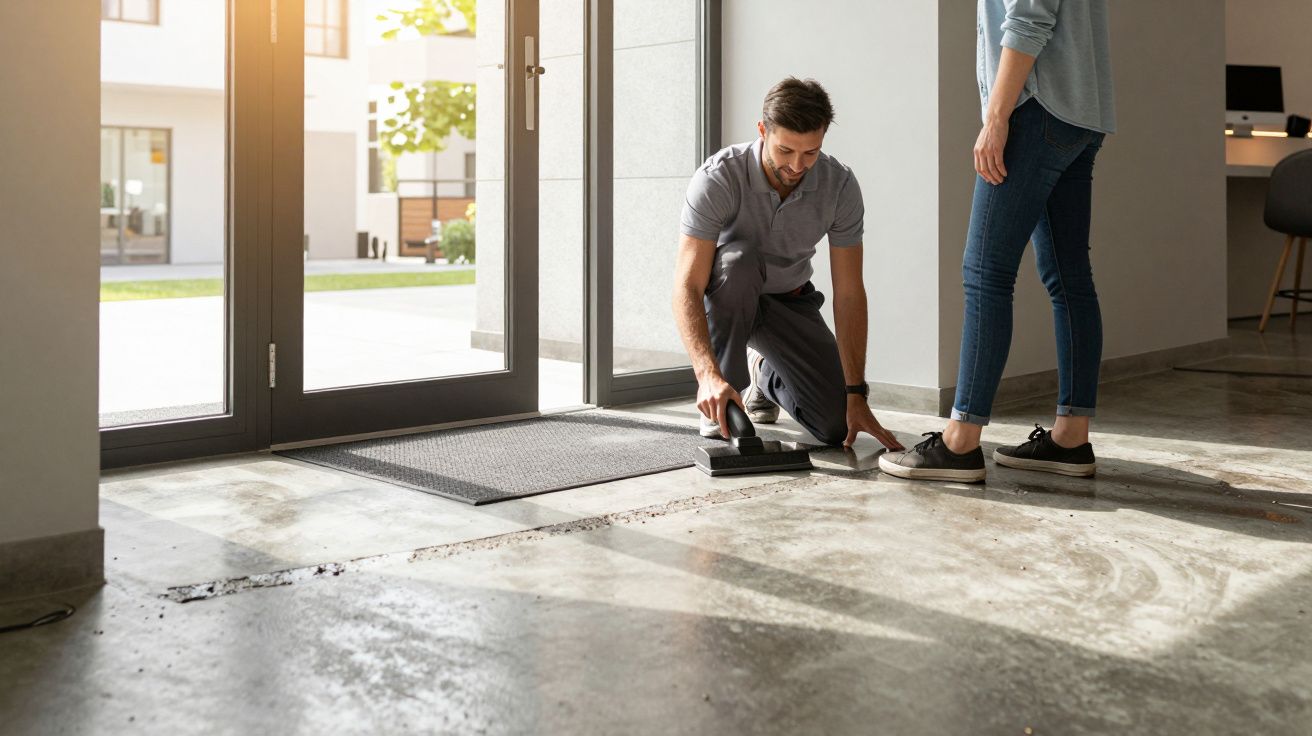
People love bold materials & surfaces that look “architectural” on day one, especially in high-density residential areas where buildings have to work hard and look good doing it. But one particular choice keeps backfiring once the first winter grime, bike tyres and bin days arrive. It isn’t about taste. It’s about what happens when a surface meets constant footfall, shared corridors and the reality of thousands of daily touchpoints.
The material is polished concrete-often specified for lobbies, stairwells and communal hallways because it feels modern, durable and low-maintenance. In dense schemes, it can become the exact opposite: noisy, slippery at the wrong moments, and oddly expensive to keep looking “clean”.
Where the polished-concrete obsession came from
The look didn’t appear out of nowhere. It sits at the crossroads of industrial aesthetics, value engineering, and the promise of “hard-wearing” finishes that don’t need replacing every few years.
The promise behind the spec sheet
Developers and designers are sold a neat story: pour once, grind, seal, done. No grout to crack, no tiles to pop, no carpet to stain. The finish photographs beautifully under warm lighting, and it signals a certain seriousness-like the building isn’t pretending to be cosy.
There’s also a psychological element. Concrete reads as honest and resilient, which is comforting when you’re trying to build for heavy use.
What “low-maintenance” quietly excludes
“Low-maintenance” often means “doesn’t need replacing”. It doesn’t always mean “stays looking acceptable with basic cleaning”. In high-density blocks, the day-to-day reality is:
- Wet shoes and umbrella drips in the same pinch points every morning
- Delivery trolleys, prams, move-ins, move-outs
- Shared bins, occasional leaks, the odd spill no one admits to
- Cleaning teams working fast, with whatever chemicals procurement bought cheapest this quarter
Polished concrete can survive that. The finish, though, often doesn’t.
How it’s supposed to work (and why it doesn’t)
At its best, polished concrete is a system: the slab quality, the grinding stages, the densifier, the sealer, the cleaning regime. Miss one part, and you don’t get the Instagram floor-you get a stressed surface that shows every compromise.
The typical “protocol” on new builds
A standard route looks like this:
- Grind the slab to expose a chosen aggregate level.
- Apply a chemical densifier to harden the surface.
- Polish to a target sheen (often high gloss in marketing suites).
- Seal for stain resistance and easier cleaning.
On paper, that’s robust. In practice, the slab itself is frequently poured for speed, not for a flawless final finish. And the people using the building aren’t walking through a showroom.
In a busy entrance, a high-gloss floor behaves like a mirror for dirt: it doesn’t get “dirty” faster, it just shows it sooner.
The small tweaks that turn into big problems
In high-density circulation spaces, a few common decisions create outsized trouble:
- Chasing a higher sheen to make the lobby feel “premium”
- Using thin topical sealers that scuff under grit and trolley wheels
- Skipping proper entrance matting because it “ruins the look”
- Cleaning with strong degreasers that strip sealers or leave hazy residues
The result is familiar: dull traffic lanes, blotchy patches, and a surface that never looks uniformly clean again without periodic re-polishing.
The backfire in high-density residential areas
The failure mode isn’t dramatic. It’s the slow erosion of appearance, comfort and trust: residents stop believing the building is well managed because the first thing they see every day looks permanently tired.
1) It becomes a slip risk at exactly the wrong times
Polished concrete can be fine when dry. The issue is the transition moments: rain, condensation, a single spill, shoes carrying grit and water. In dense buildings, those moments are constant.
Add glossy sealers and you can get the worst combination: a surface that looks “hard-wearing” and reads as safe, right up until someone slides near the lift bank.
2) It amplifies noise and makes neighbours feel closer than they are
Hard surfaces bounce sound. In corridors and stair cores-already echo-prone-polished concrete can make the whole place feel louder: footsteps, suitcase wheels, doors closing two floors away.
That matters in high-density living because the building’s finishes become part of the social contract. Quiet, soft materials smooth over friction. Loud ones don’t.
3) It shows wear as “neglect”, even when it’s structurally fine
Concrete doesn’t fail politely. It scuffs, it hazes, it picks up micro-scratches, and the sheen changes in the busiest paths first. Those marks aren’t damage in an engineering sense, but they read as cheapness.
Residents rarely separate “finish performance” from “management competence”. If the lobby floor looks grim, everything else feels suspect.
4) Maintenance becomes specialist, not simple
To keep polished concrete looking consistent, you usually need:
- Correct neutral cleaners (not whatever is on offer)
- Scheduled burnishing or re-polishing
- Resealing at intervals, sometimes more often near entrances
- Proper grit control (mat wells, routine vacuuming, not just mopping)
That’s doable, but it’s not “wipe and forget”. In a building with tight service-charge politics, this is where the backfire lands: the floor either costs more than expected, or looks worse than promised.
A quick reality check: where it can work
Polished concrete isn’t inherently bad. It’s just unforgiving when density and shared use are high.
It tends to work better when:
- The building has deep entrance matting and sheltered thresholds
- The concrete is specified early, with slab quality controlled for exposure and flatness
- The finish is lower sheen (more forgiving) rather than mirror-gloss
- There’s a clear cleaning plan that doesn’t rely on guesswork
If you want the look, the building has to be set up to support it.
Better alternatives that still feel modern
If the goal is a contemporary, resilient lobby without the constant visual decay, there are options that behave better in shared circulation spaces.
Consider:
- Porcelain tiles (matt, through-body): consistent appearance, easy to replace locally, predictable cleaning
- Terrazzo-look porcelain: similar vibe, less fussy, good slip ratings available
- Rubber flooring (architectural grades): quieter, forgiving underfoot, excellent for stairs and long corridors
- Textured stone or stone-look surfaces: hides grit and wear better than a high polish
None of these are magic. They just fail more gracefully under the daily grind of dense living.
If you already have it: small changes that help fast
If your building is already committed to polished concrete, you don’t have to rip it out to stop the bleeding. Start with the stuff that controls the damage cycle.
- Install or upgrade proper mat wells (not thin loose mats that curl).
- Switch to pH-neutral cleaners and ban harsh degreasers unless spot-used correctly.
- Reduce sheen expectations: a satin finish often looks cleaner more of the time.
- Treat entrances like battlefields: vacuum grit daily, mop second.
- Budget for periodic professional maintenance so it stays even, not patchy.
The quickest win in high-density buildings is nearly always grit control. Most “mysterious wear” is just sand doing what sand does.
What this choice reveals about building culture
Polished concrete is rarely chosen because it performs best in dense communal spaces. It’s chosen because it photographs well, sounds durable, and feels like a single decision that simplifies everything.
In high-density residential areas, surfaces aren’t just finishes. They’re public infrastructure. The wrong material doesn’t merely look a bit off; it changes how a building feels to live in-day after day, step after step.




Comments (0)
No comments yet. Be the first to comment!
Leave a Comment