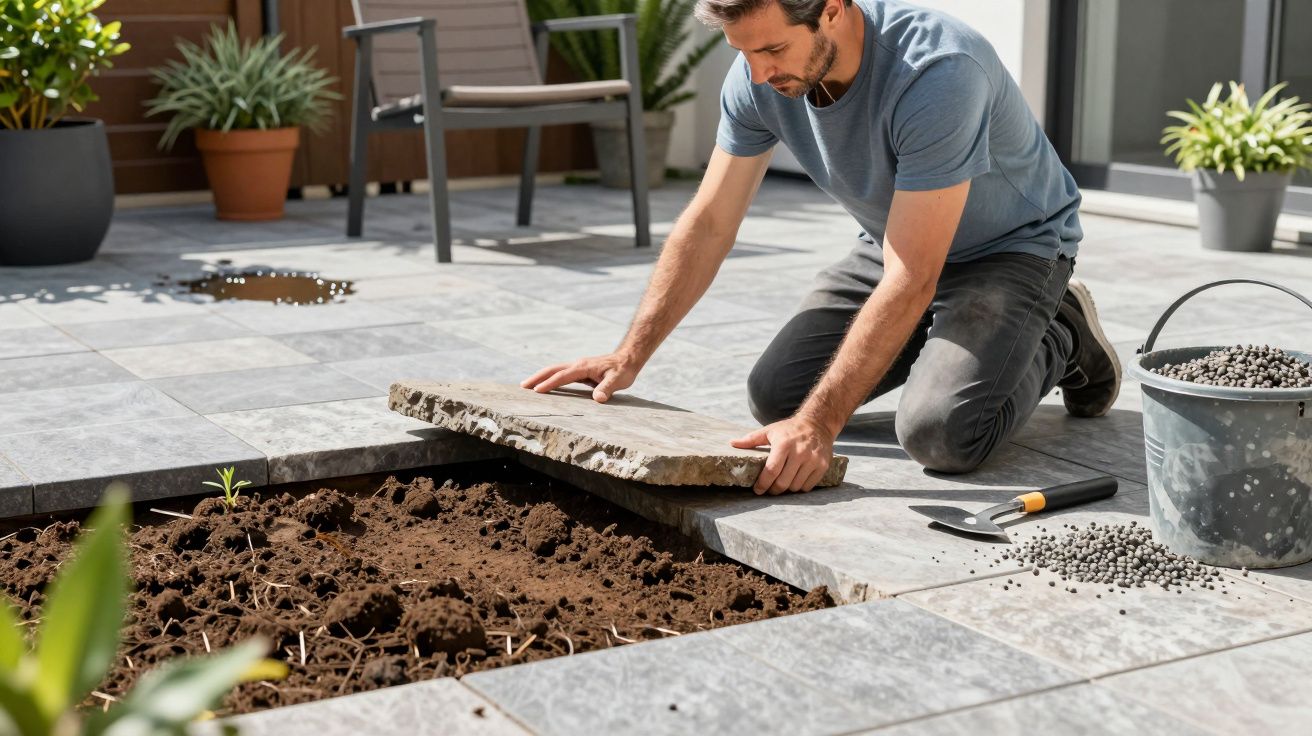
Hard landscaping can feel like the grown-up bit of a garden makeover: crisp edges, clean lines, a patio you can actually use. But when the project context is “quick win, tight budget, get it finished this weekend”, one particular shortcut keeps turning up - and it quietly converts a low-fuss space into years of fiddly upkeep. It looks tidy on day one, then starts demanding your time in small, relentless ways.
You see it most often when someone wants a paved area fast: slabs or blocks laid straight onto soil, or onto a thin sprinkle of sand, with a bit of cement “where it needs it”. The surface may even feel solid at first. Then the seasons do what they always do.
The shortcut: laying paving without a proper base (and hoping it behaves)
The trap is simple: skipping the sub-base and the groundwork that hard landscaping relies on - excavation depth, compacted MOT Type 1, a consistent bedding layer, and falls for drainage. In the moment, it feels like you’re cutting out “invisible” work. In reality, you’re removing the part that stops movement.
A patio is not a tabletop. It’s a small piece of construction living outdoors, sitting on ground that swells, shrinks, drains badly, freezes, dries out, and gets walked on while carrying furniture. Without a stable, compacted base, the paving starts negotiating with the soil underneath. The soil always wins.
How it becomes a maintenance trap (in slow, annoying instalments)
At first it’s cosmetic. One slab sits a touch low where the ground softened after rain, and you tell yourself it’s fine. A month later, a corner rocks underfoot, then the jointing opens, then weeds arrive because weeds love an invitation.
After that, maintenance isn’t one big repair - it’s constant small jobs:
- Resetting a few slabs that have dipped or lifted.
- Repointing joints that keep cracking.
- Sweeping sand back into gaps after every heavy rain.
- Pulling weeds that root in joints because the surface is always slightly moving.
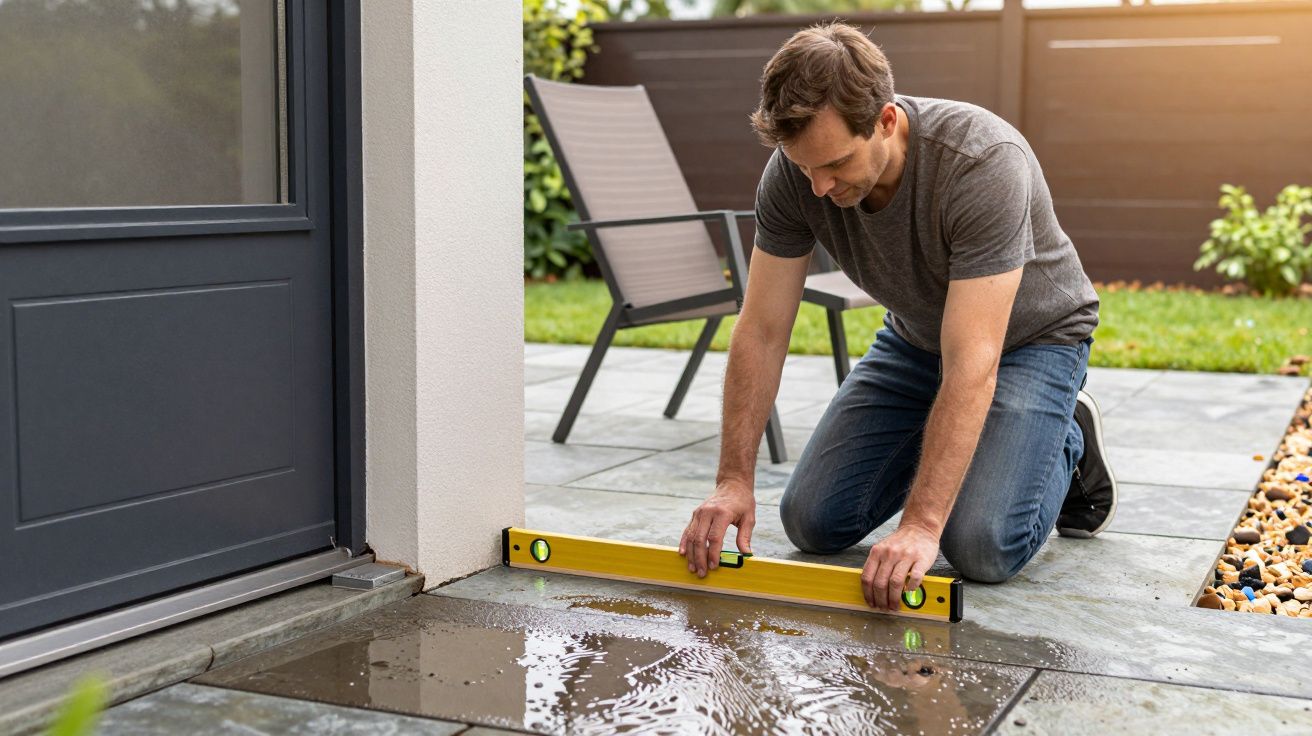
- Trying to stop puddles forming where the levels have shifted.
The cruel part is the rhythm. It never fails all at once, so it’s easy to keep patching. You end up in a loop of “just sort that bit” weekends, which is exactly what hard landscaping was meant to prevent.
A patio laid on hope doesn’t collapse dramatically. It just keeps asking for ten minutes of your life, forever.
The two forces you can’t outsmart: water and movement
Water is the accelerator. If you don’t build proper falls away from the house and into a suitable drainage route, it will sit on the surface or soak into the bedding layer. Wet bedding moves; saturated soil pumps under load; winter frost expands what’s already loose.
Movement does the rest. Even if the slabs are thick, the ground beneath can settle unevenly. Clay soils shrink and swell. Tree roots and burrowing wildlife create voids. Foot traffic and furniture concentrate load on edges and corners. A proper sub-base spreads those forces out; bare soil concentrates them.
The project context that makes this more likely
This shortcut shows up when the brief is any combination of:
- “We’ll only use it in summer.”
- “It’s just a small area.”
- “The last patio lasted years like this.”
- “We don’t want the mess of digging.”
- “We’ll do the ‘proper’ one later.”
Later rarely comes, because the space is technically usable - just never finished. And once furniture is on it, lifting it all to rebuild the base feels like a bigger job than doing it right in the first place.
A better “shortcut” that actually saves work
If you want speed without the future hassle, shorten the design, not the groundworks. Make the paved area smaller, simpler, and more buildable, then construct that smaller area properly.
Practical options that tend to hold up:
- Reduce the footprint and keep paving where you genuinely sit/walk.
- Use gravel (with a stabilising grid and edging) for low-traffic zones.
- Choose larger-format slabs if you want fewer joints to maintain, but still build the correct base.
- Add proper edging so the surface can’t creep sideways over time.
Think of it like this: you can pay with money and effort upfront, or pay with time later. The “cheap” patio is often the most expensive one, because you pay twice - once to install it, then again in repairs and do-overs.
The simple spec that stops most of the pain
Exact depths vary with soil and use, but the shape of the solution stays consistent: dig out, build up in layers, compact properly, and manage water.
A solid baseline (for typical domestic patios) usually means:
- Enough excavation to remove soft topsoil and reach firm ground.
- A compacted sub-base (often MOT Type 1) laid in layers.
- A consistent bedding layer (sharp sand or mortar, depending on the system).
- Correct falls so water moves away instead of pooling.
- Jointing suited to the paving and exposure (not whatever’s cheapest in the trolley).
If you’re paying someone, this is where to focus your questions. Not “what slabs do you recommend?” but “how deep are you digging, what sub-base are you using, and how are you compacting it?”
A quick “future you” test before you start
Stand where the patio will be and imagine doing maintenance in November, not July. If the plan depends on perfect weather, perfectly stable soil, and nobody ever dragging a heavy planter across the edge, it’s not a plan - it’s wishful thinking.
Hard landscaping is meant to buy you ease. When the base is skipped, you don’t get ease; you get a neat-looking surface that quietly recruits you into ongoing caretaking.
A small checklist you can keep on your phone
- Can water run off the surface with a clear fall?
- Is topsoil being removed rather than built on?
- Is there a compacted sub-base, not just sand on soil?
- Are edges restrained so the paving can’t spread?
- Is the jointing method chosen for durability, not speed?
FAQ:
- Is this only a problem on clay soils? Clay makes it worse because it moves a lot with moisture, but any soil can settle or soften. The sub-base is what separates your paving from that movement.
- What if the patio is already down and starting to wobble? You can sometimes lift and relay a small section, but if the underlying base is wrong, patching tends to be temporary. Rebuilding the base is the durable fix.
- Are “dry lay” systems always bad? Not necessarily. They can work well when designed as a system (proper sub-base, bedding, and restraint). The problem is dry-laying straight onto soil or an inconsistent layer.
- Does resin-bound surfacing avoid this trap? It still needs correct ground preparation and drainage. Resin on a poor base just fails differently - cracking, lifting, or trapping water where it shouldn’t be.


Comments (0)
No comments yet. Be the first to comment!
Leave a Comment