The planting was in, the paving was level, and the lighting made the whole space glow at dusk. On paper, it was a textbook garden redesign - until the structural garden works underneath were treated like an afterthought. One small detail turned a “finished” garden into a space nobody could comfortably use, especially after rain.
Friends would step outside, look around, and say the right things: “It’s lovely.” Then they’d hesitate, shuffle back towards the door, and sit inside instead. The problem wasn’t taste. It was physics.
The moment a garden stops being a garden
Most unusable gardens don’t fail dramatically. They fail quietly, over a few weeks, as weather and gravity test what’s been built.
A lawn that squelches, paving that turns slick, a step that feels just a bit too high, a corner that never dries - these aren’t “snags”. They’re signs the structure isn’t doing its job.
A garden can look “done” and still be functionally broken if water has nowhere sensible to go.
The structural detail that ruins everything: levels and falls
In many renovations, the visual layer gets the attention: slabs, sleepers, borders, new turf. But the most important measurement is often the least visible one: the fall - the slight slope that directs water away from the house and towards drainage.
Get that wrong, and a garden becomes a catchment. Water pools against thresholds, sits on patios, and saturates soil. In winter it freezes; in summer it turns joints green and slimy. Either way, you stop using the space.
What “wrong fall” looks like in real life
You’ll often notice it in small, annoying ways before you see obvious flooding:
- Puddles that reappear in the same spot after every shower.
- Patio joints staying dark and damp long after everything else dries.
- A constant algae film where you thought you’d put a seating area.
- Water beading at the back door or garage threshold.
- Newly laid turf that feels spongy, then thins and yellows.
The garden isn’t being dramatic. It’s telling you that the hard landscaping is holding water rather than moving it.
Why this happens even in expensive gardens
This is where people feel cheated: “But we paid for a full job.” The catch is that structural garden works aren’t just about digging and laying. They’re about setting levels from fixed points, allowing for materials, and planning where water will discharge - legally and safely.
A common chain of mistakes looks like this: the patio is set to match indoor floor height (for a “flush” look), the sub-base is built up, and nobody recalculates the finished fall. The surface ends up flat, or worse, back-falling towards the house.
Another version happens when a contractor avoids excavation (to save time or skip spoil removal). The new build-up steals depth that should have been used for proper base, falls, and drainage.
Water doesn’t care what the paving cost. It follows the easiest route - and sometimes that route is straight back to your door.
The quick checks that reveal the truth
You don’t need specialist kit to spot the underlying issue. You just need to look at the garden the way rain does.
A 10-minute assessment you can do at home
- Watch in real weather: go out during steady rain and look for pooling or run-off lines.
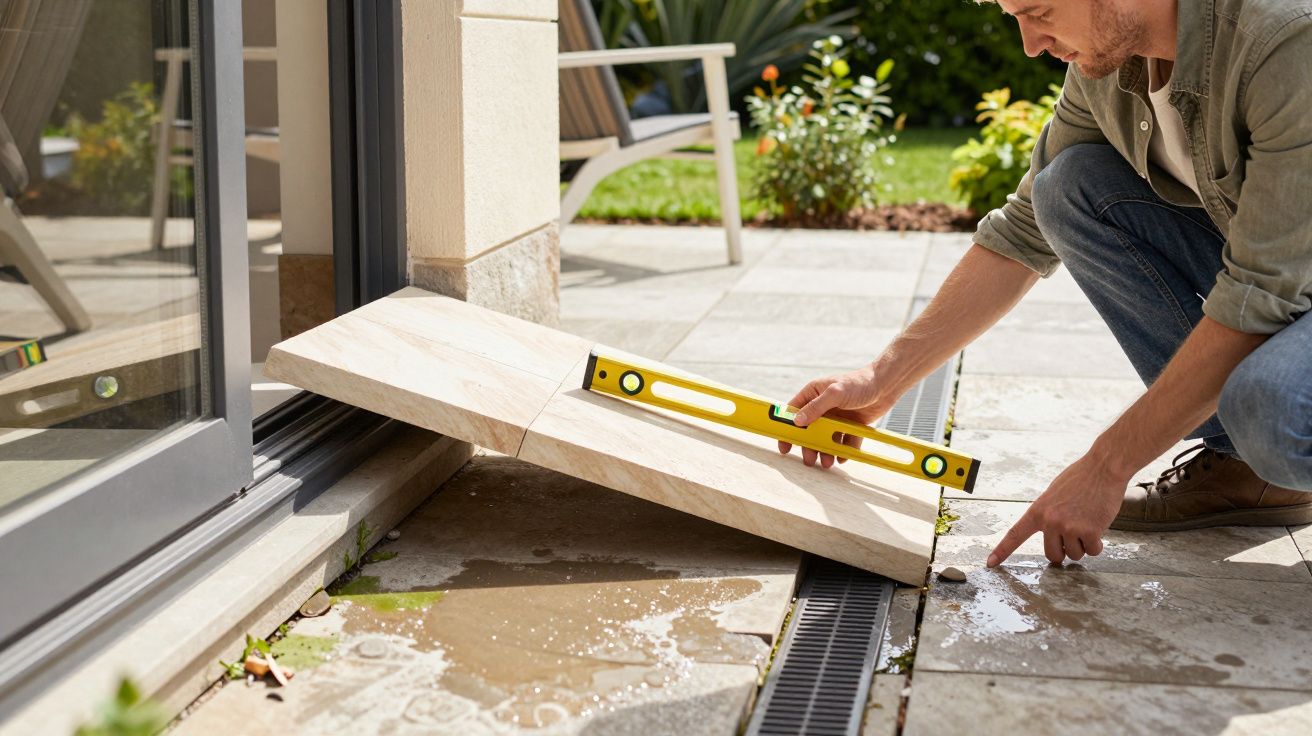
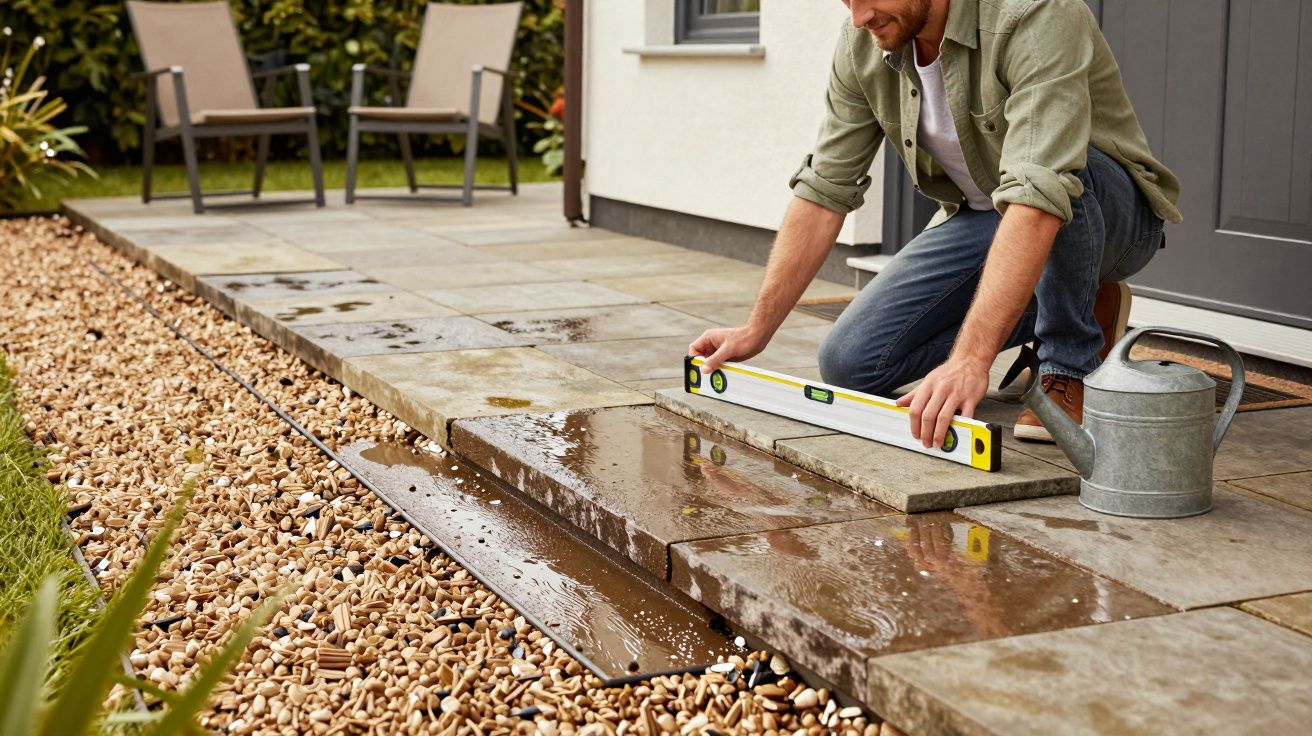
- Use a long spirit level (or a straight timber): check whether paving falls away from the house.
- Look at thresholds: any sign of splashback marks or damp at the base of walls is a clue.
- Find the “low point”: where would water sit if it had to stop somewhere?
- Check where downpipes go: if they dump into the same area as your patio run-off, you’ve doubled the problem.
If you discover the lowest point is the doorway, a lawn edge, or the middle of a seating area, the garden was never truly finished.
How drainage gets misunderstood in garden redesign
People hear “drainage” and imagine one channel drain or a gravel strip will solve it. But drainage is a system: falls, collection, and discharge. Miss one part and the whole thing underperforms.
Here are the misunderstandings that cause the most misery:
- “Permeable paving means no puddles.” Permeable surfaces still need correct levels and a suitable sub-base; they can clog, and water can still migrate sideways.
- “A soakaway will handle it.” Soakaways need the right soil conditions and sizing; heavy clay can make them pointless.
- “We’ll add gravel along the edge.” Gravel can hide wetness, not fix it, especially if the fall is wrong.
- “The lawn will absorb it.” Lawns absorb some water, but compacted subsoil and foot traffic quickly reduce infiltration.
The garden ends up looking neat while behaving like a shallow tray.
What fixing it usually involves (and what it doesn’t)
The uncomfortable truth: if the levels are wrong, cosmetic tweaks rarely last. You can re-point joints, pressure-wash algae, swap furniture - the water will still win.
A proper remedy depends on the layout, but tends to fall into a few categories:
Common structural fixes
- Re-laying paving to correct falls: lifting slabs, adjusting the sub-base, and setting a proper gradient.
- Installing linear drainage: channel drains positioned where water naturally wants to collect.
- Adding gullies and connecting to appropriate outfalls: only where permitted, and with correct silt traps.
- Rebuilding steps and thresholds: ensuring safe riser heights and avoiding water tracking towards doors.
- Reworking lawn levels and subsoil: relieving compaction, adding drainage layers, and reshaping.
It’s not always “start again”, but it is often “lift and set properly”.
How to avoid the same mistake next time
If you’re planning a garden redesign, insist that the structural garden works are discussed upfront, not buried in a quote as “groundworks”. Ask for a simple explanation of where water will go in heavy rain and how the finished levels achieve that.
A good installer won’t just promise it will be “fine”. They’ll talk in specifics: falls, thresholds, drainage positions, and what happens at the boundaries.
Questions worth asking before anyone lays a slab
- Where is the highest fixed point (usually the house threshold), and what finished level are you setting to?
- What fall will the patio have, and in which direction?
- Where does surface water discharge, and is that compliant with local rules?
- What’s the plan for downpipe water - is it tied into the same system or separated?
- What will the garden do in a one-hour downpour, not just a light shower?
If the answers feel vague, the risk isn’t that the garden won’t look good. The risk is that you won’t use it.
The takeaway nobody wants, but everyone needs
A garden becomes “usable” long before it becomes “pretty”. Seating, planting and lighting are the reward layer - but only if the levels and water management are right.
If your space looks finished yet feels avoided, don’t assume you’re being fussy. Often, it’s one structural detail quietly deciding whether your garden is a room outdoors, or just a view through the glass.



Comments (0)
No comments yet. Be the first to comment!
Leave a Comment