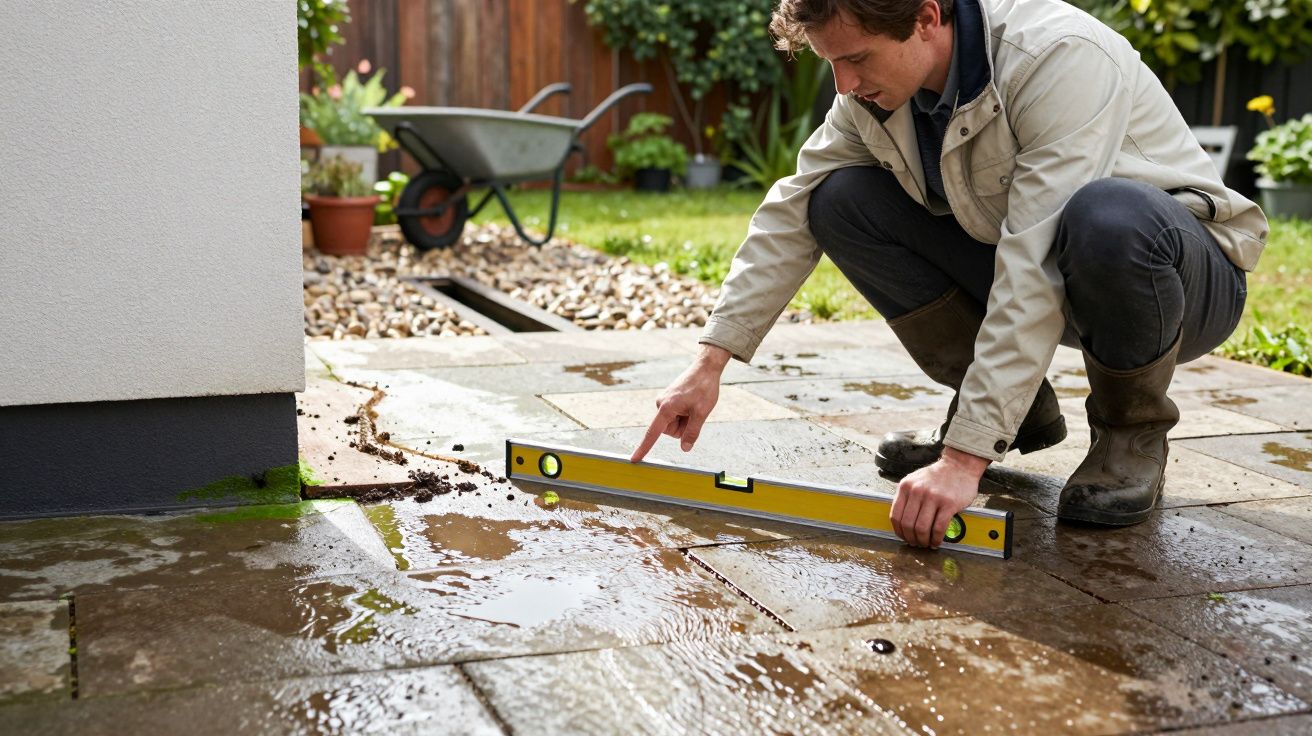
Most garden redesign decisions are made with muddy boots on and a calendar breathing down your neck. In time-constrained projects, one design shortcut shows up again and again: “We’ll sort the levels later.” It feels practical in the moment, but it’s the choice that quietly turns into extra spend, extra mess, and a garden that never quite settles.
The early version often looks fine from the kitchen window. Then the first winter arrives, the ground moves, water finds the easiest route, and the “temporary” choices harden into awkward edges you keep working around.
The shortcut: skipping proper levels and drainage (and calling it ‘good enough’)
The temptation is understandable. You want a new patio, a cleaner lawn edge, a path you can push a wheelbarrow down. The ground looks roughly flat, the installer says they can “make it work”, and the quote is cheaper if nobody starts digging trenches or talking about fall, soakaways, or sub-bases.
So you end up with a surface that is level-ish to the eye, but not designed to shed water with intention. That’s the key difference: not whether it looks straight on day one, but whether it has a plan for where rain goes on day one hundred.
Water doesn’t negotiate. It follows gravity, and it remembers every shortcut you tried to take.
Why it costs more later: water is the hidden budget line
When levels are guessed rather than set, drainage becomes accidental. You might get away with it in a dry spring, then spend autumn wondering why the paving is always dark in one corner, why the fence base stays damp, or why the lawn has a permanent squelchy strip.
The expensive bit isn’t just “fixing drainage”. It’s the chain reaction:
- Patios sink or rock because the sub-base wasn’t deep enough, or was laid on wet soil that later compresses.
- Jointing fails faster because water sits on the surface, freezes, expands, and breaks the bond.
- Soil washes onto hard surfaces, staining paving and clogging joints, because runoff is pulling fines downhill.
- Planting struggles in the wrong places: waterlogged pockets rot roots, while raised dry spots bake in summer.
- Structures take the hit: shed floors swell, fence posts loosen, and brick walls grow algae where splashback never stops.
What makes this feel unfair is that it’s not dramatic at first. It’s slow. You notice it in small irritations: the grit that keeps reappearing, the green film that returns a week after cleaning, the step that suddenly feels a bit too high.
Why it changes over time: ground moves, weather swings, and your garden ‘settles’
Outdoor builds don’t stay static. They settle. And settling is rarely even.
A new patio laid on a hurried base might look perfect until the soil beneath it shifts with seasonal moisture. Clay expands when wet and shrinks when dry; sandy ground can wash out in heavy rain; new-build plots often have made-up ground that continues to compact for years. Add freeze–thaw cycles and you get tiny movements that turn into visible dips.
Even well-built gardens change, but good design anticipates it. That means allowing for:
- A clear fall away from buildings (so water doesn’t drift back to your house).
- A stable sub-base depth matched to use (foot traffic is not the same as a loaded wheelbarrow).
- Edges that hold shape (because an unrestrained path will creep and spread).
- Drainage that keeps working after leaves, silt, and life happen.
In other words: time isn’t the enemy. Unplanned time is.
The quick ‘win’ that backfires in time-constrained projects
In rushed jobs, the focus becomes what you can see at handover: clean lines, fresh materials, an instant before-and-after. That’s when the levels shortcut sneaks in, because levels are invisible once the paving is down and the turf is laid.
If you’re trying to keep momentum, you might also accept compromises that make the garden harder to live with later:
- Putting the patio exactly where the old one was, even if it’s the dampest spot.
- Raising a path “just a bit” to meet a door, creating a trip or poor threshold detail.
- Copying a neighbour’s layout without checking your own drainage or sun pattern.
- Choosing impermeable paving everywhere because it looks tidy, then wondering where the water is meant to go.
None of these are moral failings. They’re just what happens when the deadline becomes the designer.
The better shortcut: make levels the first decision, not the last
If you’re going to be ruthless with time, be ruthless in the right place. The fastest gardens to build and maintain are the ones where the ground plan is clear before anyone orders materials.
A simple, low-drama approach looks like this:
- Stand in the rain once, or at least look for old water marks and algae lines. They’re honest evidence.
- Decide where water should end up (a permeable area, a soakaway, a border that can take overflow), not just where you don’t want it.
- Set finished levels from fixed points: door thresholds, air bricks, existing drains, and the damp-proof course.
- Design edges to last: metal edging, kerbs, or haunching that stops spread and subsidence.
- Keep one ‘sacrificial’ zone (gravel strip, rain garden, permeable border) so the rest of the garden stays cleaner.
You can still move fast. You’re just moving in the direction the site will keep agreeing with.
A quick gut-check before you sign off a layout
If you’re looking at a plan or a quote and want to spot the risk early, ask two questions that force clarity:
- What is the fall on the patio/path, and where does the water go?
- What is the sub-base depth and material, and how is it being compacted?
If the answers are vague, the “savings” are probably being taken from the part you’ll pay for twice.
The garden you see on day one is the optimistic version. The garden you live with is the one that has survived weather, use, and time.
FAQ:
- Isn’t drainage just for problem gardens? No. Every garden needs a plan for rainfall. Even a gentle slope can send water towards a house or create persistent damp patches if hard surfaces interrupt natural soak-in.
- Can I fix poor levels without ripping everything out? Sometimes. Minor dips can be lifted and re-laid, and additional drainage can be added, but if the sub-base is thin or unstable you often end up doing partial rebuilds.
- What’s the simplest sign levels are wrong? Puddles that stay long after rain, green algae returning quickly on paving, and soil washing onto hard surfaces are common early warnings.






Comments (0)
No comments yet. Be the first to comment!
Leave a Comment