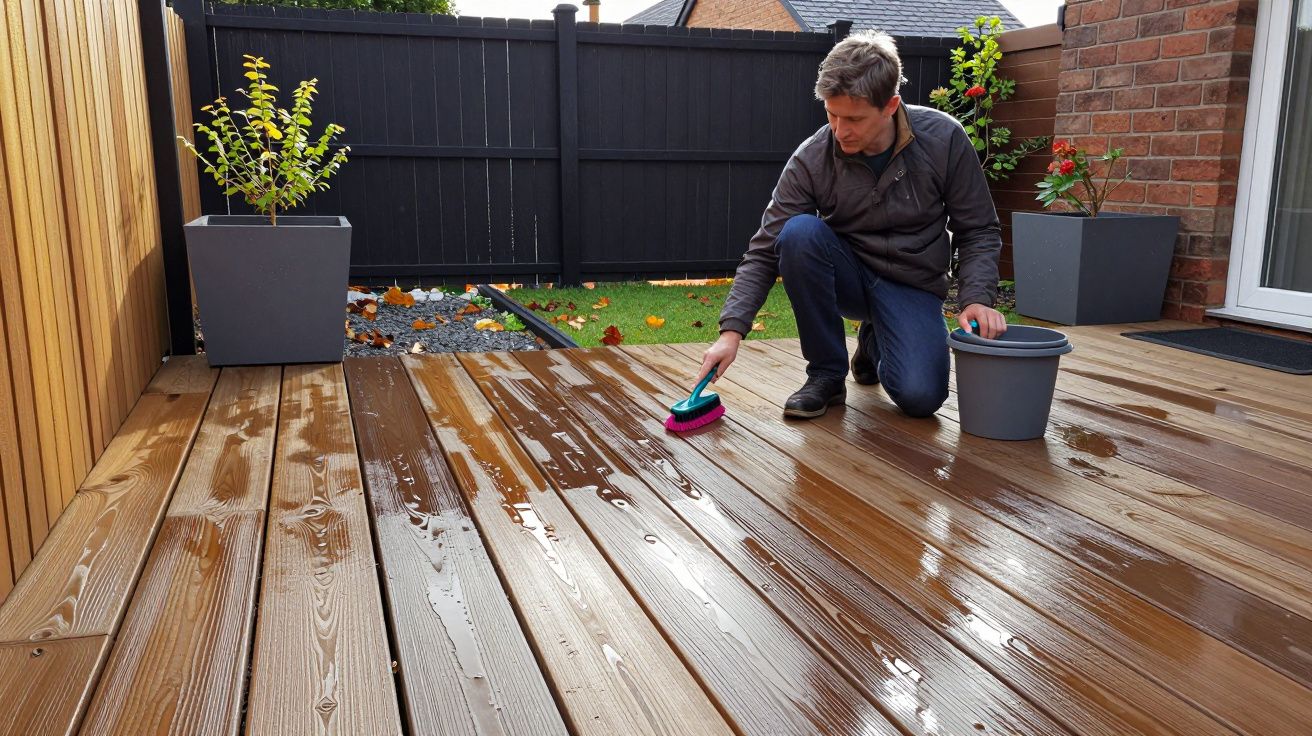
The most convincing modern patio scenes start with a promise: clean lines, uniform colour, zero fuss. Decking sits right in the middle of that promise, and the choice of materials & surfaces is what decides whether it stays crisp after a British winter or quietly turns into a regret you mop around.
You notice it first on a damp October morning. The boards still look sleek from the kitchen window, but up close there’s a sheen that wasn’t there in August - a slightly oily shine, a film that grabs at the soles of your shoes. The modern look hasn’t disappeared; it’s just started telling the truth.
The “always-perfect” decking that doesn’t like real weather
The decking choice that most often pulls this trick is smooth composite, especially in darker, uniform tones. In the brochure it reads like a miracle: no splinters, no staining, no annual sanding ritual. On day one, it looks like a designer terrace you’d see outside a new-build show home.
Then British weather arrives with its usual toolkit: leaf tannins, algae, fine grit, repeated wet-dry cycles, and long periods where a surface never quite dries. A smooth, low-texture board can make that grime look more obvious, and the lack of grain means you don’t get the “forgiving” visual noise that natural timber provides. It can still be structurally fine - it just starts looking tired in a way that feels personal, because you bought it to avoid exactly that.
What “exposed” looks like in practice
It’s rarely dramatic. It’s a slow unmasking.
- A faint patchwork of shading where planters sat and rainwater pooled
- Water marks that don’t fully disappear after a sunny spell
- Green slip-prone areas in the shade line (under a table, along a fence)
- A chalky fade on south-facing runs, especially with darker colours
- Scratches that show as lighter streaks because the surface is uniform
If you’ve ever found yourself thinking, “It looked so premium in spring,” you’re not imagining it. The first months are forgiving; the first winter is revealing.
Why it happens (and why it’s not just “cheap stuff”)
Composite decking is usually a blend of wood fibres and plastic, sometimes capped with a protective outer layer. The problem isn’t that it’s inherently bad - it’s that the wrong finish in the wrong spot behaves badly. Smooth finishes can be easier to wipe, but they can also show every mark and encourage a slick film when algae takes hold.
Add in the realities of UK gardens: north-facing patios, fences that block airflow, a barbecue corner that gets greasy, a bird feeder overhead. Your deck becomes a surface that collects life, not a sterile showroom floor. The more “minimal” the look, the more any change reads as damage rather than patina.
A useful way to think about it is this: modern decking is less like timber flooring and more like an exterior worktop. It needs a surface strategy, not just a product.
The small checks that would have saved you a lot of scrubbing
Before you buy (or before you extend what you already have), do a quick reality test. Not a lab test - a you-and-your-garden test.
- Stand where the deck will live at 9 a.m. in winter light. Is it shaded? Does it stay damp?
- Look for “drip lines”. Gutters, overhanging trees, pergolas, a hose reel - anything that creates consistent wet zones.
- Ask what texture does the board have, really? “Woodgrain” can mean deep, grippy embossing or a token pattern on a smooth face.
- Check the cleaning guidance in writing. If it says “only use X cleaner” or “avoid pressure washing”, clock that as ongoing effort, not low maintenance.
- Confirm the board profile and drainage gaps. Some systems trap debris at the edges and make cleaning feel endless.
The goal isn’t perfection; it’s knowing where your deck will be asked to perform like an outdoor surface instead of an indoor aesthetic.
If you already have it: how to get the look back without wrecking it
This is where people panic-clean and accidentally make it worse. Aggressive pressure washing can fuzz timber, but it can also lift composite caps or leave tiger-striping if you linger. Bleach can brighten, but it can also create uneven patches or degrade finishes over time.
A calmer approach usually works better:
- Sweep more often than you think you should, especially in autumn (grit + moisture is the algae starter kit).
- Use a soft brush and a manufacturer-approved cleaner, then rinse thoroughly. Residue is how that dull film sticks around.
- Tackle shade-line algae early; once it’s established, you’ll chase it all season.
- Move planters slightly every few weeks so you don’t bake in permanent “shadow stamps”.
- If you must use a pressure washer, use a wide fan, low pressure, and keep distance - and test a hidden corner first.
It’s not glamorous, but it’s cheaper than replacing boards because you tried to blast them back to new in one afternoon.
The smarter “modern” alternatives that age more gracefully
If what you love is the contemporary look - the straight edges, the quiet colour - you don’t have to give that up. You just need a surface that’s built to look better when it’s lived on.
A few options that tend to weather more honestly:
- Textured or deeper-embossed composite in mid-tones (greys, taupes) rather than near-black. It hides water marks and scratches better.
- Hardwood or modified timber (like thermally modified boards) if you’re happy with silvering and a more natural fade. The patina feels intentional.
- Porcelain paving “deck” planks if you want ultra-clean lines with less algae drama, provided the sub-base and drainage are done properly.
- Grooved boards used correctly (not always barefoot-friendly, but often better at disguising day-to-day mess).
Modern doesn’t have to mean delicate. The best contemporary gardens choose finishes that can take a year of rain and still look like they belong.
A quick decision guide (the version you’ll remember in the timber aisle)
Ask yourself one question: Do I want a surface that stays uniform, or one that forgives change? Smooth, dark, uniform boards demand uniform conditions - which most UK gardens simply don’t offer.
If you’re buying decking for the look, choose texture and mid-tones. If you’re buying it for low effort, be honest about shade, airflow and the fact that “maintenance-free” outdoors is mostly marketing. The weather will expose whatever your garden reality is; the trick is choosing materials & surfaces that don’t take it personally.






Comments (0)
No comments yet. Be the first to comment!
Leave a Comment