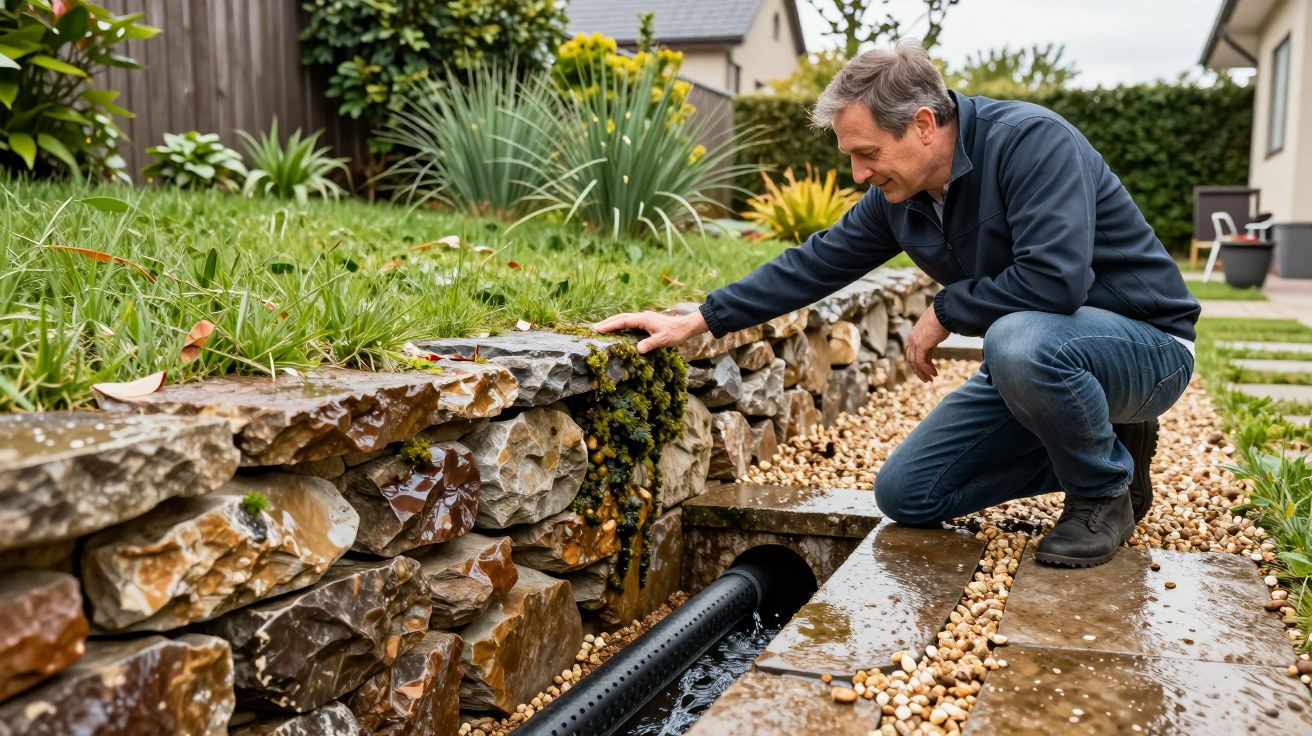
The phone call usually starts with something small: a hairline crack, a bulge in the lawn, a patio that suddenly feels “not quite level”. Retaining walls are meant to make steep gardens usable, and they sit at the heart of structural garden works because they’re literally holding back tonnes of soil. The detail most people discover too late is that a wall doesn’t fail because it’s ugly or old-looking - it fails because water has nowhere safe to go.
You can build a wall that looks immaculate on day one and still be setting up a slow-motion collapse. The warning signs arrive quietly: paving that lifts, mortar that powders, a damp stripe that never dries. Then one wet winter, it moves.
The one detail that decides whether a wall lives or dies: drainage
Soil is heavy. Wet soil is brutally heavier, and it pushes like a liquid when it’s trapped behind masonry. The mistake is thinking the wall’s job is only “strength”, when its real job is “strength plus a controlled escape route for water”.
When a retaining wall has no proper drainage, hydrostatic pressure builds behind it. That pressure doesn’t care if the facing is beautiful stone, sleepers, or crisp concrete blocks. It will find the weak point: a joint, a change in ground level, the bit the builder rushed at 4pm on a Friday.
Most garden walls don’t fail in summer. They fail after prolonged rain, when the backfill turns into a saturated sponge and the wall becomes the dam.
How this plays out in real gardens (and why it fools smart people)
The garden looks finished, so everyone relaxes. Turf goes down, the borders get planted, and you stop paying attention to what’s happening behind the wall because you can’t see it. That’s exactly why this detail gets missed: drainage is hidden, and hidden work is easy to under-specify.
Then you get the classic sequence:
- A faint belly in the middle of the wall that you swear wasn’t there last year.
- A crack that opens and closes with the seasons.
- A persistent wet patch at the base, or algae that shows where water is seeping out under pressure.
- Paving behind the wall that starts to dip because fines are being washed out.
People often assume the fix is “repoint it” or “add a bit of concrete at the bottom”. That’s treating the symptom, not the cause. If the water is still trapped, it will simply keep loading the wall until something gives.
What “proper drainage” actually means (not just a token pipe)
There are three parts to drainage behind retaining walls, and missing any one of them can undo the other two.
1) Free-draining backfill
Not the same clay you dug out, and not random rubble that clogs with silt. You want clean, graded aggregate that lets water move downwards quickly.
2) A drainage outlet
Typically a perforated land drain at the base, laid to a fall, discharging to a suitable outfall. If it can’t discharge, it’s just a pipe-shaped ornament.
3) A filter layer to stop clogging
Geotextile membrane (used correctly) or a graded filter arrangement. Without it, soil migrates into the stone, then into the pipe, and your “drainage” quietly dies.
A detail that gets missed: weep holes alone are not a drainage strategy. They can help relieve pressure, but they’re not a substitute for a continuous drain and free-draining backfill. They also block up - often right when you need them most.
Reading the risk before the wall starts moving
You don’t need to excavate half the garden to do a basic risk check. Walk it like you’d read a balance sheet: look for tiny frictions that hint at bigger forces.
Three quick checks homeowners can do:
- After heavy rain, is there water sitting behind the wall area? If the lawn feels boggy up against it, that’s a clue.
- Is there a consistent damp line on the face? Damp that never quite disappears suggests trapped water, not just “UK weather”.
- Has anything changed uphill? New patio, a shed base, a blocked gully, raised beds - small changes can redirect a surprising amount of runoff.
If the wall is over about a metre, supporting a driveway, or close to the house, treat “it’ll probably be fine” as a gamble. The repair costs can jump fast because access, demolition, waste removal and reinstatement often cost more than the wall itself.
The uncomfortable truth about “stronger wall” fixes
When a wall shows movement, people reach for heavier solutions: thicker blocks, more concrete, more steel. Those can be correct - but without drainage, you’re simply building a sturdier container for pressure.
A retained slope is a system: wall, footing, backfill, drainage, surface water management. Miss one, and the system behaves like a bad shortcut. You can get away with it for a while, until you can’t.
“We didn’t need a taller wall,” one contractor told me. “We needed somewhere for the water to go.”
That’s the detail. Not glamorous. Not visible in the before-and-after photos. But it’s the difference between a garden that stays put and one that slowly starts to argue with gravity.
| What to look for | What it can mean | What to do next |
|---|---|---|
| Bulging or leaning face | Pressure building behind | Get drainage assessed, not just repointed |
| Damp stripe/algae line | Persistent seepage | Check outfalls, consider adding land drain |
| Sunken paving behind | Washout of fines | Investigate backfill and filter layer |
FAQ:
- Do all retaining walls need drainage? Almost all do. Any wall holding back soil where water can collect needs a way to relieve pressure safely.
- Are weep holes enough? Rarely on their own. They can block and they don’t replace a continuous drain and free-draining backfill.
- Can I retrofit drainage without rebuilding the wall? Sometimes, but it depends on access and how the wall was built. Often you need excavation behind the wall to do it properly.
- When do I need an engineer? If the wall is tall, supporting loads (driveways, structures), showing significant movement, or close to property boundaries, get professional advice.
- What’s the most common cause of sudden failure? Prolonged rain with trapped water behind the wall, leading to rapid increases in hydrostatic pressure.




Comments (0)
No comments yet. Be the first to comment!
Leave a Comment