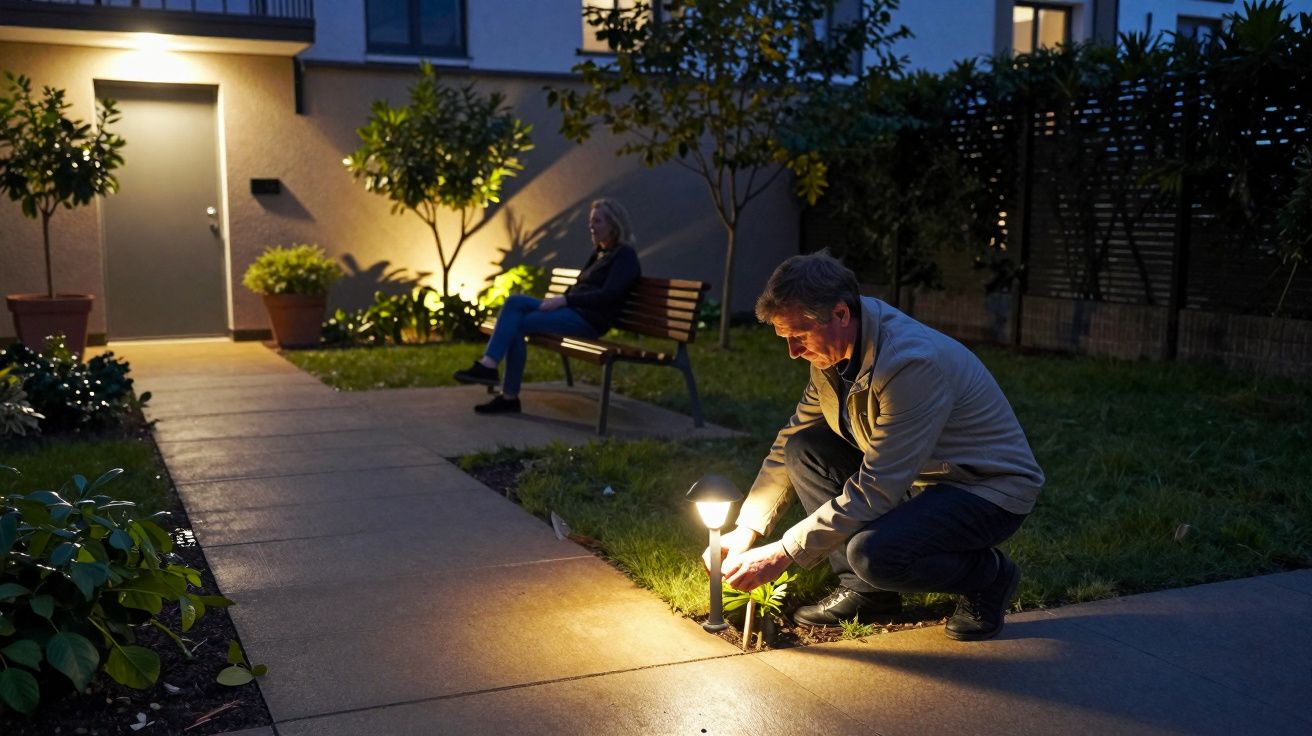
You notice it on the walk home: a neat little patch of green between buildings, benches still warm from the day, plants doing their best. Then night lands, and the same space feels oddly tense. The hidden reason is often the use of light and shadow in urban gardens-how fixtures, sightlines and dark pockets shape your comfort more than the planting ever will.
Most “awkward at night” gardens aren’t unsafe in a dramatic way. They just ask your eyes and brain to work too hard, so you move faster, talk less, and don’t linger.
The real discomfort isn’t darkness - it’s contrast
Our bodies cope well with low light when it’s even. What rattles us is harsh contrast: bright pools under a lamp, then sudden blackness behind a hedge, then glare off pale paving. Your pupils keep adjusting, and every adjustment makes the unseen parts feel more significant than they are.
Add one more ingredient: uncertainty. If you can’t read the edges of a path, or see who’s sitting on the next bench until you’re close, your brain flags it as “unresolved”, and unresolved spaces feel awkward.
How urban gardens accidentally create “blind spots”
Small gardens in cities are full of vertical surfaces: walls, fences, bins, bike racks, trellises. At night, these objects either catch light and throw hard shadows, or disappear completely and become silhouettes you can’t interpret quickly.
Common design moves that look brilliant by day can backfire after dark:
- Uplighting trees or tall grasses that creates theatrical shadows across faces and paths.
- One bright light by the entrance that makes the rest of the garden feel like a void.
- Dense planting at shoulder height near seating, which blocks peripheral vision and hides movement.
- Glossy leaves and wet paving reflecting light into your eyes like a low-level headlamp.
None of this is “wrong”. It’s just the kind of lighting that photographs well, but feels strange when you’re the one inside the frame.
The overlooked culprit: faces become unreadable
A garden can be perfectly lit for walking and still feel uncomfortable for sitting. That’s because we judge social safety through faces: are people relaxed, are they looking at you, is someone waiting?
When light comes from above or below only, it sculpts faces into deep eye sockets and sharp cheek shadows. You can’t read expressions. You can’t make quick, normal eye contact. The space turns socially awkward, even if nothing is happening.
A simple test: if you can see a bench clearly but can’t comfortably recognise a friend sitting on it from a few metres away, the lighting is working against you.
A quick “night audit” you can do in five minutes
Go back after dark (or at dusk) and walk it like a stranger would. You’re not looking for perfection; you’re looking for sudden changes.
Check these three points
- Transitions: doorway to garden, pavement to path, path to seating. Do you step from bright to dark in one stride?
- Edges: can you see where planting ends and walking space begins? Soft edges are calming; invisible edges are not.
- Escape lines: from the bench, can you see the exit and the main path without turning your whole body?
If any of those feel murky, it’s usually not a crime problem. It’s a legibility problem.
The fix is usually softer, lower, and more even
The goal isn’t to flood an urban garden with light. It’s to remove the “black pockets” and reduce glare so your eyes stop fighting the scene.
Practical improvements that tend to work:
- Use multiple dimmer sources instead of one bright lamp. Even light reads as friendly.
- Add low, shielded path lighting that illuminates the ground without shining into faces.
- Light vertical surfaces gently (a wall wash) so the garden has visible boundaries.
- Trim or thin planting near entrances and benches to reduce hiding places and heavy shadow bands.
- Choose warmer colour temperatures (often described as warm white) so skin tones look normal and less stark.
Think “moonlight you can navigate by”, not “car park”.
Where shadow is helpful (yes, you still need it)
A garden with no shadow looks flat and exposed, like a showroom. People don’t relax there either, because they feel on display. The trick is to keep shadow where it adds depth, and remove it where it blocks understanding.
Good shadow in a night garden:
- Under planting, not across faces
- Beyond the main paths, not beside the entrance
- In the background, not at eye level around seating
In other words: let the garden be moody, but keep the human zones readable.
A small checklist for designers, residents and caretakers
You don’t need a full redesign to change how the space feels at night. Start with a few high-impact, low-drama adjustments.
- Reduce glare first: aim lights down and shield the source.
- Fill the voids: add a second, softer light where the garden currently “drops off”.
- Make seating sociable: avoid uplights and harsh downlights over benches.
- Keep sightlines clean: no dense, shoulder-height planting right next to paths and seats.
When the use of light and shadow supports orientation and social cues, urban gardens stop feeling like a stage set and start feeling like a place you can actually inhabit.
FAQ:
- Isn’t more lighting always safer? Not necessarily. More light can mean more glare and deeper shadows, which reduces visibility. Even, well-aimed light usually feels safer than brightness.
- Why do some gardens feel fine at dusk but awkward later? Dusk gives you “free” ambient light from the sky, so contrast is lower. Once the sky goes dark, any uneven lighting becomes more obvious.
- Do solar lights fix this? They can help if they’re spaced closely and shielded. One or two weak solar stakes often create patchy pools that worsen the contrast problem.
- What’s the fastest improvement with the least work? Add a soft, low path light near the darkest transition (often the entrance) and angle existing fixtures to reduce glare into eyes.




Comments (0)
No comments yet. Be the first to comment!
Leave a Comment