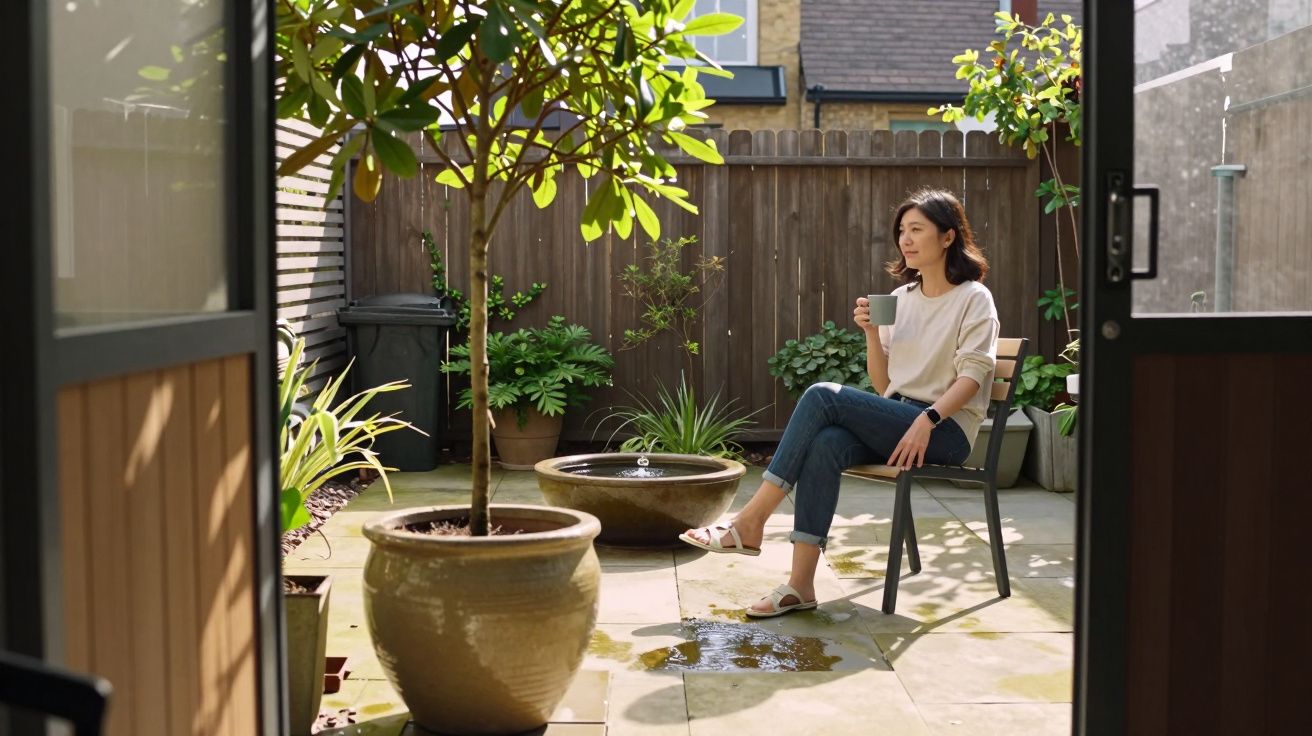
Courtyard gardens can look gorgeous in photos yet feel oddly exposing when you actually sit down with a coffee. The hidden culprit is usually sightline control: who can see in, what you’re forced to look at, and how your eye is funnelled through the space. Get that wrong and even expensive planting reads as “awkward”, because your body never quite relaxes.
Most people assume the problem is size. Often it’s the opposite: a small, walled space creates intense, unavoidable lines of view, so every door, window and corner becomes part of the experience.
The awkward feeling isn’t in your head. It’s in the geometry.
Courtyard gardens are basically outdoor rooms, and rooms live or die on where the “gaze” goes. In a typical UK courtyard you have hard boundaries, neighbouring windows, a back door, maybe a kitchen sink view and a fence that’s too close to ignore. That means the sightlines are short, strong and constant.
When those lines point at the wrong things, you get a low-level stress response: you feel watched, or you feel trapped, or you keep noticing clutter and drains and bins. It’s not precious. It’s your brain doing threat assessment with the information you’ve given it.
A courtyard can be beautifully planted and still feel unsettled if your default view lands on the least forgiving corner.
What “sightline control” actually means in a courtyard
It’s not just about blocking neighbours. It’s about editing what’s visually loud, and choosing what becomes the “resting point” for the eye.
In practice, sightline control is three moves:
- Interrupt direct lines from windows and doors into seating areas.
- Redirect the eye towards one calm, deliberate focal point.
- Soften the hard edges that make the space read as a box.
Small spaces exaggerate mistakes. A hedge that would be “a bit thin” in a big garden becomes a see-through apology in a courtyard, because there’s nowhere else for your eye to go.
The common layout mistake: seating on the main axis
Walk through most courtyard gardens and you’ll spot the pattern: door opens, straight path, chair at the end, fence behind it. It feels logical, symmetrical, tidy. It also puts you on the main axis of movement and view.
From that chair you’re usually:
- facing the brightest glare (because courtyards bounce light)
- looking straight at the boundary (so the space feels shorter)
- exposed to upper-floor sightlines (because you’re centred)
The fix is rarely “more screening everywhere”. It’s often moving the seat off-axis so you’re not sitting in the line of fire.
A quick test you can do in five minutes
Stand at the back door and take a slow step outside. Pause. Notice where your eyes land without trying.
Now sit where you normally sit. Look up, then left and right. If you keep finding windows, drains, bins, or a blank fence, that’s your answer: the garden is directing attention to the wrong targets.
The three sightlines that make courtyards feel exposed
Courtyard gardens have a predictable set of visual pressures. You don’t need to solve all of them, but you do need to know which one is doing the damage.
1) The neighbour’s “downward” view
Even a frosted side window can feel like an audience when it’s above you. The discomfort often comes from uncertainty-you can’t tell if you’re being watched, so you behave as if you are.
Best responses are high-and-light rather than heavy-and-high:
- multi-stem small trees (amelanchier, birch, acer) to break up view cones
- trellis with climbers to create a soft veil
- a pergola edge or sail shade to cut the vertical line without boxing you in
2) The straight shot from your own door
A door-to-fence sightline turns the garden into a corridor. It makes everything feel like a passageway rather than a place to linger.
Break it gently:
- shift the path so it “arrives” at an angle
- add a planter or low wall as a deliberate stop
- place a focal object (pot, bowl fountain, sculpture, feature plant) where the eye can rest
3) The clutter line (bins, bikes, meters, drain covers)
Courtyards collect practical stuff. The problem isn’t that it exists; it’s that the garden makes you look at it.
A simple screen works better than apologetic camouflage:
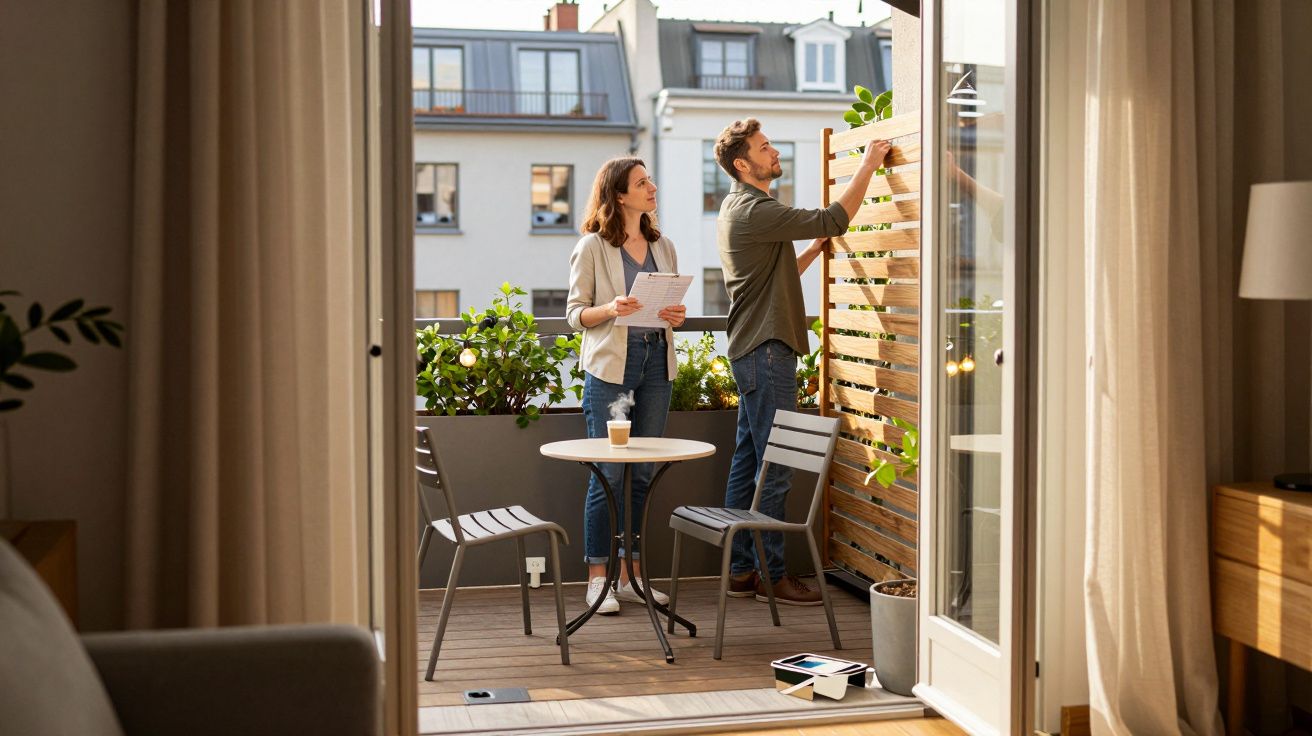
- one solid panel (timber slats, painted fence section, reed roll) to hide the whole cluster
- a tall pot with a single upright plant to create a visual “bookmark”
- storage that reads as furniture, not as a pile (bench box, slim locker)
A small design shift that makes the space feel bigger
The most effective courtyard trick is counterintuitive: stop trying to show the whole garden at once. When everything is visible, the space feels finished and flat-like a display.
When you control sightlines so part of the courtyard is hinted at rather than revealed, the brain reads depth. A bit of concealment creates the sense that there’s more going on than a rectangle of paving.
Good ways to do this without shrinking usable space:
- a single tall planter placed to block one corner from the main view
- a light canopy of leaves (multi-stem tree) that breaks the “box” outline
- layered heights: low planting, mid shrubs, one higher element for punctuation
Privacy in a courtyard isn’t a wall. It’s a sequence: what you notice first, what you notice next, and what you never need to notice at all.
The courtyard “comfort plan”: what to change first
If your courtyard gardens feel awkward, don’t start with a shopping list. Start with the view.
- Choose the seat first. Put it where you feel least watched, even if it’s not symmetrical.
- Pick one focal point. Give your eye a calm job: a tree, a pot, a water bowl, a lit wall.
- Screen one thing properly. Hide the worst clutter in one confident move, not ten little excuses.
- Soften the boundary. Use planting, trellis, or texture to stop the fence shouting.
Do those four and the garden usually feels “done” long before you’ve filled every gap with plants.
A quick guide to courtyard sightline fixes
| Problem you feel | Likely sightline issue | The simplest fix |
|---|---|---|
| “I can’t relax” | Upper windows overlooking seating | Tree canopy or trellis veil |
| “It feels like a corridor” | Door-to-fence straight axis | Off-axis seat + focal point |
| “It looks messy” | Clutter line dominates view | One solid screen + tall pot |
FAQ:
- Do I need to block every neighbour’s window? No. Aim to break up direct view cones to the seating area; partial filtering often feels more natural than full coverage.
- Will taller fences solve the awkwardness? Sometimes, but height alone can make a courtyard feel like a box. A lighter screen (trellis, climbers, multi-stem tree) often improves comfort without heaviness.
- What if I rent and can’t build anything? Use large pots, a freestanding trellis, a foldable screen, and move seating off the main axis. You can change sightlines without fixing to walls.
- Is a water feature worth it in a tiny courtyard? If it becomes the focal point, yes. Even a simple bowl fountain gives the eye (and ear) something to settle on, which reduces that “exposed” feeling.



Comments (0)
No comments yet. Be the first to comment!
Leave a Comment