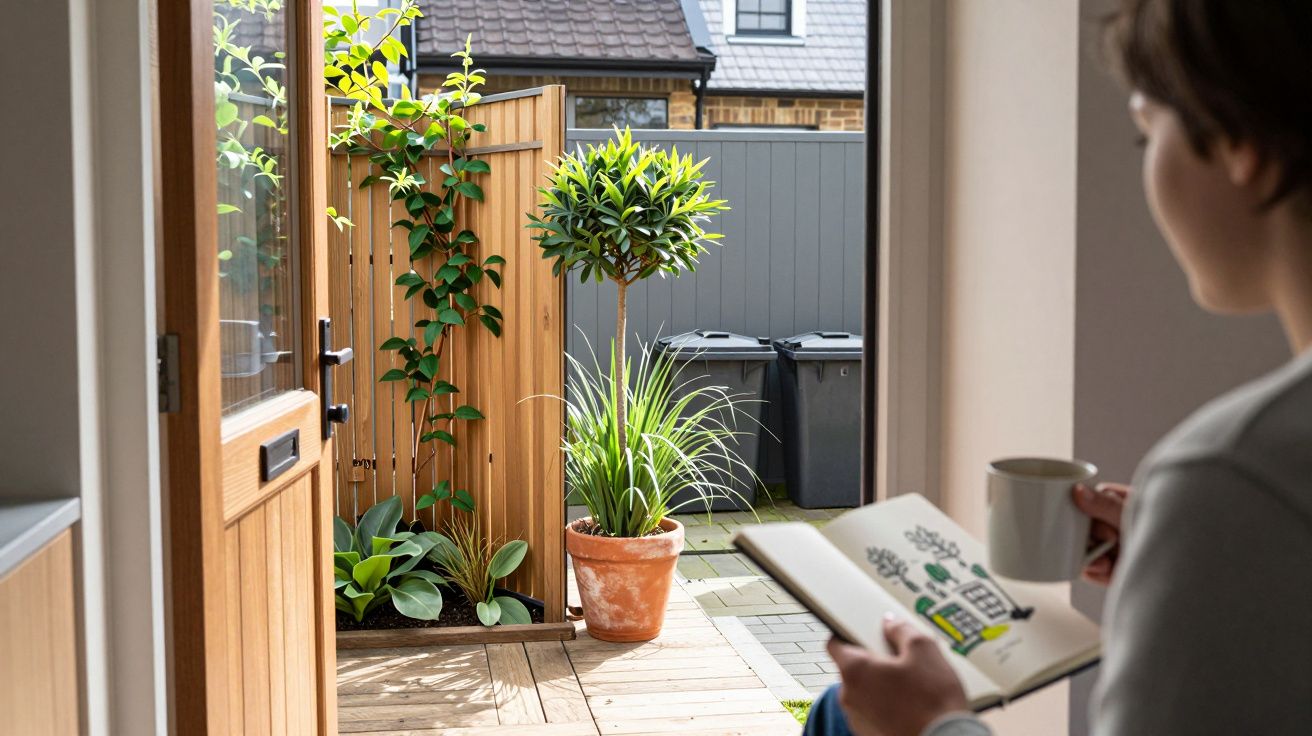
You notice it when you’re holding a mug at the back door and the garden feels smaller than it measures. Line of sight control in small urban gardens is the quiet craft of deciding what you can see, what you can’t, and how the eye travels through the space. Ignore it, and you don’t just lose privacy - you lose usable square metres, calm, and the sense that the garden belongs to you.
Most people reach for more plants, a taller fence, another pot. Then the view from the kitchen turns into a cluttered wall, the seating spot feels exposed, and every “fix” adds more visual noise. The hidden cost isn’t money spent; it’s comfort you stop expecting.
The garden is not small - the view is
Sightlines work like corridors. If your main view is a straight shot from the back door to a bright fence panel, your brain reads the space as short, flat, and finished. If your main view breaks once or twice - a curve, a screen, a layered edge - the same footprint feels deeper and calmer.
This is why one awkward angle can ruin an otherwise lovely patio. A neighbour’s upstairs window, a bin store, the back of a shed: they pull your attention the way a phone buzz pulls you out of a conversation. You don’t relax because you can’t stop checking.
The trap is treating privacy as a height problem. Often it’s a direction problem.
What ignoring sightlines steals from you
There’s a blunt trade you make without realising. You accept a garden that looks fine in photos but doesn’t feel good to sit in, because the eye has nowhere soft to land.
Common “costs” show up as habits:
- You avoid the best chair because it’s in view from the side return or the upstairs flat.
- You keep the blinds half-closed because the garden doesn’t feel like a private extension of the house.
- You stop using the far end because it feels like a dead zone - exposed, shaded, or visually messy.
- You buy more stuff (planters, screens, ornaments) to compensate, and the space feels tighter.
A garden can be tiny and still feel generous. The difference is whether the view has intention.
A simple way to audit your sightlines in ten minutes
Do this before you buy anything. Walk the garden with a notebook and pretend you’re seeing it for the first time.
Start with three “stations”:
- Back door / kitchen threshold: your most frequent viewpoint.
- Primary seat: where you want to exhale.
- Far end: where the garden should feel like it continues, even if it doesn’t.
At each station, ask two questions: what is my eye drawn to first, and what do I keep noticing even when I try not to?
You’ll usually find one dominant problem line: a straight view into a neighbour’s window, a direct hit on the bins, a fence that looks like a hard stop. That’s your leverage point. Fix that one, and the rest gets easier.
“Most gardens don’t need more features. They need one better view.”
Line of sight control that works in small spaces
The goal isn’t to block everything. It’s to guide the eye, like good lighting indoors. You want a mix of screening, framing, and distraction - and you want it to look deliberate, not defensive.
Practical moves that tend to work in small urban gardens:
- Offset the screening: instead of a full-width trellis, place a panel or tall planter slightly off-centre to break the straight line from door to fence.
- Create a ‘soft stop’: a small tree in a pot, a tall grass clump, or a climber on a narrow obelisk gives the eye a natural resting point.
- Use “see-through” privacy: slatted screens, multi-stem planting, or light trellis reduce the feeling of being on display without turning the garden into a box.
- Angle the seating: a chair rotated 20 degrees away from the worst sightline often does more than an extra metre of planting.
- Hide utilities with a reason: bins behind a screen that also supports a climber feels like design. Bins behind a random wall feels like shame.
Small gardens punish heavy-handed fixes. A solid, tall barrier can solve privacy and kill light, airflow, and mood in one go. The best line of sight control feels like a garden becoming itself, not a garden armouring up.
The privacy paradox: higher fences, smaller life
There’s a particular misery to the “maximum fence” approach. You build up, the light drops, the shadows harden, and suddenly the only sunny patch is the one place you didn’t want to sit. You end up indoors more, because the garden feels colder and more enclosed.
In terraced streets and tight plots, privacy is rarely won by height alone. It’s won by breaking the obvious view and giving your eye something better to do. A layered edge - low planting, then medium texture, then a taller element - reads calmer than a single tall screen.
And yes, there are practical limits. Overlooking is real. But the fix can still be elegant.
A quick “good, better, best” plan
If you want a fast decision framework, use this:
- Good: remove the worst focal point (move bins, repaint a bright fence panel, tidy the utility corner).
- Better: break the main sightline with one intentional vertical element (screen, tall planter, or climber support).
- Best: add a second layer that creates depth (a partial divider plus a focal plant, or a curved path edge that shifts the view).
You’re not trying to create rooms like a large garden. You’re creating pauses - little moments where the eye slows down. That’s what makes a small space feel lived in, not merely contained.
| Move | What it changes | Why it matters |
|---|---|---|
| Break the straight line | Stops the “hard stop” at the fence | Space feels deeper |
| Add a focal point | Gives the eye somewhere to rest | Garden feels calmer |
| Use semi-transparent screening | Balances privacy and light | Space stays open |
FAQ:
- How do I get privacy without losing light? Use slatted or trellis-style screening with planting. It interrupts views without creating a dark wall.
- What’s the first sightline to fix in a small garden? The view from the back door or kitchen. It’s the one you live with every day, so it sets the emotional tone.
- Do I need to block overlooking completely? Not always. Often you just need to stop feeling “in the spotlight” by breaking the most direct lines and angling seating away.
- Are tall plants better than fences for line of sight control? Often, yes. Plants soften edges, move in the wind, and feel less oppressive - but they need the right pot size and watering to stay effective.
- What if my garden is overlooked from several directions? Prioritise the seating area first, then create one layered boundary. Solve one viewpoint properly rather than patching five badly.



Comments (0)
No comments yet. Be the first to comment!
Leave a Comment