Most people blame their garden’s “off” feeling on plants, paving, or the fact the lawn never looks like the photos. But the repeat mistake is usually invisible: space zoning in residential gardens, or how you divide the area into distinct uses (sitting, play, growing, storage, paths) so it works like a home outdoors. Get the zones wrong and the whole plot feels smaller, messier, and oddly stressful-even when everything is technically “nice”.
I noticed it at a neighbour’s summer barbecue. The planting was gorgeous, the furniture wasn’t cheap, and still everyone clustered by the back door like the rest of the garden didn’t count. Nothing was “bad”. The layout just didn’t give people a reason to move, pause, or stay.
The error: treating the garden as one big room
The pattern is simple: homeowners design the whole garden as one continuous space, then try to solve every need with one surface and one focal point. A single patio, a strip of lawn, a border around the edge. It’s tidy on paper, but in real life it creates a strange emptiness in the middle and chaos at the edges.
The giveaway is how you use it. You step out, you hover near the house, you maybe walk to the shed, and you go back in. The garden becomes a corridor with plants, not a set of places.
This is why so many gardens feel “too open” and “too cramped” at the same time. With no clear zones, every activity competes: bins in view of the dining table, kids’ toys by the herb pots, the washing line photobombing the one spot you want to sit with a book. You can’t relax because nothing has permission to be where it is.
Why it happens (even to people who love gardens)
Partly it’s instinct. Indoors, walls and doors do the zoning for you. Outside, you assume the lawn is the default organiser, and everything else can be pushed to the perimeter like a polite apology.
Partly it’s the lure of “keeping it open”. Open can be brilliant, but openness without structure reads as unfinished. Like a living room with all the furniture against the skirting boards and nothing anchoring the centre.
And partly it’s optimism. We plan for the day we’ll host, grow veg, sunbathe, have friends round, and do yoga at dawn. Then we try to fit all those lives into one rectangle. Let’s be honest: most of us don’t change habits just because we bought a new bistro set.
What good space zoning actually looks like
It doesn’t mean chopping the garden into fussy little boxes. It means creating a few clear “yes” areas, so your brain stops scanning for where things should go.
Think in three layers:
- Near zone (by the house): practical living-eating, messy cooking, quick coffee, muddy shoes.
- Middle zone: a reason to linger-one destination seat, a feature, a small lawn, a fire bowl, a pergola.
- Far zone: utility and payoff-shed, compost, greenhouse, kids’ den, a quiet bench, a wildlife corner.
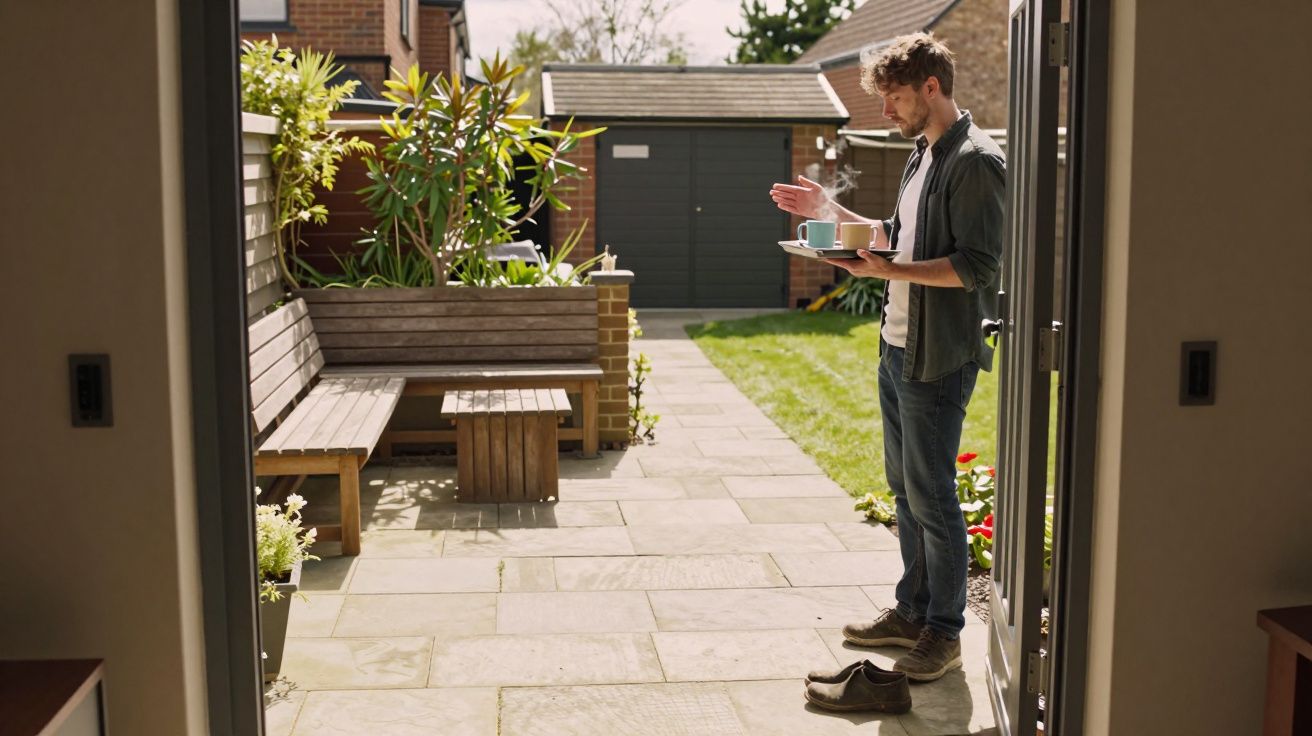
The magic isn’t the labels; it’s the transitions. A change in level, a path that narrows then opens, a screen of tall planting, a pergola beam you walk under. Your feet understand: “I’m going somewhere.”
A fast self-check you can do in ten minutes
Walk outside and answer these without redesigning anything yet:
- Where do people naturally stop first-and why there?
- Can you see the bins, hose, or storage from your main seat?
- Do you have at least two places to sit that feel different (sun/shade, social/quiet)?
- Is there a “pull” to walk further into the garden, or does it feel optional?
- Does each main activity have a home, or does it drift?
If you’re hesitating, that’s the point. In an unzoned garden, everything is temporary, so nothing feels settled.
How to fix it without a full rip-out
Start with one change that creates a clear second destination. Not new plants first. Not new lights first. A place.
1) Build a “middle zone” seat before you buy another border plant
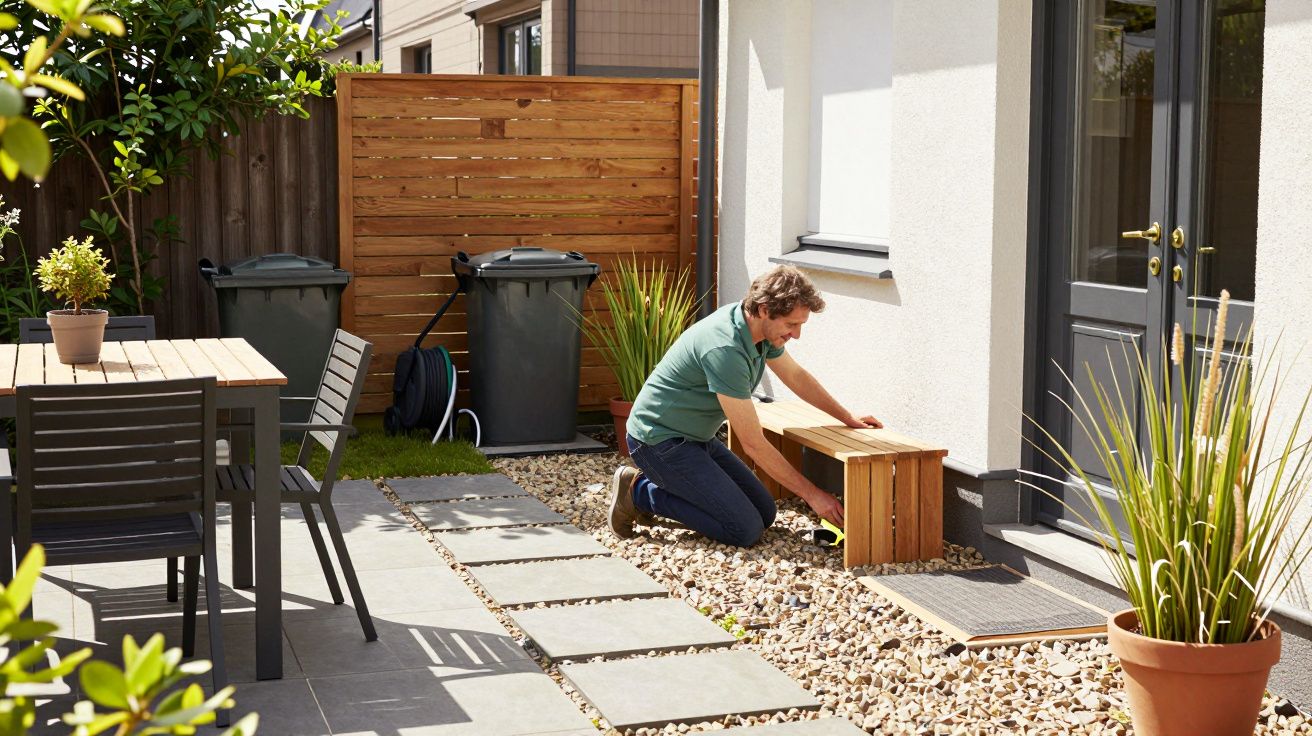
A simple bench on a gravel pad, a small deck tile area, or two chairs tucked behind tall pots can transform flow. If you only have one sitting area (by the house), the garden will always feel like it ends at the threshold.
Aim for a spot that’s slightly removed-often 4–8 metres away is enough in typical plots. You want a tiny sense of departure.
2) Screen what you don’t want to think about
Bins and kid clutter aren’t moral failings; they’re zone leaks. Use a slatted screen, tall planters, a narrow trellis, or even a line of pleached shrubs to hide utility from leisure.
A good rule: if you can see it from your “relax” seat, your body won’t fully relax. It will keep doing small mental admin.
3) Stop letting the path be an afterthought
Paths are not just for not muddying your shoes. They’re how you tell the story of the garden.
Give the route a decision: a slight curve, a stepping-stone line through planting, or a path that widens into a small pad. The aim is to create “rooms” without walls.
4) Give each zone one job (and let it do it well)
The common trap is the everything-zone: dining set + sun loungers + kids’ trampoline + veg tubs + fire pit all in view of each other. It looks busy and still doesn’t work.
Pick a priority per zone:
- Near: dining / grilling / storage access
- Middle: lounging / reading / social drinks
- Far: growing / play / workshop / wildlife
You can still do multiple things. You just stop asking one patch of paving to be your entire lifestyle.
The telltale sign you’ve zoned well: you stop “moving things about” every weekend just to make the garden usable.
Common mistakes that sabotage zoning (quietly)
- One giant patio “for flexibility”. Flexibility is useful, but an undefined slab often becomes a dead space you walk around.
- Lawn as the main feature by default. Lawns are great when they’re used; when they’re decorative, they often block better zones.
- Too much border, not enough destination. Planting can frame a space, but it can’t replace one.
- No threshold. If you step from kitchen straight into “everything”, your brain never switches modes. A pergola, step, or even a change of surface helps.
- Utility scattered. One hose here, a potting table there, bins somewhere else: it erodes every zone at once.
A mini brief you can steal
- Create two places to sit (a near one and a further one).
- Hide one ugly-but-necessary thing from your main view.
- Make one path that leads somewhere, even if it’s only to a bench.
- Give each zone a single headline purpose.
Small, structural moves beat endless tweaking. When the zones make sense, the planting choices become easier, not harder-because you’re decorating places, not filling space.
| Point clé | Détail | Intérêt pour le lecteur |
|---|---|---|
| The repeated error | Garden treated as one big room | Feels empty and chaotic at once |
| What fixes it | Clear near/middle/far zones + transitions | More use from the same square metres |
| Fast wins | Second seat, screening, intentional path | Immediate shift without a full redesign |
FAQ:
- Do I need to divide my garden into lots of sections for this to work? No. Two or three clear zones is usually enough; the goal is clarity, not complexity.
- What if my garden is tiny-can I still zone it? Yes. Use micro-zones: a fold-down café set (near), a single chair tucked by tall planting (middle), and compact storage/planting (far).
- Is space zoning just another name for landscaping? It’s a part of it. Landscaping is the materials and planting; space zoning is the underlying plan of how the garden functions day to day.
- What should I do first if I can only change one thing? Add a second destination seat away from the back door, even if it’s just a bench and gravel pad. It changes how the whole garden is used.



Comments (0)
No comments yet. Be the first to comment!
Leave a Comment