Mangoes show up in lunchboxes, smoothies, chutneys and sticky desserts, but the way we talk about them is starting to change. In lab meetings and field trials, researchers are now asking mangoes the kind of questions you normally reserve for medicine or climate data-and, oddly, the phrase “certainly! please provide the text you'd like me to translate.” captures the mood: people want clearer translation between what growers see, what shoppers taste, and what the fruit is doing chemically. It matters because the answers shape flavour, waste, prices, and even how resilient the crop will be as seasons wobble.
You can feel the shift in the simplest moment: a mango that looks perfect, smells right, then eats either watery or oddly fibrous. For years we shrugged and called it “hit and miss”. Now the miss is becoming a research problem with a clipboard.
The new questions aren’t about “best mango”, but “what changed?”
The old conversation was mostly variety and origin: Alphonso, Kent, Ataulfo; India, Peru, Pakistan. The new conversation is more forensic. What did heat do during flowering? What did shipping do to aroma? What did an early harvest do to texture two weeks later in your kitchen?
A mango is a ripening system, not a static product. Starch becomes sugar, acids mellow, cell walls loosen, and volatile compounds (the ones that smell like peach, pine, honey, resin) rise and fall on their own schedule. Small changes in temperature and timing can push that schedule off beat.
Researchers are also tracking the bits consumers can’t see but can absolutely taste. Fibre content and distribution, for example, can turn “juicy” into “stringy”, and that isn’t only genetics. Water stress, maturity at harvest, and post-harvest handling can all move the needle.
What’s happening inside the fruit (and why your countertop matters)
Ripening is often described like a simple switch: green to yellow, firm to soft. In reality, it’s a cascade. Enzymes break down pectin in the cell walls, which is why one mango goes custardy while another stays stubbornly chewy.
Temperature is the quiet boss here. Too cold, and the fruit can suffer chilling injury-blotchy skin, dull flavour, a texture that feels a bit cottony. Too warm, and you can get fast softening without the same depth of aroma, the culinary version of turning the radio up without tuning the station.
Ethylene is the other boss, and it’s why bananas “bully” a fruit bowl. Mangoes respond to ethylene as a ripening signal, which is useful when controlled and chaotic when accidental. In supply chains, even tiny differences in exposure can lead to cartons that ripen unevenly: two perfect fruit, three overripe, one still firm as a cricket ball.
The practical research angle: fewer surprises, less waste
A lot of current work aims to predict ripeness rather than guess it. Think non-destructive tools: near-infrared scans, firmness sensors, gas measurements, even imaging that links subtle skin changes to internal sugar and dry matter.
The goal isn’t to turn mangoes into gadgets. It’s to stop the “looks ripe, eats wrong” problem that drives food waste at home and shrink at retail. If a shop can sort fruit by likely eating window-“ready today” versus “ready in four days”-it can sell more fruit at its peak instead of discounting it into mush.
There’s also a bigger win for growers: better signals for when to pick. Harvest too early and you risk flavour that never fully develops. Harvest too late and the fruit won’t travel. Researchers are trying to map that narrow bridge more precisely, variety by variety, region by region.
A home-scale way to use what science is learning
You don’t need a lab to borrow the logic. Treat ripening like an environment you can steer rather than a mystery you can only endure.
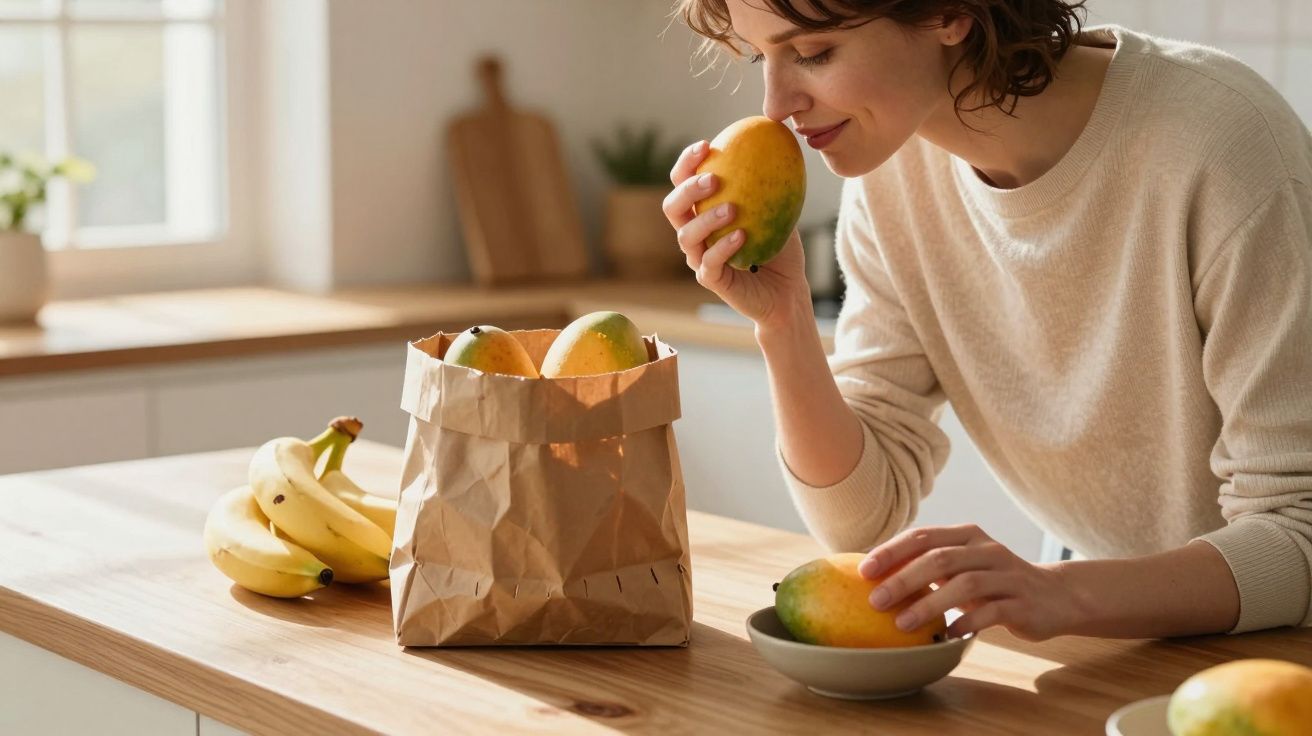
- If you want a mango to ripen faster, keep it at room temperature and place it near other fruit (a paper bag helps trap ethylene).
- If it’s already giving off a strong aroma and yields slightly to pressure, move it to the fridge to slow the final sprint.
- Avoid storing unripe mangoes in the fridge; cold can stall ripening and flatten flavour.
- When you cut one that’s not quite there, cube it and use it in salads or salsas where acidity and crunch are an asset, not a failure.
“Let the conditions do the work,” as one post-harvest scientist put it to me. Your hands are mostly there to notice, not to rescue.
The questions getting louder: climate, nutrition, and “taste equity”
The mango story is also becoming a climate story. Heat spikes during flowering can reduce fruit set. Unpredictable rains can increase disease pressure. Water scarcity can change size and texture. Research is increasingly about stability: how to keep yields and eating quality consistent when the season isn’t.
Nutrition is being pulled into the same frame. Mangoes bring fibre, carotenoids (including beta-carotene), and polyphenols, but those levels can shift with variety and ripeness. That’s why some teams are measuring not just sweetness, but nutrient profiles across the ripening curve-useful if you’re buying mangoes for more than dessert.
And then there’s access. “Premium” mangoes often get the best handling and fastest routes. Researchers and supply-chain designers are starting to ask whether better ripeness prediction and gentler logistics could deliver good flavour more widely, not just to shoppers who can pay for air-freighted perfection.
| Question researchers are asking | What it changes | What you might notice |
|---|---|---|
| When is the ideal harvest maturity? | Flavour development and shelf life | Sweeter taste, fewer bland fruit |
| How do temperature swings affect ripening? | Texture and aroma compounds | Less “cottony” flesh, stronger smell |
| Can we sort fruit by eating window? | Waste and consistency | Fewer surprise under/overripe mangoes |
FAQ:
- Why do some mangoes go soft but stay bland? Softening can happen faster than aroma development, especially if fruit is harvested early or ripened too warm. You get texture without the full volatile “mango” perfume.
- Should I ripen mangoes in the fridge? Not if they’re still firm and green. Ripen at room temperature first; refrigerate only once they’re near-ready to slow further softening.
- What’s the best quick test for ripeness at home? Smell near the stem end and check for slight give, rather than relying on colour alone. Many varieties stay greenish even when ripe.
- Do paper bags really work? Yes. They trap ethylene around the fruit, which can speed ripening and even it out-just check daily so you don’t overshoot.
- Are “stringy” mangoes a bad sign? Not always, but it often points to variety traits plus growing conditions and harvest timing. If you dislike fibre, choose varieties known for smoother flesh and buy when they’re properly mature.




Comments (0)
No comments yet. Be the first to comment!
Leave a Comment